

In the current competitive environment, enterprise architecture (EA) has moved beyond being a static, IT-centric discipline. It is now a crucial strategic driver for business agility and sustained innovation. A well-defined architecture is no longer just about managing technology complexity; it’s about aligning every component of your organization—from technology stacks and data pipelines to business processes—with core strategic objectives. Failure to achieve this alignment leads to siloed decision-making, redundant investments, mounting technical debt, and a significant loss of competitive advantage.
This article bypasses abstract theories to deliver a curated collection of seven actionable enterprise architecture best practices. Each practice is designed to be a practical tool, not just a concept. We will dive into specific implementation advice, explore real-world scenarios, and provide concrete steps to help you build a resilient, adaptive, and future-ready enterprise. As highlighted in discussions on DATA-NIZANT, the most effective architectures are those that are both robust and flexible, enabling growth rather than constraining it. To successfully architect your enterprise for the future, you'll need a clear plan, much like what is detailed in a comprehensive Digital Transformation Roadmap guide.
Whether you are an enterprise IT leader establishing a new EA function or a technology strategist refining an existing one, these principles offer a clear roadmap. We will cover everything from aligning EA with business strategy and implementing robust governance to embracing agile approaches and leveraging modern technology patterns. By the end of this roundup, you will have a clear framework for transforming your enterprise architecture from a cost center into a powerful engine for value creation and strategic success.
1. Align EA with Business Strategy and Objectives
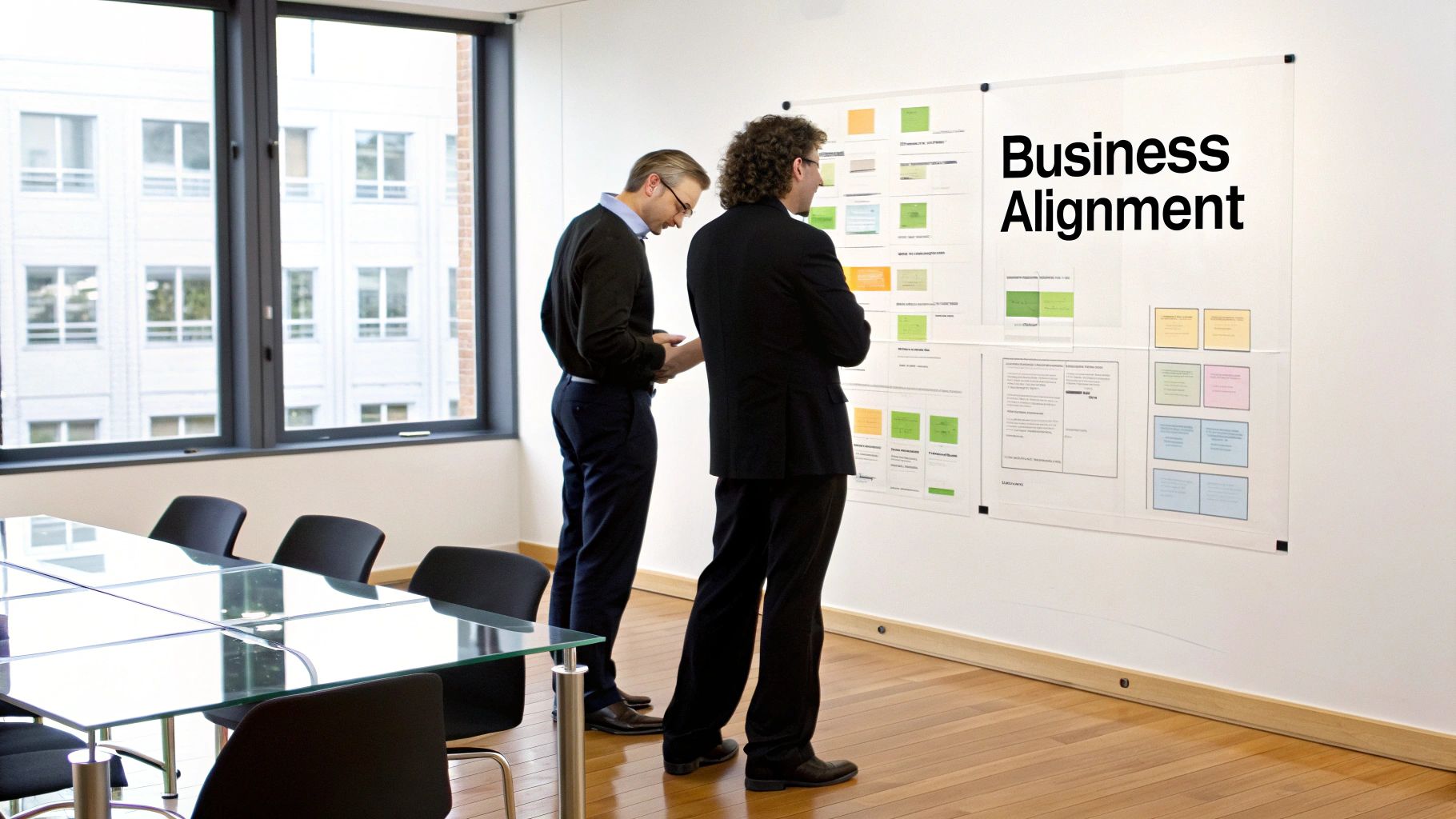
The foundational principle of effective enterprise architecture is its direct and unbreakable link to business strategy. This alignment ensures that every technological decision, architectural blueprint, and IT investment serves a clear business purpose. It transforms the EA function from a cost center focused on technical standards into a strategic partner that drives business value, innovation, and competitive advantage. Without this connection, even the most elegant architecture is merely a technical exercise, disconnected from the organization's core mission.
At its core, this practice involves creating a transparent line of sight from high-level business goals down to specific technology initiatives. It answers the critical question: "How does this technology decision help us achieve our strategic objectives?" By embedding business context into the architectural process, organizations can prioritize investments, manage risks more effectively, and ensure that technology acts as an enabler, not an inhibitor, of growth.
Practical Example: A Retailer's Omni-Channel Strategy
A large retail company's strategic objective is to "create a seamless omni-channel customer experience." The EA team translates this into specific architectural initiatives. Instead of just upgrading the e-commerce platform, they design a customer data platform (CDP) that unifies customer profiles from in-store POS systems, the website, and the mobile app. This architectural decision directly supports the business strategy by enabling personalized marketing and consistent service across all channels, turning a high-level goal into a tangible, technology-driven reality.
Actionable Insights to Implement This Practice
- Establish a Business-EA Steering Committee: Create a formal body with representatives from both business units and the EA team. Actionable Insight: In the first meeting, have business leaders present their top three strategic goals for the next 18 months. The EA team's task is to map current and proposed technology initiatives to each of those goals, immediately highlighting gaps and misalignments.
- Develop Business Capability Maps: Visualize what the business does, independent of how it does it. Actionable Insight: Create a "heat map" over your capability model. Use red for capabilities that are strategically critical but technologically underserved, yellow for those that are adequate, and green for those that are well-supported. This visual tool makes prioritization debates with business leaders far more productive.
- Utilize Value Stream Mapping: Analyze and map the sequence of activities required to deliver value to a customer. Actionable Insight: Map the "order-to-cash" value stream. Identify every system touchpoint and manual handoff. This will quickly reveal bottlenecks—like manual order entry from one system to another—that can be automated with APIs, directly improving operational efficiency.
- Define Business-Outcome-Driven Metrics: Move beyond technical metrics like server uptime. Actionable Insight: Instead of tracking "server uptime," track "percentage of customer orders processed without manual intervention." This metric directly ties architectural improvements (like automation) to a tangible business outcome (operational efficiency). Developing a comprehensive visual plan can be a crucial first step; you can create a robust framework by using a technology roadmap template.
2. Adopt a Standardized EA Framework
Implementing a well-established enterprise architecture framework provides the structure, methodology, and common language essential for consistent and effective EA practices. Frameworks like TOGAF or Zachman offer proven, repeatable processes for developing, managing, and governing architecture across a complex organization. This approach moves EA from an ad-hoc, reactive function to a disciplined, proactive practice, ensuring that architectural decisions are made consistently and coherently.
Adopting a framework establishes a shared understanding among stakeholders, from IT teams to business leaders. It provides a standardized set of tools, templates, and terminologies, which reduces ambiguity and improves communication. This structured approach is fundamental to creating a holistic and integrated view of the enterprise, allowing architects to manage complexity, mitigate risks, and align technology initiatives with strategic goals in a systematic way.

Practical Example: A Financial Services Firm Adopting TOGAF
A mid-sized insurance company struggled with inconsistent project delivery and redundant software purchases across its departments. To fix this, they adopted a tailored version of TOGAF. They started by applying the Architecture Development Method (ADM) to a single project: developing a new claims processing application. By following the TOGAF phases, they first defined a clear business architecture (Phase B), identifying the need for a "fraud detection" capability. This led them to discover another department was already using a suitable fraud detection tool, preventing a redundant purchase and promoting a standardized, shared service. The framework provided the discipline to look beyond the immediate project to the wider enterprise context.
Actionable Insights to Implement This Practice
- Select and Customize the Right Framework: Evaluate leading frameworks like TOGAF, Zachman, or FEAF against your organization's needs. Actionable Insight: Don't try to implement the entire TOGAF framework at once. Start with the "Architecture Vision" (Phase A) and "Business Architecture" (Phase B) for all new major projects. This ensures business alignment from day one, delivering immediate value without the overhead of the full framework.
- Invest in Training and Certification: Ensure your EA team is proficient in the chosen framework. Actionable Insight: Instead of just certifying architects, run half-day workshops for project managers and business analysts on the basics of your chosen framework. This creates a shared vocabulary and understanding, making collaboration with the EA team much smoother.
- Start Small and Iterate: Avoid a "big bang" implementation. Actionable Insight: Pick one troubled but visible project to pilot your framework. Successfully applying the framework to turn it around will create a powerful success story that serves as internal marketing for wider adoption.
- Utilize EA Tools and Repositories: Leverage specialized EA tools to manage the artifacts prescribed by the framework. Actionable Insight: Begin by using a simple tool, even a well-structured wiki like Confluence, to build your repository of architectural principles and standards. The goal is accessibility and collaboration, not complex tooling. Make it the go-to place for developers to find the "paved road" for building new applications.
3. Implement Robust EA Governance
While a strong strategy provides the direction for enterprise architecture, robust governance provides the necessary guardrails and decision-making framework to keep it on track. EA governance establishes the processes, standards, and controls that ensure architectural decisions align with business objectives and are implemented consistently across the organization. It transforms architecture from a set of recommendations into an enforceable, value-driven discipline. Without effective governance, even the best-laid architectural plans can dissolve into inconsistent technology silos, redundant spending, and accumulated technical debt.
This practice is about creating a system of accountability and structured decision-making. It defines who can make which architectural decisions, what criteria should be used, and how compliance will be monitored. By formalizing this process, organizations can mitigate risks, ensure interoperability between systems, and maximize the return on their technology investments. It provides the essential structure needed to translate architectural vision into operational reality, making it one of the most critical enterprise architecture best practices.

Practical Example: A Healthcare Provider's Data Security Governance
A large hospital system needed to ensure HIPAA compliance across all new application development. They established an Architecture Review Board (ARB) with a mandatory security checkpoint. Before any project involving patient data could proceed to development, the solution architect had to present their design to the ARB. The board used a simple checklist: "Does the design use end-to-end encryption? Is data access logged and audited? Is data-at-rest encrypted?" If the answer to any of these was no, the project was paused until the design was remediated. This simple, non-negotiable governance process prevented costly compliance failures before they happened.
Actionable Insights to Implement This Practice
- Establish Clear Governance Roles: Define the roles and responsibilities of bodies like an Architecture Review Board (ARB). Actionable Insight: Create a simple RACI (Responsible, Accountable, Consulted, Informed) chart for key architectural decisions (e.g., "Selecting a new CRM platform," "Approving an exception to a technology standard"). This clarifies who has the final say and eliminates ambiguity.
- Create a Streamlined Review Process: Design an architecture review process that is agile, not bureaucratic. Actionable Insight: Implement a "Request for Comment" (RFC) process using a shared document platform. Before an ARB meeting, the architect posts their design proposal, and stakeholders can comment asynchronously. This resolves most questions beforehand, making the actual meeting shorter and more focused on critical decision points.
- Balance Rigor with Agility: Governance should not stifle innovation. Actionable Insight: Create a "guardrails, not gates" model. For low-risk projects (e.g., internal tools with no sensitive data), publish a clear set of standards and pre-approved patterns. If a team builds within these guardrails, they can proceed without a formal review, enabling speed and autonomy.
- Implement Compliance Dashboards: Use automated tools to create dashboards that monitor compliance with architectural standards. Actionable Insight: Use security scanning tools to automatically check code repositories for non-approved libraries or insecure dependencies. Display the results on a public dashboard. This uses transparency and peer pressure to encourage compliance without manual oversight. As new technologies like AI are adopted, extending this oversight is crucial; you can explore key principles by reviewing AI governance best practices.
4. Focus on Business Capabilities and Value Streams
A technology-first approach to enterprise architecture often leads to complex, siloed systems that fail to deliver cohesive business value. One of the most impactful enterprise architecture best practices is to reverse this perspective by focusing first on business capabilities and value streams. This practice involves abstracting what the business does from how it does it, creating a stable foundation for strategic planning and technology investment. It shifts the conversation from "What technology should we buy?" to "What capabilities do we need to win in our market, and how can technology enable them?"
At its core, this approach creates a shared language and model between business and IT. A business capability represents a specific ability an organization needs to execute its business model or fulfill its mission, such as "Manage Customer Relationships" or "Process Insurance Claims." Value streams then map the end-to-end flow of activities that deliver a product or service to a customer. By modeling these elements, architects can pinpoint redundancies, identify strategic gaps, and design technology solutions that directly support how the organization creates value.

Practical Example: A University's Student Onboarding Process
A university mapped its "Student Onboarding" value stream and identified that prospective students had to interact with five different departments and seven different software systems from application to enrollment. This was enabled by a "Student Admissions" capability that was highly fragmented. By visualizing this, the EA team proposed a single, unified portal (a new technology solution) that integrated the underlying systems via APIs. This architectural decision was driven directly by the need to improve a specific business capability and streamline a critical value stream, resulting in a drastically improved student experience and reduced administrative overhead.
Actionable Insights to Implement This Practice
- Develop a Business Capability Map: Start by collaborating with business leaders to identify and define the core capabilities of the organization. Actionable Insight: During a workshop, give business leaders sticky notes and ask them to write down "the things our company does to make money." Group these notes thematically on a whiteboard to build your initial, high-level capability map. This business-first language ensures immediate buy-in.
- Involve Business Stakeholders: The definition and validation of capabilities and value streams cannot be an IT-only exercise. Actionable Insight: Co-create the capability map in a live workshop with business leaders. This ensures the language is theirs and the model reflects business reality. Their involvement turns it from an "IT document" into a "shared strategic plan."
- Use Capability Heat Maps for Prioritization: Assess each capability against dimensions like strategic importance and performance. Actionable Insight: Overlay your application portfolio onto your capability map. This will immediately show you which business-critical capabilities are supported by aging, legacy technology (a high-risk area) and where you have multiple, redundant applications supporting the same capability (a cost-saving opportunity).
- Link Capabilities to Customer Journeys: To ensure customer-centricity, map your business capabilities to the stages of the customer journey. Actionable Insight: Take a key customer journey, like "Purchasing a Product." For each stage (Awareness, Consideration, Purchase, Service), list the business capabilities that are required. This highlights which capabilities have the biggest impact on customer experience and should be prioritized for investment.
5. Embrace Agile and Iterative EA Approaches
The era of rigid, multi-year enterprise architecture plans has given way to a more dynamic and responsive model. Embracing agile and iterative EA approaches means shifting from extensive upfront design to a flexible, continuous process that delivers value incrementally. This practice integrates architecture into the rhythm of agile development, ensuring that architectural guidance is timely, relevant, and adapts to the organization's evolving needs. It transforms the EA function from a distant gatekeeper into an embedded partner in value creation.
At its heart, this approach prioritizes collaboration, feedback, and adaptive planning over comprehensive, static documentation. It answers the question: "What is the minimum viable architecture we need right now to enable the next increment of business value?" By focusing on just-in-time architectural decisions and continuous improvement, organizations can avoid over-engineering, reduce waste, and accelerate the delivery of technology-enabled business solutions, making it one of the most critical enterprise architecture best practices for the modern digital enterprise.
Practical Example: A FinTech's New Mobile Banking App
A FinTech startup was building a new mobile banking app. Instead of a year-long architecture design phase, the enterprise architect joined the first development sprint. The initial goal was simple: "Allow a user to view their balance." The architect designed a minimal, secure API gateway and a single microservice to fetch balance data. This was the "minimum viable architecture." In later sprints, as features like "Transfer Funds" were added, the architect iteratively added new microservices and event-driven patterns. The architecture grew and evolved with the product, preventing over-engineering and delivering value to customers within weeks, not years.
Actionable Insights to Implement This Practice
- Establish an Architectural Runway: Proactively build a foundation of necessary infrastructure and code that allows agile teams to release features without delay. Actionable Insight: If you know multiple teams will need a logging service in the next quarter, have an architect or platform team build a standardized, easy-to-use logging library before the development sprints begin. This is building the runway just ahead of the plane.
- Utilize Minimum Viable Architecture (MVA): Define the bare-minimum architectural components required to support an initial product release. Actionable Insight: For a new product, ask: "What is the simplest architecture that will work for the first 1,000 users?" Defer decisions about scaling to millions of users until there is evidence the product is successful. This avoids premature optimization and wasted effort.
- Implement Architecture Sprints: Align architectural work with development sprints. Actionable Insight: Dedicate every fourth sprint as an "architecture and refactoring sprint." This gives teams dedicated time to pay down technical debt, upgrade libraries, and implement architectural improvements that are difficult to fit into feature-focused sprints.
- Focus on Intentional Architecture: While the architecture is emergent, it is not accidental. Actionable Insight: Define and document a handful of non-negotiable "architectural principles" (e.g., "All services must communicate via APIs," "All customer data must be encrypted at rest"). This gives teams autonomy to innovate within a set of safe, strategic boundaries, a key concept explored in discussions on data governance frameworks.
6. Leverage Cloud-Native and Modern Technology Patterns
Modern enterprise architecture is not about maintaining the status quo; it is about building for the future. Embracing cloud-native technologies, microservices, and modern architectural patterns is essential for any organization aiming for agility, scalability, and resilience. This practice shifts the focus from monolithic, on-premise systems to distributed, flexible architectures designed to thrive in dynamic digital ecosystems.
At its heart, this approach involves leveraging cloud platforms, containerization (like Docker and Kubernetes), serverless computing, and API-first designs. By adopting these patterns, organizations can decouple services, accelerate development cycles, and scale resources on demand. This is a cornerstone of effective enterprise architecture best practices, transforming IT from a rigid cost center into a dynamic engine for innovation and rapid value delivery.
Practical Example: An E-commerce Company's Black Friday Scaling
An online retailer's monolithic website crashed every Black Friday due to massive traffic spikes. The EA team re-architected the site using cloud-native patterns. They broke the monolith into microservices for "product search," "shopping cart," and "payment processing," and deployed them on a Kubernetes cluster in AWS. When traffic surged on Black Friday, the platform automatically scaled up the number of "product search" containers to handle the load, while the "shopping cart" service scaled independently. The site remained fast and responsive, leading to record sales. This elasticity is a direct benefit of a modern, cloud-native architecture.
Actionable Insights to Implement This Practice
- Adopt the Strangler Fig Pattern for Modernization: Instead of a risky "big bang" rewrite of legacy systems, gradually build new services around the old monolith. Actionable Insight: Identify one piece of functionality in your legacy monolith, like "user profile management." Build a new microservice for it. Then, use a proxy or API gateway to redirect all calls for user profiles to the new service. Repeat this process feature by feature until the old monolith is "strangled."
- Establish a Cloud Center of Excellence (CCoE): Create a dedicated team to develop best practices and governance for cloud technologies. Actionable Insight: The CCoE’s first task should be creating and publishing reusable Infrastructure-as-Code (IaC) templates (e.g., Terraform or CloudFormation). This allows development teams to provision secure, compliant cloud environments in minutes, not weeks.
- Implement Comprehensive API Management: As you move to a distributed architecture, APIs become the connective tissue. Actionable Insight: Deploy an API Gateway. Route all traffic to your microservices through it. This gives you a single point to enforce security (API keys, OAuth), monitor traffic, and manage request rates, which is essential for a reliable distributed system. You can learn more by exploring different microservices architecture patterns.
- Invest in Observability and Monitoring: Distributed systems are more complex to monitor than monoliths. Actionable Insight: Implement a distributed tracing tool (like Jaeger or Datadog APM). When a user reports an error, you can see the entire lifecycle of their request as it travels across multiple microservices, immediately pinpointing which service failed and why.
7. Establish Strong Data Architecture and Governance
In the modern enterprise, data is no longer a byproduct of business operations; it is a core strategic asset. Establishing strong data architecture and governance is a critical enterprise architecture best practice that ensures this asset is managed, protected, and leveraged effectively. This practice involves creating a blueprint for how data is collected, stored, integrated, and used, supported by a formal framework of policies, roles, and standards that govern its entire lifecycle.
This approach transforms data from a siloed, inconsistent liability into a reliable, enterprise-wide resource for insight and innovation. It directly addresses the "how" behind data-driven decision-making, ensuring that the right data is available to the right people at the right time, in the right format. By treating data architecture as a foundational pillar of enterprise architecture, organizations can unlock its full potential, driving everything from operational efficiency and regulatory compliance to advanced analytics and competitive differentiation.
Practical Example: A CPG Company's "Single View of Product"
A global consumer packaged goods (CPG) company had product information scattered across ERP systems, marketing databases, and spreadsheets, leading to inconsistent product listings on retail websites. To solve this, they implemented a Master Data Management (MDM) program, a core data architecture initiative. They created a central "golden record" for every product. Now, when a new product is created, its data is entered and validated once in the MDM system, which then feeds the consistent, accurate information to all other systems. This strong data architecture eliminated costly errors and improved relationships with retail partners.
Actionable Insights to Implement This Practice
- Start with Critical Data Domains: Rather than attempting to govern all data at once, identify the most critical business data domains. Actionable Insight: Start with the "Customer" data domain. Your goal is to be able to answer one question consistently across the entire company: "How many unique customers do we have?" This seemingly simple goal will force you to address data silos, duplication, and quality issues in your most valuable data asset.
- Establish Clear Data Ownership and Stewardship: Assign formal roles and responsibilities for data. Actionable Insight: For each critical data domain (like "Product"), officially nominate a Data Owner from the business (e.g., the Head of Product). This person is now formally accountable for the quality and definition of product data, creating a powerful incentive for improvement.
- Implement a Data Catalog: Deploy a data catalog to serve as a central, searchable inventory of all data assets. Actionable Insight: Start by cataloging just the top 20 most frequently used data reports in your BI tool. For each one, document who owns it, what the key metrics mean, and where the data comes from. This provides immediate value to a large number of users and builds momentum for the cataloging initiative.
- Utilize Data Lineage Tools: Track the flow of data from its source to its consumption. Actionable Insight: When a key sales report shows an incorrect number, use a data lineage tool to trace the problematic metric back through the data warehouse and ETL jobs to the source system. This reduces debugging time from days to minutes.
- Adhere to Foundational Principles: Building a robust data architecture requires a strong theoretical underpinning. Following established data architecture principles provides a consistent and scalable framework for all data-related initiatives.
- Ensure Security and Compliance: Establishing strong data architecture and governance relies on adhering to essential data management best practices, covering critical aspects like security, quality, and regulatory compliance from the outset.
7 Key Enterprise Architecture Best Practices Comparison
| Practice | Implementation Complexity 🔄 | Resource Requirements ⚡ | Expected Outcomes 📊 | Ideal Use Cases 💡 | Key Advantages ⭐ |
|---|---|---|---|---|---|
| Align EA with Business Strategy and Objectives | Medium – requires ongoing alignment and monitoring | Moderate – involves cross-functional collaboration | Strong business-IT alignment, justified investments | Organizations prioritizing strategic value from EA | Ensures business value delivery, improves agility |
| Adopt a Standardized EA Framework | High – involves learning and customizing frameworks | High – training and cultural adaptation needed | Consistent EA approach, improved communication | Enterprises seeking structured EA methodology | Proven best practices, supports compliance |
| Implement Robust EA Governance | High – governance bodies and processes needed | High – organizational commitment required | Consistent architecture, risk reduction, compliance | Large organizations needing control and standards | Reduces architectural debt, improves decision-making |
| Focus on Business Capabilities and Value Streams | Medium – requires deep business knowledge | Moderate – business and IT collaboration | Clear prioritization, business-contextualized EA | Organizations emphasizing business-driven architecture | Better alignment to business needs, supports transformation |
| Embrace Agile and Iterative EA Approaches | Medium – cultural shift and iterative cycles | Moderate – ongoing collaboration and feedback | Faster value delivery, responsiveness to change | Dynamic environments needing flexibility | Incremental delivery, enhanced stakeholder engagement |
| Leverage Cloud-Native and Modern Technology Patterns | High – new skills and architectural complexity | High – investment in cloud and DevOps practices | Scalable, resilient, and agile architectures | Organizations adopting cloud and microservices | Improved scalability, faster deployment |
| Establish Strong Data Architecture and Governance | High – complex data governance and architecture | High – extensive data management and policies | Data-driven decision making, quality, compliance | Enterprises managing large and diverse data assets | Enables analytics, supports compliance and AI |
Building a Future-Proof Architectural Practice
The journey through the cornerstones of modern enterprise architecture reveals a clear, compelling narrative: EA is no longer a static, back-office function concerned with rigid blueprints. Instead, it has evolved into a dynamic, strategic discipline that actively shapes business outcomes, drives innovation, and builds organizational resilience. The best practices we've explored, from aligning with business objectives to embracing agile methodologies and establishing robust data governance, are not isolated tactics. They are interconnected components of a holistic system designed to create a living, breathing architecture that evolves in lockstep with your enterprise.
Mastering these enterprise architecture best practices is the difference between an IT organization that simply supports the business and one that actively leads it into the future. By anchoring every architectural decision in strategic business goals, you ensure that technology investments deliver tangible value, not just technical capability. Adopting a standardized framework like TOGAF or Zachman provides a common language and a consistent approach, eliminating ambiguity and fostering collaboration across diverse teams. This structured approach, when combined with strong governance, ensures that architectural principles are upheld, standards are maintained, and the organization is protected from the long-term costs of technical debt and architectural drift.
From Theory to Strategic Impact
The true power of these practices is realized when they are integrated into the daily rhythm of the organization. Focusing on business capabilities and value streams shifts the conversation from "what technology are we building?" to "what business outcomes are we enabling?". This value-centric perspective is crucial for gaining executive buy-in and demonstrating the strategic importance of EA. When this is coupled with an agile, iterative approach, enterprise architecture becomes a facilitator of change rather than a bottleneck. Instead of delivering a monolithic, five-year plan, modern EA provides just-in-time guidance, enabling teams to build, learn, and adapt quickly while staying aligned with the long-term vision.
A critical thread weaving through all these practices is the foundational role of data. As we’ve explored in articles on the DATA-NIZANT blog, from building robust data platforms to leveraging AI, a coherent data architecture is non-negotiable in the digital age. Establishing strong data governance and a clear data strategy is the bedrock upon which future innovations like advanced analytics, machine learning, and generative AI are built. Without this, even the most sophisticated technology patterns and cloud-native services will fail to deliver on their promise.
Your Actionable Roadmap to Architectural Excellence
Transforming your EA practice is a continuous journey, not a destination. The key is to start now with deliberate, incremental steps. Here is a practical roadmap to begin embedding these principles:
- Conduct a Maturity Assessment: Honestly evaluate your current EA practice against the seven best practices discussed. Identify your strengths and, more importantly, pinpoint the 1-2 areas that offer the greatest potential for improvement.
- Launch a Pilot Initiative: Select a single, high-impact business initiative to apply these principles. Use it as a learning ground to demonstrate the value of strategic EA, agile methods, and robust governance in a controlled environment.
- Build a Cross-Functional Guild: Create a community of practice or "architecture guild" that includes architects, engineers, product managers, and business stakeholders. This fosters a culture of shared ownership and collaborative decision-making.
- Communicate and Evangelize: Continuously communicate the "why" behind your architectural decisions. Use metrics and success stories from your pilot to build momentum and evangelize the value of a mature EA practice across the organization.
By embracing these enterprise architecture best practices, you are not just designing systems; you are architecting the future of your business. You are building an enterprise that is not only efficient and scalable but also agile, innovative, and prepared to thrive in an era of constant change. The result is a future-proof organization, ready to seize new opportunities and navigate the challenges of tomorrow with confidence and clarity.
Ready to build a data-driven foundation for your architectural strategy? The experts at DATA-NIZANT specialize in designing and implementing robust data architectures that power modern enterprises. Visit DATA-NIZANT to learn how our expertise can help you turn architectural vision into tangible business value.



It is in point of fact a great and helpful piece of info. I¦m glad that you shared this helpful information with us. Please keep us informed like this. Thank you for sharing.