

A technology roadmap template gives you a solid, pre-built structure for laying out your strategic tech plans. But it's so much more than just a document. Think of it as a critical communication tool that connects everything from your AI deployments to major infrastructure upgrades with your core business goals. It’s how you get everyone, from the engineers in the trenches to the C-suite, pulling in the same direction.
Why a Roadmap Is Your Most Important Strategic Tool

Forget about those old, dusty project plans that get filed away and never seen again. A modern technology roadmap is a living, breathing blueprint that closes the gap between technical work and executive strategy. It brings clarity, helps manage stakeholder expectations, and keeps your innovation efforts focused.
As tech stacks have become more complex, organizations everywhere have started using technology roadmaps to visually communicate their plans. These can be as focused as a single product's future capabilities or as broad as an entire company's tech portfolio. This isn't just a trend; it's a fundamental shift toward more transparent and coordinated tech investments, which ultimately leads to faster, smarter decisions. For a deeper dive into how these roadmaps tie IT to business outcomes, check out these insights on strategic technology planning from Aha.io.
A Practical Example: Bringing Order to Chaos
We saw the power of this firsthand at Datanizant. We were working with a retail client whose tech projects were completely disconnected. Their teams were working incredibly hard, but in total silos. One group was building an ambitious AI-powered recommendation engine. At the same time, the infrastructure team was planning a massive cloud migration, completely unaware of the AI project's huge computing needs.
The result was predictable chaos. Budgets were a mess, timelines were constantly clashing, and the leadership team had no idea how all these expensive projects were supposed to support their main goal: increasing customer lifetime value.
By putting a clear technology roadmap in place, we unified their efforts. The roadmap visually connected the AI initiative to the infrastructure upgrade, reframing them as two dependent parts of a single, overarching strategic goal.
This simple act of creating a shared vision delivered immediate results:
- Aligned Priorities: The cloud migration was re-prioritized and its scope adjusted to specifically support the AI engine's launch. This ensured the right resources were ready when needed.
- Clear Communication: For the first time, stakeholders could see a direct line from technology spending to business results, which completely renewed their buy-in.
- Proactive Planning: The roadmap made future dependencies crystal clear, allowing them to get ahead on data governance and security planning.
This experience really drives home a crucial point. A well-structured technology roadmap template doesn’t just organize tasks; it rallies the entire organization around a shared vision for the future. It transforms a collection of isolated projects into a powerful, coordinated strategy.
Building The Foundation For A Powerful Roadmap
Jumping straight into a technology roadmap template without laying the proper groundwork is a bit like building a house without a foundation. It’s a common mistake. Before you even think about populating timelines and initiatives, there’s some critical prep work to do. This ensures your roadmap is strategic, realistic, and actually tied to what the business needs to achieve.
This foundational phase is often overlooked, but honestly, it's where the most value is generated. It all starts with a comprehensive audit of your current technology stack. You need a clear, unbiased picture of what you have, what’s working, what's creating friction, and what’s getting old. This isn’t just about making a list of software; it's about deeply understanding its capabilities and limitations.
Link Technology Directly To Business Goals
Once you have a handle on your current state, the next move is to anchor every potential tech initiative to a specific business goal. Technology for its own sake is a recipe for expensive, low-impact projects. You need to be able to draw a straight line from a proposed action to a business objective.
Actionable Insight: Instead of saying "We need a new CRM," which frames it as a cost, reframe it around the outcome. A SaaS company aiming to reduce customer churn by 15% can’t just ask for a new system. Their roadmap must spell out the connection:
- Business Goal: Reduce customer churn by 15%.
- Strategic Initiative: Implement a new CRM with predictive analytics.
- Actionable Outcome: Proactively identify at-risk customers by analyzing usage patterns and trigger automated retention campaigns, directly impacting the churn metric.
This simple reframing of the discussion turns a cost center into a value driver. Suddenly, getting buy-in is a whole lot easier. This structured approach is what turns a simple roadmap into an effective strategic tool.
A powerful roadmap doesn't just list projects; it tells a story about how technology will achieve specific business victories. It answers the "why" before it ever gets to the "what" or "when."
Engage Stakeholders and Run Discovery Workshops
The final piece of this foundational puzzle is getting the right people in the room. A roadmap built in an IT silo is just doomed to fail. You need a cross-functional team of stakeholders, from C-suite execs who define the business strategy all the way to the front-line engineers who understand the technical realities.
This is where effective discovery workshops come in. These aren't just brainstorming sessions; they should be structured forums for identifying real pain points and opportunities. As we discuss in our guide to data science project management, successfully managing these sessions is a core skill that ensures all voices are heard and everyone is aligned.
The infographic below gives you a sense of how you might structure a discovery process to collaboratively outline a workflow.
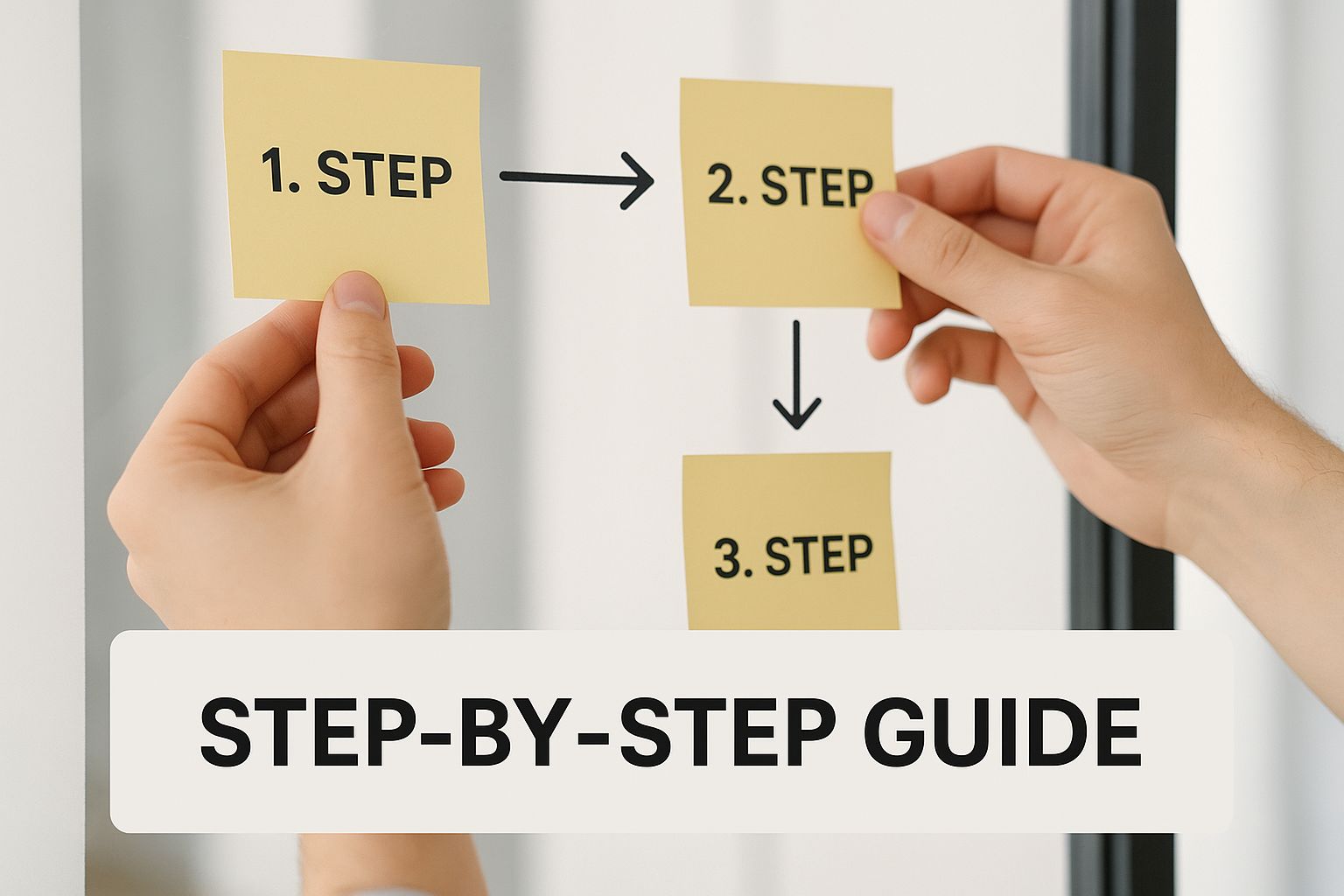
As you can see, it's a very tangible, collaborative process where ideas are captured and organized to build a shared understanding. By getting this groundwork done—auditing your tech, aligning with business goals, and engaging the right people—you transform a blank template into a genuine blueprint for strategic success.
How to Customize Your Technology Roadmap Template

A generic technology roadmap template is a great starting point, but let’s be honest—its real value comes alive only after you’ve customized it. You need to mold it to fit your organization's unique DNA. That’s how you turn a simple document into a strategic command center that reflects how your teams actually work and what your business truly needs.
The first thing to nail down is the format. Not all roadmaps are built the same, and the visual structure you choose should make sense for your team's workflow and the project itself.
- Timeline (Gantt-style) View: This is your best bet for projects where deadlines and dependencies are everything. It gives you a crystal-clear view of when initiatives start and end, making it perfect for things like hardware rollouts or infrastructure upgrades with hard go-live dates.
- Kanban-style View: If you’re running an agile team, this is for you. A Kanban view visualizes your workflow in stages (think To Do, In Progress, Done) and puts the focus on continuous delivery and flexibility rather than rigid timelines.
Once you’ve settled on a format, the real work begins. It’s time to tailor the fields to your specific context.
A Practical Example: Tailoring Your Template for an AI Project
Let's walk through a real-world example. Here at Datanizant, we recently helped a client roll out a massive AI system for predictive maintenance. The standard template they had—with basic fields like "Initiative" and "Status"—was way too simple for a project with so many moving parts. We had to make it their own.
We kicked things off by adding custom streams to the roadmap. This let us break down the huge project into parallel, more manageable work areas. Suddenly, different teams could see exactly what they were responsible for within the bigger picture, which brought a ton of clarity.
These custom streams included:
- Data Acquisition & Preparation: This stream covered everything from sourcing new datasets to the nitty-gritty of cleaning and labeling them. A key initiative here was building automated data pipelines to guarantee a steady flow of high-quality data for the models.
- Model Training & Validation: This was the core data science work, tracking all the experiments with different algorithms, hyperparameter tuning, and performance testing.
- Ethical & Compliance Review: For any AI project, this is non-negotiable. We made it a dedicated stream to ensure all fairness, bias, and privacy checks were completed and documented at every key milestone.
- Phased Deployment: Instead of a risky "big bang" launch, we mapped out a multi-stage rollout. It started with a pilot program at a single factory, and we scaled up from there.
By transforming a generic template into this detailed, multi-stream view, we gave every stakeholder—from data scientists to legal experts—a single source of truth. It wasn't just a list of tasks; it was a coherent story of how the entire AI initiative would come to life.
This level of detail is what separates a good roadmap from a great one. You also need to customize fields for resource allocation, spelling out which teams or even which individuals are assigned to each initiative. And don't forget to add a field for dependencies. This lets you visually link tasks—for example, making the "Model Training" phase dependent on completing the "Data Acquisition" stream—to prevent bottlenecks and keep the project flowing logically.
You've customized your roadmap template, and it looks great. But a beautiful roadmap is useless if it's filled with the wrong things. Now for the hard part: deciding what actually gets built.
This is where strategy hits the pavement. It's also where a lot of roadmaps lose their way, slowly turning into a cluttered wishlist of pet projects instead of a clear plan that drives the business forward.
The goal is to stop guessing and start making data-informed decisions. You need to fill your roadmap with work that delivers the most significant business impact, which means you need a system to evaluate and compare potential projects objectively. Without one, you’ll burn time and money on low-value tasks or "nice-to-have" features that don't move the needle.
Choosing Your Prioritization Framework
Two of the most practical and widely used frameworks I've seen are the MoSCoW method and the Value vs. Effort matrix. They take different tacks but both aim to bring much-needed clarity to your decision-making process.
So, how do you pick the right one for your team? It really depends on your goals—are you focused on clear, non-negotiable requirements, or are you trying to balance impact against development cost?
Here’s a quick comparison to help you decide.
Choosing Your Prioritization Framework
| Framework | Best For | Pros | Cons |
|---|---|---|---|
| MoSCoW | Defining scope with clear, non-negotiable requirements (Must-haves, Should-haves, Could-haves, Won't-haves). | – Excellent for communicating priorities to stakeholders. – Creates a clear hierarchy of what's essential. |
– Can lead to scope creep if "Should-haves" aren't managed. – Less emphasis on development cost. |
| Value vs. Effort | Balancing business impact against the resources required to deliver it. Ideal for resource-constrained teams. | – Visually intuitive and easy to understand. – Forces a practical conversation about ROI. |
– "Value" and "Effort" can be subjective if not defined clearly. – Can oversimplify complex strategic decisions. |
For most tech roadmaps, especially in a fast-moving environment, the Value vs. Effort matrix is incredibly powerful because it forces you to think critically about both sides of the equation.
Initiatives that are high-value and low-effort are your quick wins—the no-brainers you should tackle right away. On the flip side, low-value, high-effort projects are the time-sinks you should actively avoid.
The real strategic magic happens in the other two quadrants. High-value, high-effort projects are your major strategic bets. Low-value, low-effort tasks are things you can slot in when there are gaps in the schedule.
Actionable Insight: Let's walk through a common scenario. Imagine your team has two big projects competing for resources: a full migration to the cloud and building a new dashboard for the marketing team. The dashboard is a "nice-to-have" that would save a few hours of manual reporting each week. The cloud migration, however, is a massive undertaking.
By plotting these on a Value vs. Effort matrix, the choice becomes obvious.
- Internal Dashboard: Low-to-medium value, low effort. It's a helpful tweak but not a game-changer.
- Cloud Migration: Very high value, very high effort. This directly impacts your ability to scale, your long-term cost savings, and what products you can even build in the future.
The matrix makes it crystal clear: the cloud migration is the strategic priority, even with its complexity. The dashboard can wait. This simple framework is a fantastic tool for preventing teams from defaulting to easy tasks over truly impactful ones. For a deeper look at how data-driven decisions can reshape business functions, our post on machine learning in marketing offers related insights into applying analytics for strategic gain.
Deconstruct Initiatives into Actionable Work
Once you've locked in your major initiatives, the final step is to break them down into pieces your development teams can actually execute. A high-level goal like "Migrate to the Cloud" is far too big to be actionable on its own.
You need to deconstruct it into more granular components that connect strategy to daily work. Here's how that typically looks:
- Themes: These are the broad, strategic focus areas. For our cloud migration example, a theme might be "Improve Infrastructure Scalability."
- Epics: These are large bodies of work that fall under a theme. An epic here could be "Migrate Customer Database to AWS RDS."
- Stories: These are the specific, concrete tasks the development teams will tackle in their sprints. A story might be, "As a developer, I need to set up the new RDS instance with the correct security groups."
This hierarchy translates your big-picture strategy into executable work. It ensures that the priorities on your roadmap are the same ones driving what your developers are building every single day.
Your Roadmap Isn't Static—It's a Living Document
Let's be honest. Creating a technology roadmap is a huge accomplishment. But its real power isn’t in the one-time act of building it; it's in how you use it day-to-day. A roadmap that just sits there, collecting digital dust, becomes obsolete almost immediately.
To get real value, you have to treat your roadmap as a living, breathing guide. It needs to be communicated constantly, reviewed regularly, and adapted whenever things change. Think of it less as a "set it and forget it" plan and more as an active management tool.
Different people need different views. Your board, for instance, just wants the high-level summary that ties tech initiatives back to business goals. Your engineering teams? They need the nitty-gritty details on dependencies, timelines, and who’s doing what.
Establish a Cadence for Review and Adaptation
A static roadmap is a useless roadmap. To keep yours relevant, you need a consistent review cycle. For most companies, a quarterly review hits the sweet spot. It's frequent enough to react to market shifts but not so often that you're in a state of constant churn.
These regular check-ins are where the magic happens. They serve a few critical functions:
- Re-prioritize Initiatives: New opportunities pop up. A competitor makes a move. A quarterly review gives you a dedicated time to make these kinds of strategic adjustments.
- Assess Progress: Are you hitting your milestones? If not, why? This is your chance to spot roadblocks and shift resources before a project derails completely.
- Update Timelines: Let’s face it, delays happen. A realistic roadmap has to reflect today's reality, not the plan you made three months ago.
Your roadmap isn't just a project plan; it's a dynamic guide. The real power of a great roadmap lies in its ability to adapt to new information, making it an indispensable tool for navigating an unpredictable world.
Build in Flexibility and Manage Your Risks
No roadmap ever survives first contact with reality. It’s just a fact. Unexpected hurdles are part of the game. The best, most resilient roadmaps are the ones that build in flexibility from the very beginning.
Actionable Insight: Don't schedule your teams at 100% capacity. Leave a 15-20% buffer in your planning. That breathing room is what allows you to absorb unexpected technical debt, fix critical bugs, or pivot to a new opportunity without throwing the entire quarter's plan into chaos.
This is especially true when you look at the bigger picture. The tech world moves fast. For example, a 2025 technology industry outlook from Deloitte highlights how the rapid growth in generative AI and a related surge in semiconductor demand will force companies to rethink their strategies.
At the same time, cybersecurity threats are exploding, projected to cost the global economy a staggering $10.5 trillion in 2025. A static plan simply can't cope with these kinds of variables. A living roadmap, on the other hand, has risk management baked right in, accounting for everything from supply chain disruptions to new security vulnerabilities.
This proactive approach to risk connects directly to your broader tech strategy. As we discuss in our guide on data analytics and cloud computing, it's one thing to manage a portfolio of new cloud infrastructure, but it's another to balance that with legacy systems.
By anticipating risks and communicating your strategy clearly, your roadmap becomes more than a chart of projects. It transforms into a resilient guide for genuine, long-term success.
Even with the best technology roadmap template, a few questions are bound to pop up. Let’s be real—building a roadmap is a messy, collaborative process. It's totally normal to feel a bit of uncertainty as you translate high-level strategy into a concrete plan.
At Datanizant, we see the same questions surface time and again with our clients. Getting these sorted out early can save you from common pitfalls and help turn your roadmap into a powerful decision-making tool. So, let’s jump into the most frequent queries we hear and give you some actionable advice.
What Is the Difference Between a Technology Roadmap and a Project Plan?
This one comes up a lot, and it's probably the most critical distinction to get right. It’s simple when you think about it: the roadmap is your strategic guide, while the project plan is purely tactical.
-
Technology Roadmap: This document is all about the "why" and "what." It paints a picture of your technology vision over a longer horizon, usually one to three years. Its primary job is to connect your tech initiatives back to the big-picture business goals, showing how everything fits together. Think of it as the map of the entire country.
-
Project Plan: This is the nitty-gritty blueprint for a single initiative from your roadmap. It dives deep into the "how," laying out specific tasks, detailed timelines, who’s doing what, and how much it will cost. This is your turn-by-turn navigation to a specific city on that map.
Your roadmap sets the destination and the major highways you'll take to get there. Your project plans are the detailed itineraries for each leg of the journey. One can’t function without the other.
How Often Should We Update Our Technology Roadmap?
There isn't a single right answer here, but a quarterly review and update cycle is a great place to start for most teams. This rhythm is frequent enough to keep you agile—letting you react to market changes or new tech—but not so often that you're stuck in constant planning mode.
Of course, your context is king.
- Startups or AI-focused teams are dealing with rapid change. Lighter, monthly check-ins might be necessary to stay on top of things.
- Large enterprises managing stable, long-term infrastructure projects might find a semi-annual review is plenty.
The goal is to treat your roadmap as a living document, not something you carve in stone and forget about. Regular reviews are what keep it relevant and trustworthy.
Who Should Ultimately Own the Technology Roadmap?
Roadmap creation is a team sport. You absolutely need input from business leaders, product managers, and engineers. But when it comes to ownership, there has to be a single person who is ultimately responsible. Without a clear owner, a roadmap will inevitably get neglected and fall out of date.
This role usually falls to a senior technology leader like the Chief Technology Officer (CTO), Head of Engineering, or a seasoned Technical Product Manager. This person is in the driver's seat—they guide the process, make sure everything aligns with the strategy, and communicate updates to everyone who needs to know.
It's also vital that this ownership is backed by solid governance. For complex work, especially involving AI, having clear roles and responsibilities is non-negotiable. A well-defined AI governance framework can provide the structure you need to build accountability and ethical oversight directly into your roadmapping process. One person may own the document, but its success truly depends on collaboration and buy-in from the whole team.
At DATA-NIZANT, we provide the expert insights and analysis you need to master complex topics in AI, data science, and digital infrastructure. Explore our in-depth articles to build your strategic advantage at https://www.datanizant.com.