Redefining ROI in Healthcare AI: How to Measure True Value “Thinking about AI as infrastructure is the right play for health systems to determine ROI… Ultimately, that is what is going to deliver ROI over time.” – William Sheahan, Senior Vice President and Chief Innovation Officer at MedStar Health Artificial Intelligence (AI) is no longer science fiction in healthcare — it’s a powerful driver fueling better decisions, faster diagnostics, and increasingly targeted treatments. But as it takes hold, healthcare leaders are faced with a critical question: how to measure the return on investment (ROI) of these technologies beyond superficial profit…

-
-
Learn effective strategies for dropout in neural network to improve model accuracy and prevent overfitting. Boost your AI projects today!
-
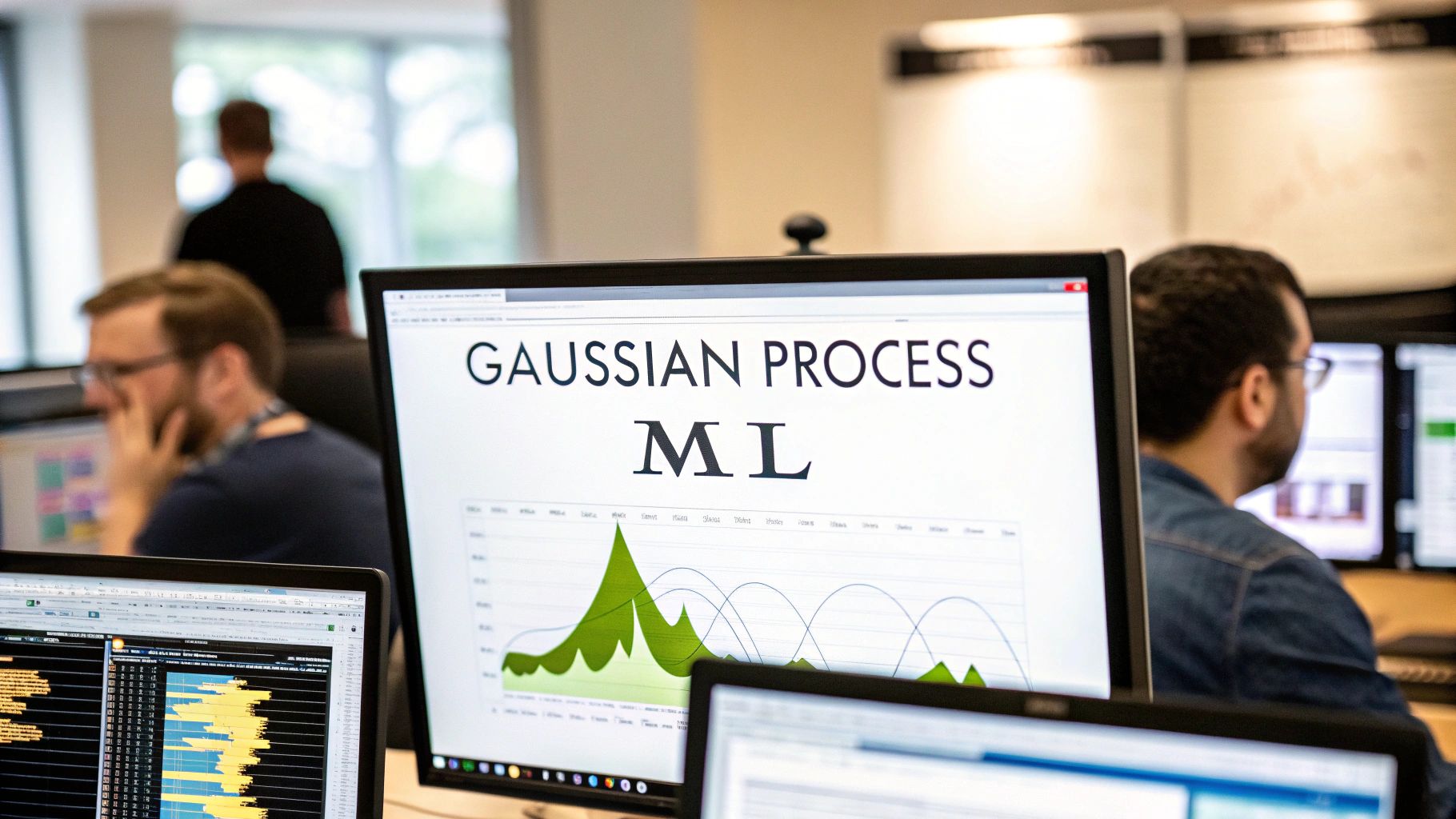
Master gaussian process machine learning with proven strategies that deliver results. Discover practical insights from ML experts on building models that work.
-
Compare random forest vs decision tree to understand their differences, strengths, and best use cases. Make informed machine learning choices today!
-
Learn how k fold cross validation enhances model reliability. Discover expert tips to implement this technique effectively and improve predictions.
-
Unlocking the Power of Time: Exploring Time Series Analysis This listicle provides a concise overview of eight essential time series analysis techniques for data professionals, researchers, and strategists. Understanding these methods is crucial for extracting meaningful insights from temporal data, enabling more accurate predictions and better decision-making. Learn how techniques like ARIMA, Exponential Smoothing, Prophet, LSTM networks, Spectral Analysis, State Space Models, Vector Autoregression (VAR), and XGBoost can be applied to solve real-world problems. Each technique is presented with practical use cases to demonstrate its value in various domains. 1. ARIMA (AutoRegressive Integrated Moving Average) ARIMA, short for AutoRegressive Integrated…
-
Unlocking the Power of Feature Selection In machine learning, choosing the right feature selection techniques is critical for model success. Too many or too few features can negatively impact performance. This listicle presents seven key feature selection techniques to improve your model's accuracy, reduce training time, and enhance interpretability. Learn how to leverage methods like Filter, Wrapper, and Embedded approaches, along with PCA, RFE, LASSO, and Mutual Information, to identify the most impactful features for your data. This knowledge empowers you to build more efficient and effective machine learning models. 1. Filter Methods (Univariate Selection) Filter methods represent a crucial…
-
Artificial Intelligence (AI) is transforming industries by automating tasks, enhancing creativity, and enabling data-driven decisions. This guide provides a detailed, technical overview of 100 AI tools, categorized by their primary use cases, to help developers, businesses, and enthusiasts leverage cutting-edge technologies in 2025. Each category includes tools with specific functionalities, technical underpinnings, and practical applications, ensuring a thorough understanding of their capabilities. 1. AI Research and Knowledge Discovery These tools leverage large language models (LLMs), natural language processing (NLP), and web scraping to provide conversational search, summarization, and research capabilities. Tool Description Logo ChatGPT (OpenAI) Conversational AI built on GPT-4o…
-
Artificial Intelligence has come a long way from rule-based systems to generative models that can create text, images, and even software code. However, the next leap forward in AI is not just about generating content—it’s about agency. Enter Agentic AI, a new paradigm where AI systems act autonomously to pursue high-level goals, reason through complex problems, and dynamically adapt to changing environments. “We’re about to empower people more than ever before.” — Sam Altman, CEO of OpenAI [thetimes.co.uk] Why This Blog Stands on Its Own This blog post is not just a continuation of my previous writings on AI but…
-
The world of multimodal AI is rapidly evolving, with models capable of both understanding and generating images with remarkable accuracy. Two of the biggest contenders in this space are DeepSeek’s Janus-Pro and OpenAI’s DALL-E 3. But which one is better suited for AI-powered creativity, image synthesis, and multimodal intelligence? Let’s dive deep into their architectures, capabilities, strengths, and limitations. 🚀 Understanding Janus-Pro and DALL-E 3 📊 Benchmark Performance & Accuracy Scores 📈 To compare these models objectively, let’s examine benchmark results based on standard text-to-image evaluation metrics: Benchmark Janus-Pro (DeepSeek) DALL-E 3 (OpenAI) FID (Fréchet Inception Distance) 14.8 (Lower is…