

Artificial intelligence is no longer a futuristic concept; it's a core component of modern business, reshaping industries from finance to healthcare. However, this power comes with profound responsibility. As organizations rush to deploy sophisticated models, the risk of unintended consequences grows exponentially. These risks include embedded bias, a lack of transparency, and significant operational failures. Simply adopting AI is not enough; governing it effectively is the true differentiator for sustainable success and building public trust.
This is where a structured approach to AI governance best practices becomes essential. It’s not about stifling innovation with bureaucracy, but about creating a robust framework for responsible, ethical, and effective AI deployment. Effective governance ensures that AI systems align with organizational values, comply with regulations, and operate as intended without causing harm. It provides the guardrails needed to navigate the complexities of AI development and integration safely.
Drawing on insights and real-world scenarios, similar to discussions on DATA-NIZANT about the complexities of AI adoption, this article will provide a detailed roundup of seven indispensable best practices. We will move beyond generic advice to offer actionable insights and practical examples you can implement today. You will learn how to:
- Establish cross-functional ethics committees.
- Implement algorithmic impact assessments.
- Develop comprehensive AI risk management frameworks.
- Ensure robust data quality and lineage.
- Implement continuous model monitoring.
- Establish clear transparency and explainability standards.
- Create human-in-the-loop decision frameworks.
This guide is designed to help you build a future-proof AI strategy grounded in accountability and operational excellence.
1. Establish Cross-Functional AI Ethics Committees
One of the most foundational ai governance best practices is moving beyond siloed decision-making by establishing a dedicated, cross-functional AI ethics committee. This governance body acts as a central nervous system for an organization's AI initiatives, ensuring that ethical considerations, risk management, and strategic alignment are embedded throughout the entire AI lifecycle, not just treated as an afterthought.

These committees are not merely symbolic; they are operational powerhouses designed to provide robust oversight. By bringing diverse experts to the same table, they create a constructive tension that balances innovation with responsibility. A data scientist might focus on model accuracy, a legal expert on regulatory compliance, a business leader on market viability, and an ethicist on potential societal impact. This multifaceted perspective is critical for identifying blind spots that a homogenous team would likely miss.
Why It's a Best Practice
An AI ethics committee formalizes accountability. It creates a clear, documented process for reviewing, challenging, and approving high-stakes AI projects. This structure is essential for navigating the complex trade-offs inherent in AI development, such as balancing personalization with privacy or automation with job displacement. A well-run committee can prevent costly reputational damage and regulatory fines by proactively addressing ethical risks before they escalate. As discussed in posts on datanizant.com about building ethical AI, this formal body is a key defense against future risks.
Actionable Insight: The true power of an AI ethics committee lies in its authority. To be effective, the committee must have the real power to halt or demand modifications to any AI project, regardless of its potential profitability or the seniority of its sponsors.
How to Implement It
Successfully establishing an AI ethics committee requires a deliberate and structured approach.
- Practical Example: A financial services company planning a new AI-based loan approval system would bring it before their committee. The committee reviews the model for potential bias against protected demographic groups. They discover the training data is skewed and mandate that the data science team rebalance the dataset and implement fairness-aware training techniques before the project can move forward. This prevents a discriminatory product from ever reaching the market.
- Create a Clear Charter: Define the committee's mission, scope, authority, and decision-making processes. Specify what types of projects require mandatory review, such as those using sensitive personal data or making consequential decisions about individuals.
- Assemble a Diverse Team: Go beyond internal stakeholders. Include legal counsel, ethicists, senior technologists, business unit leaders, and HR representatives. Crucially, consider adding external experts like academics, community advocates, or industry-specific ethicists to provide an unbiased, outside-in perspective.
- Develop Standardized Review Processes: Implement standardized templates and risk assessment frameworks. These tools should guide project teams in presenting their initiatives to the committee, covering areas like data sourcing, model fairness, transparency, and potential for misuse.
- Empower with Authority: Ensure the committee's recommendations are binding. Its decisions should be integrated into the organization’s official project management and stage-gate approval processes. Without this authority, the committee risks becoming a "rubber-stamp" body with no real influence.
2. Implement Algorithmic Impact Assessments
Another cornerstone of effective ai governance best practices is the proactive implementation of Algorithmic Impact Assessments (AIAs). An AIA is a structured, systematic process used to evaluate and document the potential societal impacts of an automated system before it is deployed. It moves beyond purely technical metrics to rigorously examine potential harms, biases, and unintended consequences on the individuals and communities the system will affect.
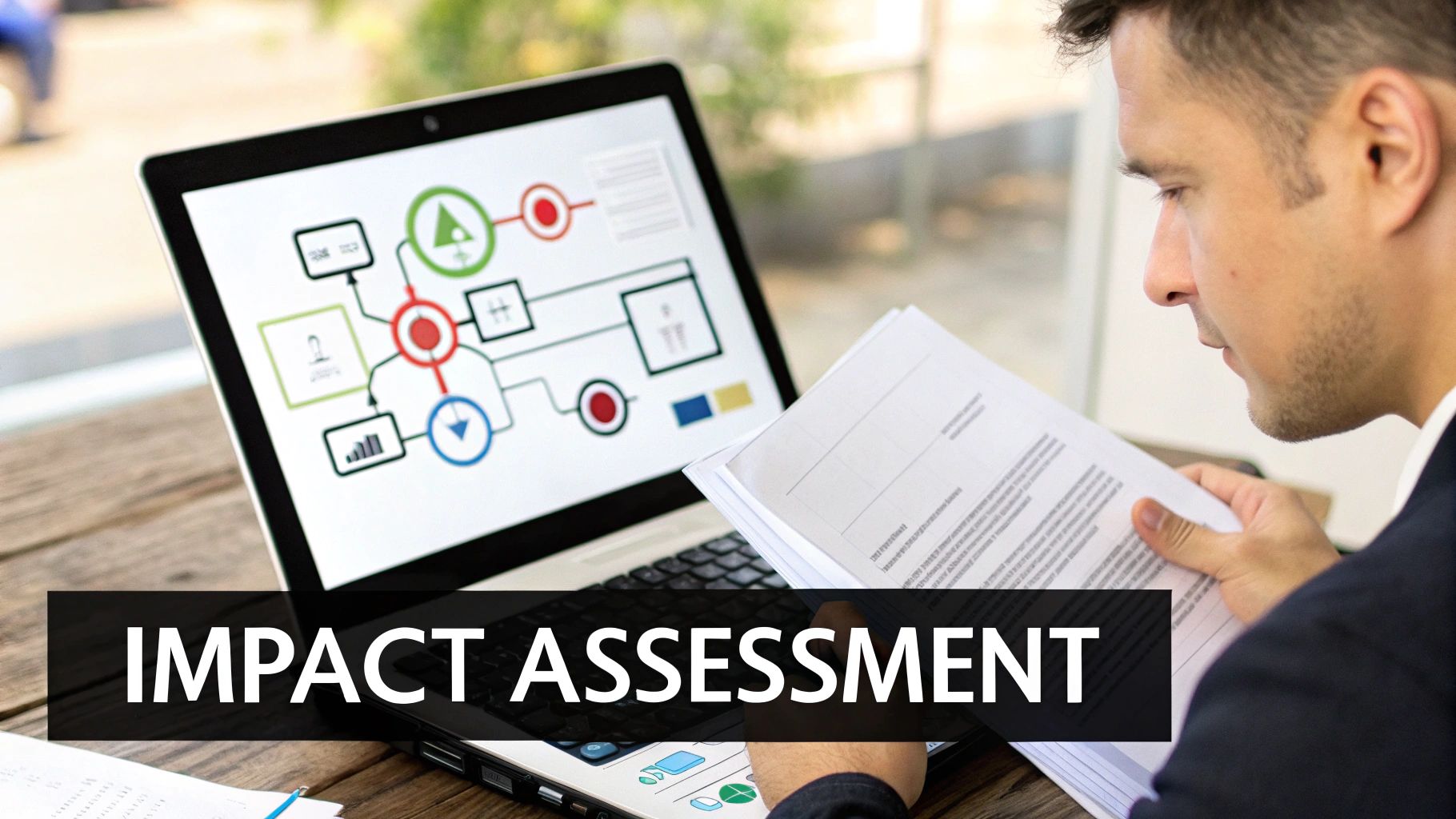
Popularized by advocates like Cathy O'Neil and institutions such as the AI Now Institute, AIAs function like an environmental impact assessment but for algorithms. They force organizations to confront difficult questions early: Who could be negatively affected by this system? How might it reinforce existing inequalities? What are the mechanisms for appeal and redress if the system makes a mistake? This proactive scrutiny is essential for building trustworthy AI that serves society responsibly.
Why It's a Best Practice
AIAs institutionalize foresight and accountability. Instead of reacting to algorithmic harm after it occurs, organizations can anticipate and mitigate risks during the design phase. This process is critical for high-stakes domains like hiring, lending, or criminal justice, where an automated decision can have life-altering consequences. Leading public sector bodies have already adopted this approach; notable examples include Canada’s Directive on Automated Decision-Making and the assessment toolkit developed by the UK Government. These frameworks provide a clear roadmap for responsible innovation.
Actionable Insight: An Algorithmic Impact Assessment is not a one-time, check-the-box exercise. It's a living document that should be revisited and updated throughout the AI system's lifecycle as the model, data, and societal context evolve.
How to Implement It
Integrating AIAs into your development process requires a clear methodology and organizational commitment.
- Practical Example: A city government wants to use an AI to optimize public transport routes. Before development, they conduct an AIA. Through community consultations required by the AIA, they learn the proposed model would inadvertently reduce services to low-income neighborhoods that have less predictable travel patterns, even though those residents rely on public transit most. The city then revises the model's objective function to prioritize equity of access over pure efficiency, a change that would have been missed without the AIA.
- Start Early and Iterate: The AIA process should begin at the project's conception, not just before deployment. This allows insights from the assessment to guide design and data collection choices, making it far more effective and less costly than trying to fix a flawed system later.
- Use Standardized Frameworks: Don't reinvent the wheel. Adapt established frameworks like those proposed in the EU AI Act or provided by governments like Canada. A standardized template ensures all key areas are covered, from data provenance and fairness metrics to transparency and contestability.
- Document Assumptions and Limitations: Be brutally honest about the system’s limitations. Clearly document all assumptions made during development, the potential for model drift, and the specific scenarios where the AI is likely to fail or produce biased outcomes.
- Plan for Ongoing Monitoring: An AIA should conclude with a concrete plan for post-deployment monitoring. Define the key performance indicators (KPIs) for fairness and impact, establish thresholds for intervention, and schedule regular reassessments to ensure the system continues to operate as intended.
3. Develop Comprehensive AI Risk Management Frameworks
While an ethics committee provides oversight, a formal risk management framework provides the operational blueprint for systematically managing AI's inherent uncertainties. This is one of the most critical ai governance best practices because it translates abstract ethical principles into concrete, measurable controls. It involves a structured approach to identifying, assessing, mitigating, and monitoring risks throughout the entire AI lifecycle, from initial data collection to post-deployment performance.

These frameworks are not about stifling innovation; they are about enabling it safely and responsibly. By integrating AI-specific risks like algorithmic bias, model drift, and adversarial attacks into traditional enterprise risk management (ERM), organizations can make informed decisions. This allows teams to pursue ambitious AI projects with a clear understanding of the potential downsides and a robust plan to address them, preventing small technical issues from spiraling into major business or reputational crises.
Why It's a Best Practice
A dedicated AI risk framework provides a repeatable, defensible, and transparent process for managing the unique challenges posed by AI systems. It moves an organization from an ad-hoc, reactive posture to a proactive and systematic one. This is essential for building trust with regulators, customers, and internal stakeholders, proving that the organization is not just building powerful technology but is also managing it with diligence and foresight. Frameworks like the NIST AI Risk Management Framework (AI RMF 1.0) provide a common language and structure that helps align technical teams with business and legal functions.
Actionable Insight: An effective AI risk framework is a living document, not a static checklist. It must be continuously updated to address new technological vulnerabilities, evolving regulatory landscapes, and changing societal expectations regarding the use of automated systems.
How to Implement It
Building a robust AI risk framework requires adapting existing processes and embedding new, AI-specific controls.
- Practical Example: A retail company uses an AI for dynamic pricing. Their AI risk framework identifies "model drift" as a key risk. They implement a monitoring control that tracks the average price change daily. If the change exceeds a predefined threshold (e.g., +/- 15%), it triggers an alert for manual review. This prevents a bug or unexpected market data from causing runaway prices that damage customer trust and brand reputation.
- Adapt, Don't Reinvent: Leverage your existing enterprise risk management (ERM) framework as a foundation. Integrate AI-specific risk categories rather than creating a completely separate, siloed process. This ensures AI governance is seen as part of overall business governance.
- Define Risk Appetite: Establish and document clear risk appetite statements for different types of AI applications. A customer-facing chatbot carries a different risk profile than an AI model used for clinical trial analysis, and the tolerance for error should reflect that.
- Map and Categorize AI-Specific Risks: Go beyond traditional IT risks. Explicitly identify, categorize, and plan for emerging threats such as data poisoning, adversarial attacks, fairness and bias issues, model explainability challenges, and unexpected model performance degradation (model drift). As detailed in datanizant.com posts on data science project management, risk identification must be a part of the project plan from day one.
- Conduct Regular Stress Testing: Proactively simulate failure scenarios. Use stress testing and scenario planning to understand how your AI systems will behave under extreme or unexpected conditions, helping to identify hidden vulnerabilities in the model or the processes surrounding it.
4. Ensure Data Quality and Lineage Management
A core pillar of effective ai governance best practices is the rigorous management of the data that fuels AI models. High-quality, well-documented data is not a luxury; it is the bedrock of reliable, fair, and compliant AI systems. This practice involves establishing robust processes to ensure data integrity, track its origins and transformations (lineage), and maintain its quality throughout the entire AI lifecycle.

Often summarized by the principle "garbage in, garbage out," the performance of any AI model is fundamentally capped by the quality of its training data. Poor data quality can introduce subtle biases, lead to inaccurate predictions, and create significant compliance risks. Data lineage management provides the crucial audit trail needed to understand a model's behavior, debug issues, and demonstrate regulatory compliance, such as with GDPR or HIPAA's data handling requirements.
Why It's a Best Practice
Implementing strong data quality and lineage management builds trust and reduces risk. When you can trace a model's output back to the specific data points it was trained on, you gain unprecedented transparency. This traceability is essential for auditing, explaining model decisions to stakeholders, and quickly identifying the root cause of performance degradation or biased outcomes. Following the principles outlined in datanizant.com articles about creating a robust data governance policy formalizes this essential practice.
Actionable Insight: Data lineage is not just a technical requirement but a strategic asset. It enables "explainable AI" (XAI) by providing a clear, auditable map of the data's journey, making it possible to justify a model's logic to regulators, customers, and internal executives.
How to Implement It
A systematic approach is required to integrate data quality and lineage into your AI workflows.
- Practical Example: A manufacturing AI predicts equipment failure. When a failure is missed, the team uses their data lineage tool to trace the prediction back. They discover the sensor data for that machine was being incorrectly aggregated, leading to faulty training inputs. Without lineage, they might have spent weeks trying to retrain the model with the same bad data. With lineage, they fix the data pipeline error directly, solving the root cause in hours.
- Implement Automated Data Quality Checks: Integrate automated validation scripts at data ingestion points. These checks should flag anomalies, missing values, incorrect formats, and statistical outliers before the data enters the training pipeline.
- Use Metadata and Lineage Tools: Adopt specialized tools to automatically capture and visualize data lineage. These tools should track data sources, transformations, versions, and usage across all AI projects.
- Establish Clear Data Stewardship: Assign clear ownership and stewardship roles for critical datasets. Data stewards are responsible for defining quality metrics, overseeing access controls, and ensuring the data is fit for its intended purpose.
- Conduct Regular Data Audits: Don't assume data quality is static. Perform periodic audits of data sources, pipelines, and quality metrics to detect and remediate drift or degradation over time.
5. Implement Model Monitoring and Performance Management
Launching an AI model into a production environment is the beginning, not the end, of its lifecycle. A critical component of ai governance best practices is the implementation of robust, continuous model monitoring and performance management. This practice ensures that AI systems, once deployed, continue to operate safely, effectively, and as intended, preventing the silent degradation that can lead to costly errors, biased outcomes, and eroded trust.
This governance layer involves setting up automated systems to track a model's operational health in real-time. It goes beyond simple server uptime to scrutinize the model's predictive accuracy, data inputs, and output distributions. Just as Google's Site Reliability Engineering (SRE) principles apply to software, MLOps practitioners apply similar rigor to AI, recognizing that models are dynamic systems susceptible to decay.
Why It's a Best Practice
AI models are not static; they exist in a constantly changing world. A phenomenon known as "model drift" or "concept drift" occurs when the statistical properties of the production data diverge from the data the model was trained on. This can happen for many reasons, a shift in user behavior, new market trends, or external events. Without monitoring, a high-performing fraud detection model can slowly become less effective, allowing more fraudulent transactions to slip through and creating significant financial risk. This concept is a core element of machine learning model monitoring strategies covered on datanizant.com.
Actionable Insight: Effective model monitoring connects technical metrics to business outcomes. It’s not enough to know that a model's accuracy has dropped by 3%; it's crucial to understand that this drop translates to a 5% increase in customer churn or a $1 million loss in potential revenue.
How to Implement It
Building a successful model monitoring framework requires a combination of technology, process, and clear ownership.
- Practical Example: An e-commerce company uses an AI model for product recommendations. Their monitoring system detects a sudden drop in the click-through rate (a key business KPI) for the recommendation widget. The alert also shows a significant "data drift" in the user location feature—a new marketing campaign has driven traffic from a new country. The team realizes the model wasn't trained on this demographic and quickly triggers a retraining pipeline with the new data, restoring performance before sales are impacted.
- Define Clear Performance Thresholds: Before deployment, establish specific, measurable Service Level Agreements (SLAs) for each model. These should include technical metrics (e.g., accuracy, precision, latency) and business KPIs (e.g., conversion rate, fraud detection rate).
- Track Both Data and Model Drift: Implement tools to monitor for both data drift (changes in input data distributions) and concept drift (changes in the relationship between inputs and outputs). Tools like Amazon SageMaker Model Monitor or Azure Machine Learning's monitoring features are designed for this.
- Implement Automated Retraining Triggers: Set up automated alerts that are triggered when performance metrics fall below predefined thresholds. These alerts can initiate an automated retraining pipeline or notify the MLOps team to investigate and intervene.
- Establish Clear Escalation Paths: Create a documented procedure for when performance degradation is detected. This should specify who is responsible for analysis, what steps should be taken, and who has the authority to roll back a model or deploy a new version.
6. Establish AI Transparency and Explainability Standards
A critical component of robust ai governance best practices is the establishment of clear standards for AI transparency and explainability. This involves moving beyond "black box" models, where even the creators cannot fully articulate the reasoning behind an output. Instead, it prioritizes systematic approaches to make AI decision-making processes understandable to stakeholders, including end-users, regulators, and internal auditors.
This practice is not just about technical methods; it's a holistic strategy that combines interpretable model design with effective communication. The goal is to translate the complex, mathematical behaviors of an AI system into accessible, human-readable explanations. This builds trust, facilitates debugging, ensures fairness, and provides a clear mechanism for accountability when AI systems make consequential decisions, such as in credit scoring or medical diagnostics.
Why It's a Best Practice
Establishing explainability standards demystifies AI and makes it auditable. When a model denies a loan application, for example, regulators and customers have a right to know why. Explainable AI (XAI) provides the tools to answer that "why," moving from a correlation-based guess to a cause-oriented explanation. This capability is becoming a legal and regulatory necessity, as seen in the European Central Bank's requirements for financial institutions. For more depth on this, explore datanizant.com's guides on unlocking AI transparency with explainable AI (XAI).
Actionable Insight: True explainability is audience-dependent. A highly technical SHAP plot might be perfect for a data scientist, but a simple, feature-based narrative ("Your loan was denied due to a high debt-to-income ratio") is far more effective for a customer.
How to Implement It
Integrating transparency and explainability requires both technical tooling and a strategic mindset.
- Practical Example: A healthcare provider uses an AI to predict patient readmission risk. When the model flags a patient as "high-risk," it doesn't just provide a score. The dashboard for the care manager displays the top three contributing factors, such as "History of medication non-adherence," "Number of prior hospital visits," and "Lack of a post-discharge care plan." This actionable explanation allows the care manager to address the specific risks rather than just seeing a generic warning.
- Choose the Right Techniques: Implement a mix of explainability methods. Techniques like LIME (Local Interpretable Model-agnostic Explanations) and SHAP (SHapley Additive exPlanations) can explain individual predictions from complex models. For simpler needs, consider inherently interpretable models like decision trees or linear regression.
- Match Explanations to Stakeholders: Develop different "tiers" of explanation. Create detailed technical documentation for developers and auditors, and simplified, intuitive summaries for end-users and business leaders.
- Test Explanations for Clarity: Don't assume your explanations are understandable. Conduct user testing with the target audience to ensure the explanations are clear, useful, and don't cause confusion. Iterate on the communication format based on this feedback.
- Balance Transparency and IP: Develop a policy that defines how much information to share publicly versus what remains proprietary. You can provide a clear explanation of a decision's logic (e.g., FICO's reason codes) without revealing the entire secret sauce of the underlying model.
7. Create Human-in-the-Loop Decision Frameworks
Another critical pillar of effective ai governance best practices is the implementation of structured human-in-the-loop (HITL) decision frameworks. This approach ensures that while AI systems can automate complex tasks and provide powerful insights, final accountability and critical judgment remain firmly in human hands. A HITL framework is not just about having a person click "approve"; it's a carefully designed system that defines when, how, and with what information a human expert should intervene in an AI-driven process.
These frameworks are essential for mitigating the risks associated with full automation in high-stakes environments. They blend the computational power and speed of AI with the contextual awareness, ethical reasoning, and nuanced understanding that only humans possess. This systematic collaboration prevents blind reliance on algorithms and maintains a vital layer of human oversight.
Why It's a Best Practice
A human-in-the-loop framework formalizes the partnership between human and machine, turning it into a reliable and auditable process. This is particularly vital in sectors where an erroneous AI decision could have severe consequences, such as in medical diagnoses, legal judgments, or critical infrastructure control. By mandating meaningful human review, organizations can catch algorithmic errors, correct for inherent biases, and adapt to novel situations that an AI model was not trained to handle. This practice builds trust with users, satisfies regulatory requirements for accountability, and reduces the likelihood of catastrophic failures.
Actionable Insight: An effective human-in-the-loop system isn't about simply adding a human checkpoint. It's about designing the entire workflow to empower the human decision-maker, providing them with clear explanations, confidence scores, and contextual data to make a truly informed judgment, thus combating automation bias.
How to Implement It
Building a robust HITL framework requires a strategic design that focuses on seamless and effective human-AI collaboration.
- Practical Example: A social media platform uses AI to flag potentially harmful content. Instead of auto-deleting, the AI routes flagged content to human moderators based on confidence scores. Posts with a >95% confidence score for a clear violation (like spam) might be removed automatically, while content with a 60-90% score (potential hate speech, which is highly contextual) is sent to a specialized human review queue. The moderator's decision (delete or keep) is then fed back to the model as a new training example, improving its accuracy over time.
- Define Intervention Thresholds: Clearly establish the rules for when human intervention is mandatory. This could be based on the AI model's confidence score falling below a certain level, the type of data involved (e.g., sensitive personal information), or the potential impact of the decision (e.g., all high-stakes financial or medical decisions).
- Design Explainable Interfaces: Create user interfaces that don't just present the AI's final recommendation but also explain the "why" behind it. Use techniques like SHAP or LIME to visualize which factors most influenced the model's output, giving the human reviewer the context needed to validate or challenge the conclusion.
- Provide Comprehensive Training: Human reviewers must be trained not only on how to use the system but also on the AI's capabilities and limitations. This includes training to recognize and counteract "automation bias," the tendency to over-rely on the machine's suggestion.
- Establish Feedback Loops: Implement mechanisms for human operators to provide feedback on the AI's performance. This feedback, such as correcting a misclassification or flagging a biased recommendation, should be systematically collected and used to retrain and improve the AI model over time, creating a virtuous cycle of improvement.
AI Governance Best Practices Comparison
| Approach | Implementation Complexity 🔄 | Resource Requirements ⚡ | Expected Outcomes 📊 | Ideal Use Cases 💡 | Key Advantages ⭐ |
|---|---|---|---|---|---|
| Establish Cross-Functional AI Ethics Committees | High – requires coordination across disciplines and senior stakeholders | Significant – time from experts and governance overhead | Improved ethical oversight, accountability, reduced blind spots | Organizations needing broad ethical governance over AI projects | Diverse perspectives, systematic oversight, accountability |
| Implement Algorithmic Impact Assessments | Medium to High – structured evaluation with specialized expertise | Moderate to High – requires data, expertise for assessment | Early identification of risks and biases, regulatory compliance | Pre-deployment risk evaluation in sensitive/public domains | Proactive risk detection, transparency, evidence-based decisions |
| Develop Comprehensive AI Risk Management Frameworks | High – integrates multiple risk categories and requires ongoing updates | High – investment in tools, expertise and monitoring systems | Systematic risk handling, resource optimization, regulatory compliance | Enterprises managing AI at scale with complex risk profiles | Holistic risk management, supports executive reporting, compliance |
| Ensure Data Quality and Lineage Management | Medium to High – involves technical infrastructure and processes | High – infrastructure for tracking, validation, and governance | Higher model reliability, compliance, faster issue resolution | Data-driven AI development requiring traceability and auditability | Improves model accuracy, supports fairness, regulatory adherence |
| Implement Model Monitoring and Performance Management | Medium – continuous monitoring infrastructure with alerting | Moderate to High – tooling and tuning to avoid alert fatigue | Maintains model effectiveness, early detection of drift/bias | Production AI systems needing ongoing performance assurance | Early degradation detection, supports compliance, rapid issue response |
| Establish AI Transparency and Explainability Standards | Medium – technical and communication layers to explain AI decisions | Moderate – compute overhead and specialized methods | Increased trust, improved human-AI collaboration, regulatory compliance | AI systems in regulated or high-stakes decision environments | Builds trust, aids debugging, identifies biases |
| Create Human-in-the-Loop Decision Frameworks | Medium – requires UI design, training, and clear intervention protocols | Moderate – training and change management efforts | Maintains human oversight, reduces AI errors, compliance | High-stakes decisions requiring human judgment and final approval | Ensures human agency, error correction, stakeholder confidence |
From Principles to Practice: Embedding Governance in Your AI Culture
Navigating the landscape of artificial intelligence requires more than just technical prowess; it demands a deep, organizational commitment to responsible innovation. Throughout this guide, we have explored a comprehensive suite of AI governance best practices, moving from foundational principles to tangible, operational tactics. The journey from establishing a cross-functional AI ethics committee to implementing robust human-in-the-loop frameworks is not a linear path but a continuous, iterative cycle of improvement and adaptation. Adopting these measures is the difference between simply using AI and truly mastering it in a way that is sustainable, ethical, and aligned with core business values.
The core takeaway is that effective governance is not a bureaucratic hurdle to be cleared, but a strategic enabler that builds trust and resilience. When you meticulously conduct Algorithmic Impact Assessments, you are not just checking a box; you are proactively identifying and mitigating potential harms before they can impact your customers or your brand's reputation. Similarly, by focusing on data quality and lineage management, you ensure that the very foundation of your AI models is solid, preventing the "garbage in, garbage out" phenomenon that plagues so many AI initiatives.
Synthesizing the Pillars of Effective Governance
The seven best practices we've discussed are interconnected, forming a holistic system for responsible AI deployment. Think of them not as a checklist, but as mutually reinforcing pillars supporting your entire AI ecosystem:
- Human Oversight: Your AI Ethics Committee and Human-in-the-Loop Frameworks ensure that technology serves human values, providing critical checkpoints and accountability.
- Proactive Risk Management: Algorithmic Impact Assessments and AI Risk Management Frameworks create a forward-looking posture, transforming your organization from reactive to proactive in managing AI-related risks.
- Technical Integrity: Data Quality Management, Model Monitoring, and Explainability Standards form the technical bedrock of trustworthy AI, ensuring your systems are accurate, reliable, and understandable.
As highlighted in various DATA-NIZANT analyses, the most mature organizations weave these practices into the very fabric of their operational culture. Governance becomes less of a top-down mandate and more of a shared responsibility, empowering data scientists, ML engineers, and business leaders to build and deploy AI with confidence.
Your Actionable Roadmap for AI Governance
Mastering these concepts is not an overnight endeavor. It requires a strategic and phased approach. Here are your immediate next steps to translate these principles into practice:
- Conduct a Governance Gap Analysis: Start by evaluating your current AI development lifecycle against the best practices outlined here. Identify your strengths and, more importantly, your most critical vulnerabilities. Where are the blind spots in your current process?
- Launch a Pilot Governance Program: Select a single, high-impact AI project and apply a streamlined version of these governance practices. Use this pilot to build a business case, refine your processes, and demonstrate the value of a structured governance approach to key stakeholders.
- Invest in Education and Tooling: Equip your teams with the knowledge and resources they need to succeed. This includes training on ethical AI principles, as well as investing in platforms that automate aspects of model monitoring, data validation, and explainability reporting.
Embracing this journey toward robust AI governance best practices is arguably the most critical strategic investment your organization can make today. It is the key to unlocking the immense potential of artificial intelligence while safeguarding against its inherent risks. By building a culture of responsible innovation, you not only protect your organization but also build a powerful competitive advantage, earning the trust of customers, regulators, and the public. The future will belong to those who build AI that is not just intelligent, but also wise, fair, and accountable.
Ready to operationalize your AI governance strategy? The DATA-NIZANT platform provides the integrated tooling necessary to implement robust data and model governance, turning best practices into automated, repeatable workflows. Explore how DATA-NIZANT can help you build trust and control across your entire AI lifecycle.