
When you hear about AI, you might picture a system that’s really good at one thing, like recognizing images or translating text. But what happens when you teach it to perceive the world more like we do—through sight, sound, and language all at once? And what if you also gave it the ability to learn from its actions, just like a person learning a new skill?
That’s the incredible intersection where Multimodal AI & Reinforcement Learning meet. It’s about creating systems that don’t just process static information but actively learn to make smart, goal-driven decisions in complex, ever-changing environments. This combination is what's paving the way for truly autonomous machines.
The Convergence of Sensing and Acting in AI
Think about teaching a robot to brew the perfect cup of coffee. A standard AI might just follow a rigid, pre-programmed script. But a system infused with multimodal AI and reinforcement learning would be more like a human barista.
It would see the coffee beans, hear your verbal request for "a strong latte," and maybe even feel the weight of the milk pitcher to know when it’s full. That’s the multimodal part—piecing together a rich understanding of the world from different sensory inputs (vision, audio, text).
But just understanding the world isn’t enough. The robot also needs to learn how to act. This is where reinforcement learning (RL) kicks in.
Through trial and error, the robot figures out which actions get it closer to its goal: a delicious cup of coffee. If it spills the milk, that's negative feedback, and it adjusts its approach. When it gets the temperature just right, it gets a "reward," reinforcing that specific action.
Why This Combination Matters
This fusion of sensing and acting creates a powerful feedback loop of continuous learning and improvement, which is absolutely essential for tackling complex, real-world tasks. The AI is no longer just a passive instruction-follower; it’s an active, adaptive learner. And this capability is driving some serious breakthroughs across different industries.
The market is taking notice, too. The global multimodal AI market was recently valued at USD 1.6 billion and is expected to grow at a blistering 32.7% CAGR over the next decade. A huge driver of this growth is reinforcement learning, which gives these systems the power to learn effective behaviors from a flood of complex, real-time data.
This approach is what makes true autonomy possible. Just look at these examples:
- Autonomous Vehicles: A self-driving car uses cameras (vision), LiDAR (3D spatial data), and microphones (audio) to build a complete picture of the road, pedestrians, and sirens. The RL agent then makes driving decisions—when to accelerate, brake, or turn—to navigate safely and efficiently.
- Advanced Robotics: A warehouse robot uses its camera to identify a package, text recognition to read the barcode, and tactile sensors to grip it firmly but gently. It learns the most efficient path through the warehouse by being rewarded for speed and accuracy.
- Personalized Healthcare: Imagine an AI assistant analyzing a patient's CT scans (images), doctor's notes (text), and their verbal description of symptoms (audio) to suggest a treatment plan. It could then refine those recommendations over time based on patient outcomes.
Of course, as these systems get more complex, being able to trust their decisions is non-negotiable. That's why fields like explainable AI (XAI) are so critical. They help us peek inside the "black box" to understand why the AI made a particular choice, ensuring these powerful tools are both effective and transparent.
How AI Sees, Hears, and Reads the World
To really get what multimodal AI is all about, let’s start with a familiar scene: a busy kitchen.
You can hear a pan sizzling, see steam rising from a pot, smell garlic in the air, and you’re reading a recipe on your phone. You don’t process each of these things in a vacuum. Your brain instantly fuses the sound, sight, smell, and text into one cohesive understanding of what's happening. You know dinner is underway, and you know what to do next.
Multimodal AI works in much the same way. It’s about teaching machines to perceive the world by blending different types of data—or modalities—just like we do. Instead of just analyzing text or just looking at an image, it learns from the combination, creating a much richer, more context-aware understanding of a situation.
Think about it like this: a standard, unimodal AI might look at a photo and correctly identify a dog. That's useful, but a multimodal AI could watch a video, see the dog, hear its bark, and read on-screen text identifying its breed to give a far more complete picture.
The Power of Fusing Data
The real magic here is something called data fusion, which is the process of intelligently weaving together information from different sources. It’s not just about dumping various data types into a bucket; it’s about understanding the subtle relationships between them.
For example, the word "apple" in a document is ambiguous. Is it the fruit or the company? But if you pair that text with an image of an iPhone, the AI can instantly figure out the context. That’s fusion in action.
There are a few ways to pull this off:
- Early Fusion: This is like mixing all your ingredients in a bowl right at the start. Raw data from different streams (like the pixels of an image and the soundwaves of an audio clip) are combined into a single data structure before being fed into a model.
- Late Fusion: Here, each type of data gets processed by its own specialized model first. The outputs from these individual models are then combined at the very end to make a final decision. It’s like tasting each component of a dish separately before judging the overall flavor.
- Intermediate Fusion: This is a hybrid approach. It combines data at multiple points in the process, which allows for more complex interactions between the modalities. It strikes a balance, capturing both the low-level details and the high-level concepts.
Actionable Insight: The key takeaway is that by combining data streams, multimodal AI can overcome the weaknesses of any single one. A system might struggle with a muffled voice command, but if it can also see the user's hand gestures, it can piece together the intent with much greater accuracy.
Practical Example: A Smarter Home Assistant
Let's ground this in a practical scenario where Multimodal AI & Reinforcement Learning come together. Imagine an advanced smart home assistant.
- Input Modalities: The assistant uses a microphone to capture your voice (audio) and a camera to see who's in the room (vision). It also has access to your calendar (text).
- Data Fusion: You say, "Show me my schedule for tomorrow." The AI fuses the audio of your command with the visual data that identifies you as the speaker, not your houseguest. It then pulls up your text-based calendar.
- Contextual Understanding: Because it combines these inputs, it knows to show your schedule, not a generic one. This ability to tailor its response to the individual is a core principle of building technology that genuinely serves people—a concept we explore in our article on human-centered AI.
- Action: The assistant displays your appointments on the smart screen. This ability to synthesize information from different channels leads to a much more intuitive and accurate user experience, moving far beyond simple command-and-response interactions.
If multimodal AI gives a system its senses—the ability to see, hear, and read—then Reinforcement Learning (RL) is what gives it the ability to act intelligently on that information. It’s the engine that drives decision-making, and it works a lot like how we learn from experience.
The easiest way to get your head around RL is to think about training a puppy.
When your puppy finally sits on command (an action), you give it a treat (a reward). If it chews on your favorite shoes, it gets a firm "no" (a penalty). Through this simple feedback loop, the puppy starts to connect its actions with good or bad outcomes. That constant cycle of action and consequence is the heart and soul of reinforcement learning.
The Basic Building Blocks of RL
In the AI world, we just use a few formal terms for this process. Instead of a puppy, we have an agent—our AI model that's making the decisions. This agent operates inside an environment, which can be anything from a video game level to a real-world factory floor.
The agent’s whole goal is to collect the most rewards possible by figuring out an optimal policy. You can think of a policy as its strategy or rulebook for choosing the best action in any given situation.
Let's walk through this learning cycle with a classic example: an AI learning to play an arcade game.
- Observation (State): The agent "looks" at the current game screen. It sees its character's position, where the enemies are, and any obstacles. This snapshot is the current state of the environment.
- Action: Based on that state, the agent picks an action—should it move left, right, or jump?
- Reward: The environment reacts. If the agent grabs a coin, it gets a positive reward (+10 points). If it runs into an enemy, that’s a negative reward (-50 points). If nothing much happens, the reward might just be 0.
- New State: The screen updates, presenting a new state, and the whole cycle starts over again.
By running through this trial-and-error loop millions of times, the agent slowly builds a surprisingly sophisticated strategy. It doesn't just react; it learns that jumping over a specific type of enemy usually leads to a much higher long-term score.
From Simple Games to Complex Problems
This simple, reward-driven learning is incredibly powerful. The very same principles that teach an AI to master a game can be used to solve much bigger problems, like teaching a robot the most efficient way to assemble a car part or guiding an autonomous vehicle through chaotic city traffic.
Actionable Insight: At its core, reinforcement learning is a constant balancing act between exploration and exploitation. The agent has to explore new, untested actions to see if they lead to better rewards. But it also has to exploit what it already knows to make consistently good decisions. Nailing that balance is the key to effective learning.
This framework is stunningly versatile and is the foundation for a huge range of powerful systems. For a closer look at how these ideas are being used today, check out our guide on the applications of reinforcement learning. The strategies an AI builds through RL are what allow it to go from just passively observing the world to actively and intelligently shaping it.
Combining Perception and Action in AI Systems
So far, we've looked at how Multimodal AI gives a system its senses and how Reinforcement Learning (RL) teaches it to act. Now we get to the most interesting part: fusing these two powerful fields together. This is the moment an AI stops being a passive observer and becomes an active, intelligent participant in its world, connecting what it perceives with what it does.
At the core of this integration is one major challenge: how do you translate a rich, multisensory understanding of the world into a single, best possible action? It’s not enough for an AI to see a red light, hear a siren, and read a "road closed" sign. It has to synthesize all that information to make the right call—in this case, hitting the brakes. This requires specialized architectures built to handle a constant flood of different data types.
Architectures That Bridge Senses and Strategy
To make this fusion work, engineers have developed some pretty clever models that can process sequences of multimodal data and map them to actions. One of the most important approaches involves architectures like Decision Transformers. Instead of just chasing a reward signal, these models reframe RL as a sequence modeling problem, almost like how a language model predicts the next word in a sentence.
A Decision Transformer looks at the entire history of what it has seen, the actions it took, and the rewards it got. Based on that sequence, it predicts the next best action to take to get the outcome it wants. This sequence-based approach is a natural fit for multimodal inputs, as it can easily handle streams of visual, text, and sensory data as they unfold over time.
This powerful combination of perception and action is what's really driving the industry forward. The multimodal AI market was valued at around USD 1.64 billion recently and is on track to explode to USD 20.58 billion by 2032. This incredible expansion, representing a compound annual growth rate of about 37.34%, is fueled by the demand for AI that can truly interact with the world around it. You can discover more insights about this growing market in recent industry reports.
Practical Example: An Autonomous Vehicle at an Intersection
Let's make this tangible with a real-world scenario. Picture an autonomous vehicle approaching a busy, four-way intersection. Its goal is to get through safely and efficiently, a task that demands a perfect blend of Multimodal AI & Reinforcement Learning.
Here’s a breakdown of how it all works:
-
Multimodal Perception (Sensing): The vehicle’s sensors are constantly pulling in data from every angle.
- Cameras (Vision): They spot traffic lights, pedestrians, lane markings, and other cars.
- LiDAR (Sensor Data): This builds a live 3D map of the surroundings, measuring the exact distance to every object.
- Microphones (Audio): They might pick up an emergency siren long before the vehicle is visible.
- GPS & Maps (Location Data): This tells the car its precise location and the layout of the intersection ahead.
-
Data Fusion and State Representation: The AI doesn't just look at these data streams one by one. It fuses them into a single, unified "state" of the world. It understands that the visual of a flashing light, the sound of a siren, and the map data showing a nearby hospital are all connected.
-
Reinforcement Learning (Acting): The RL agent takes this fused, multimodal state as its input. Its policy—which has been trained over millions of simulated and real-world miles—evaluates all possible actions based on a complex reward function. This function is designed to prioritize safety above all else, while still rewarding efficiency and following traffic laws.
Actionable Insight: The agent is constantly asking itself: "Given the red light, the pedestrian waiting, and the siren I'm hearing, what action will maximize my long-term reward?" The policy might decide the best move is to pull over and stop, even if the light turns green.
- Action Execution: The system sends a command to the vehicle's controls: apply the brakes, turn the steering wheel, and bring the car to a safe stop. This entire perception-to-action loop happens in milliseconds and repeats constantly as the situation changes.
The infographic below visualizes this core training loop, from collecting diverse data to refining the agent's decision-making policy.
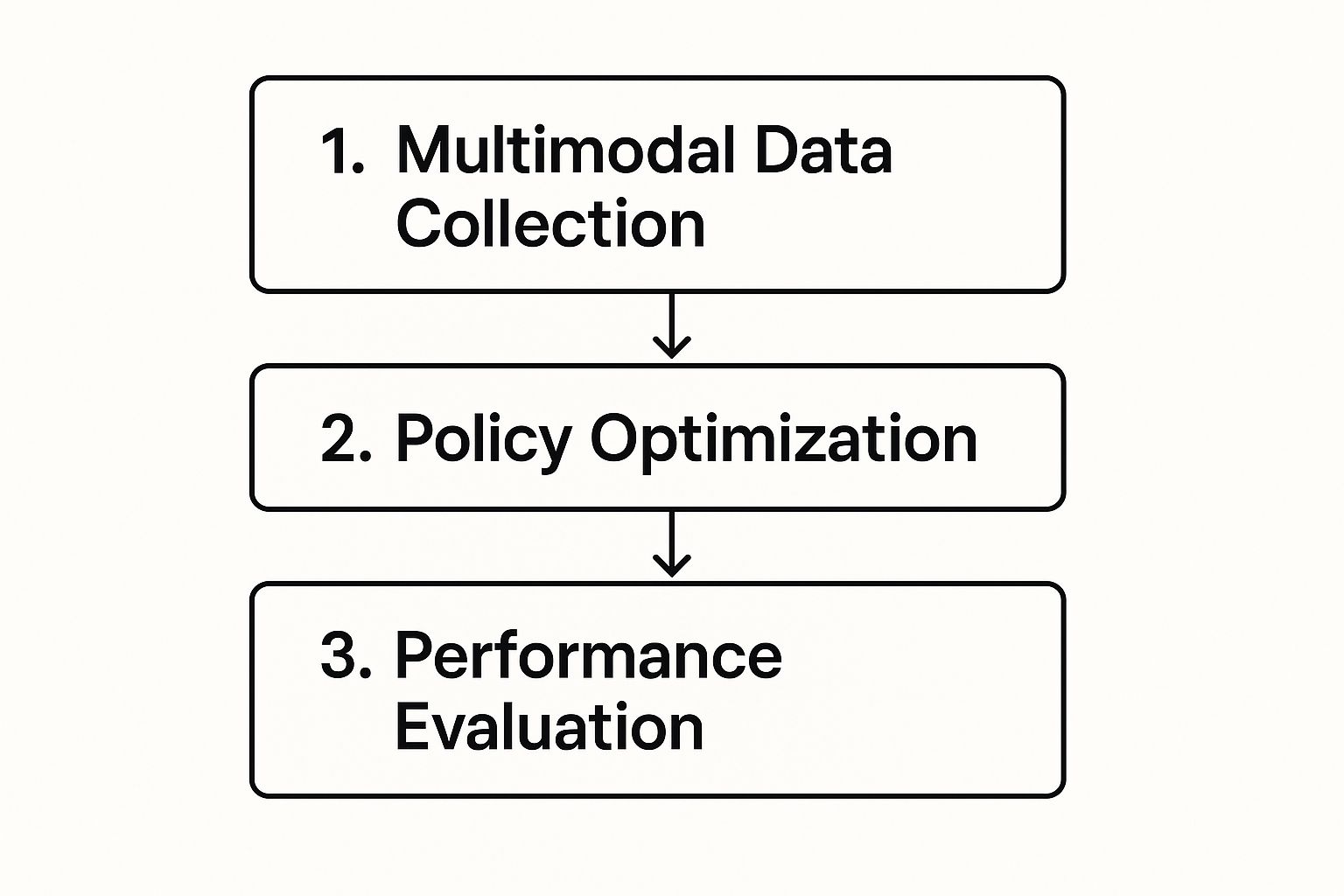
This process highlights a cyclical learning method where the agent's performance is constantly evaluated and fed back into the system to optimize its policy. This ensures it gets progressively better at handling the messy, unpredictable nature of real-world scenarios.
Real-World Applications of Multimodal RL
This isn't just theory anymore. The combination of multimodal perception and reinforcement learning is actively solving tough, real-world problems across a bunch of industries. We're moving past simple automation and building systems that can learn from messy, unpredictable environments in ways we couldn't before. From smarter robots to personalized medicine, the applications are here and they're growing fast.
And the market is noticing. The global multimodal AI market was valued at USD 1.83 billion recently, but it's expected to rocket to USD 42.38 billion by 2034. That's a compound annual growth rate of nearly 36.92%, driven by huge demand in sectors like automotive and healthcare. If you want to dig into the numbers, you can read the full research on multimodal AI adoption.
Advanced Robotics and Automation
Robotics is one of the coolest places to see Multimodal AI & Reinforcement Learning in action. Think about a warehouse robot picking and packing items. An old-school, programmed robot would grind to a halt if something was out of place. But a multimodal RL agent? It thrives on that kind of chaos.
It uses computer vision to see an object's shape and size, while its gripper's tactile sensors give it data on texture and fragility. The RL model then learns by doing—getting rewarded for successful, gentle grabs and penalized for dropping or crushing things.
Practical Example: An e-commerce warehouse robot faces a bin of mixed items. It sees a fragile lightbulb (vision) and uses its tactile sensors to determine the right pressure. It gets a +10 reward for a successful pick-and-place. If it drops the bulb (-50 reward), it learns to adjust its grip strategy for similar items in the future.
This constant feedback loop lets the robot build a nuanced strategy. It figures out that a glass vase needs a different touch than a cardboard box or a soft bag of chips, all without a human explicitly coding rules for every single item.
Personalized Healthcare and Diagnostics
In healthcare, multimodal RL is paving the way for truly personalized patient care. Imagine an AI assistant helping oncologists create treatment plans. This system could digest a massive amount of patient data from different sources:
- Imaging Data: Sifting through CT scans, MRIs, and X-rays (vision) to spot tumor characteristics.
- Clinical Notes: Parsing doctors' notes and patient histories from electronic health records (text).
- Genomic Data: Factoring in genetic markers and biomarker information (structured data).
- Verbal Descriptions: Listening to a patient's own description of their symptoms and how they're feeling (audio).
The RL agent can then suggest a treatment path—chemo, radiation, immunotherapy—based on a complete picture of the patient. The "reward" is the patient's outcome over time, like tumor shrinkage or better quality of life. As the model sees more patient journeys, it fine-tunes its recommendations, helping doctors make smarter, more individualized decisions. We cover more scenarios like this in our detailed article on examples of multimodal learning.
Human-Computer Interaction
The way we talk to our devices is also getting a major upgrade. Virtual assistants are becoming much more than just voice-activated speakers. A multimodal RL agent can create a truly interactive experience by picking up on a user's intent from multiple cues at once.
For instance, you might point at a smart display (vision) while saying, "Add that to my shopping list" (audio). The system fuses these two inputs to figure out what "that" is. The RL part learns from your corrections. If it gets it wrong and you fix it, that's a negative reward, and the agent adjusts its approach for next time. This makes the conversation between human and machine feel fluid and natural, setting the stage for AI companions that are genuinely helpful.
These examples just scratch the surface. Multimodal RL is being applied in many different fields to solve very specific, high-stakes problems.
Here’s a quick look at how various industries are putting this technology to work:
Multimodal RL Applications Across Industries
| Industry | Application Example | Data Modalities Used | RL Goal |
|---|---|---|---|
| Automotive | Autonomous Driving | Vision (cameras), LiDAR (3D maps), Audio (sirens) | Learn safe driving policies in complex urban environments. |
| Finance | Algorithmic Trading | Text (news), Audio (earnings calls), Market Data | Maximize returns by learning optimal trading strategies. |
| Retail | Smart Checkout Systems | Vision (product ID), Text (user commands), Audio (voice) | Improve checkout accuracy and reduce friction for shoppers. |
| Gaming | NPC Behavior | Vision (game state), Audio (player speech), Text (chat) | Create realistic, adaptive non-player characters. |
As you can see, the core idea is always the same: combine different data streams to give the reinforcement learning agent a richer, more complete understanding of its environment, which allows it to learn more complex and effective behaviors.
Future Challenges and Emerging Trends
As exciting as the fusion of multimodal perception and reinforcement learning is, building these systems is no walk in the park. We’re still facing some serious hurdles on the path toward a truly generalized AI. Researchers and engineers are tackling these head-on, and their work is setting the stage for the next big breakthroughs.
One of the biggest roadblocks is simply the massive amount of computation needed. Training these models requires a staggering level of processing power and enormous, high-quality datasets. This makes the whole process incredibly resource-heavy and expensive.
This is where solid AI model management becomes non-negotiable for optimizing these complex training pipelines. We actually dive deep into this topic in our guide on managing AI models at scale.
Another tricky issue is data synchronization. For an AI to learn properly, it has to perfectly line up different streams of data. Think about matching the exact video frame of someone speaking with the corresponding sound bite. Even a tiny mismatch can throw the model off, leading to bad decisions.
The Credit Assignment Puzzle
Maybe the most complex challenge of all is what’s known as the credit assignment problem. When an agent tries a complex task and either succeeds or fails, how do we figure out which specific piece of information was the reason? Was it a visual cue, a bit of text, or a sensor reading that made the difference?
Picture a robot trying to navigate a cluttered room. If it makes it to the other side, did it succeed because it saw an obstacle, felt a change in the floor’s texture, or heard a warning sound? Pinpointing that one critical input is a huge puzzle that the field is actively trying to solve.
Actionable Insight: Cracking the credit assignment problem is the key to building more reliable and explainable AI. Once we can trace a decision back to its source data, we can debug, refine, and ultimately trust these autonomous systems to a much greater degree.
Emerging Trends Shaping the Future
Despite the roadblocks, the future of Multimodal AI & Reinforcement Learning looks incredibly bright. Several exciting trends are already taking shape on the horizon.
- Integration with Large Language Models (LLMs): We’re going to see future systems use LLMs for more than just text. They’ll inject a layer of common-sense reasoning into the decision-making loop. An agent won't just see a "wet floor" sign; it will understand the implied danger—the risk of slipping—and actually change its path.
- Hyper-Efficient Models: There’s a huge push to create smaller, leaner models that can run directly on edge devices like your smartphone or a pair of smart glasses. This move will unlock real-time, on-device multimodal processing, cutting the cord to the cloud.
- Improved Generalization: The holy grail is creating agents that can take what they learned in one area and apply it to a totally new one. Imagine an AI that masters cooking in a simulated kitchen and then uses that core understanding to assist in a real-world laboratory. That’s the kind of true, adaptive intelligence we’re moving toward.
Frequently Asked Questions
Alright, let's wrap up with some quick answers to the questions that usually pop up when people start digging into Multimodal AI and Reinforcement Learning.
What's the Real Payoff of Combining These Two?
The biggest win is creating AI that's far smarter and more adaptable in messy, real-world situations. By giving an agent the ability to process multiple streams of information at once—like video, sound, and text—it develops a much richer, almost human-like grasp of its environment.
This holistic understanding is what allows it to make better judgment calls. In many complex scenarios, just having one sense, like vision alone, simply isn't enough to figure out the right move.
How Hard Is It to Actually Build a Multimodal RL System?
I won't sugarcoat it: building one of these systems is a serious undertaking. It’s tough, expensive, and requires a high level of expertise across several different domains, from fusing tricky data types to designing monster neural network architectures.
Actionable Insight: One of the gnarliest problems is just defining a good reward function. How do you teach an AI what "success" looks like in a subtle, nuanced task? It's far from simple. On top of that, you have to nail the data synchronization and get your hands on some serious computing power for training.
Is This Tech Just for Big Robotics Projects?
While it gets a lot of press for its use in massive systems like self-driving cars and factory robots, the core ideas are surprisingly flexible. You'll find the same principles powering smaller-scale applications, some of which you might interact with every day.
For example, this technology is already at work in:
- Smarter Virtual Assistants that combine your voice commands with what's on your screen to grasp your intent more accurately.
- Interactive Educational Software that adjusts how it teaches based on a student's gaze, mouse clicks, and typed responses.
- Advanced Accessibility Tools that interpret a mix of environmental cues to help users navigate their surroundings more effectively.
At DATA-NIZANT, we're all about breaking down the complex world of AI into clear, actionable insights. To keep leveling up your data science and machine learning skills, check out our in-depth articles and guides at https://www.datanizant.com.