

So, what is AI model management, really? At its heart, it’s the strategic process for handling an AI model’s entire journey—from the first line of code to its eventual retirement. Think of it like managing a professional sports team. You don’t just scout talented players and throw them onto the field; you have to continuously track their performance, monitor their health, and adapt your strategy to make sure the team keeps winning.
This structured approach is what separates a successful AI initiative from a failed one. It provides the framework needed to maximize the business value your models deliver.
What Is AI Model Management Really About?
AI model management is a disciplined system for overseeing the complete lifecycle of machine learning models. It’s far more than a technical checklist for data scientists; it’s a core business strategy that ensures your AI investments are reliable, compliant, and consistently adding value. Without it, even the most brilliant models can turn into liabilities almost overnight.
Let’s take a common example: a model built to predict customer churn. When you first deploy it, the predictions are spot-on. But over time, customer behaviors change, new market trends emerge, and the data it was trained on goes stale. Suddenly, the model’s predictions start to miss the mark. This is a classic case of model drift.
Proper model management gives you the tools to spot this decay early, automatically trigger retraining with fresh data, and deploy an updated version before it ever hurts your bottom line.
Why It’s More Than Just MLOps
People often lump AI model management in with MLOps (Machine Learning Operations), but they aren’t the same thing. While they’re closely related, MLOps is really about the “how”—automating the pipelines that build, test, and deploy models. It’s the engine room.
AI model management, on the other hand, deals with the “what” and the “why.” It covers the bigger picture, including governance, risk assessment, and making sure every model aligns with your business goals. These are the elements that matter most when you’re scaling AI across an enterprise.
This distinction is becoming more important as companies pour massive resources into AI. The market for AI in data management was recently valued at around $34.76 billion and is expected to jump to $43.85 billion in the next year. You can dig into the complete market analysis on AI in data management for a deeper dive, but the takeaway is clear: this level of investment demands a structured management strategy to secure a return.
A model is not a one-time project; it is a living asset that requires continuous oversight. AI model management provides the structure to treat models like critical business infrastructure, ensuring they are governed, secure, and performant throughout their operational life.
Core Pillars of AI Model Management
A robust AI model management strategy is built on several key pillars. These functions work together to create a reliable and scalable AI ecosystem, ensuring every model is not just technically sound but also aligned with business objectives and regulatory rules.
Here’s a quick look at the essential functions that make up a strong model management strategy.
| Pillar | Core Function | Business Impact |
|---|---|---|
| Versioning | Tracking every iteration of models, data, and code. | Ensures reproducibility, provides a clear audit trail, and simplifies rollbacks. |
| Monitoring | Continuously tracking live model performance and health. | Catches performance decay and data drift before they cause business harm. |
| Governance | Defining rules for access, deployment, and risk. | Maintains compliance, reduces risk, and aligns AI with company policies. |
| Lifecycle Automation | Automating the build, test, and deploy pipeline (MLOps). | Speeds up time-to-market for new models and reduces manual errors. |
| Model Registry | A central repository for all approved and production models. | Creates a single source of truth and improves collaboration between teams. |
These pillars aren’t just separate tasks; they’re interconnected parts of a unified system designed to manage your AI assets effectively from start to finish. Let’s break down a few of the most important ones.
The Core Pillars of a Strong Strategy
A solid model management strategy rests on a few non-negotiable functions. They work in tandem to keep your AI ecosystem reliable, scalable, and fully aligned with what the business needs.
- Versioning: This is all about keeping a meticulous record of every version of your models. That includes the code, the exact dataset it was trained on, and all the parameters used to build it. It’s the only way to guarantee you can reproduce a result or trace a decision back to its source.
- Monitoring: Once a model is live, you can’t just set it and forget it. Constant monitoring is a must. This pillar involves tracking key metrics like accuracy, latency, and fairness to catch any performance issues before they snowball.
- Governance: Governance sets the rules of the road. It defines who is allowed to access, change, or deploy models. This is what ensures all your AI activities follow internal policies and, just as importantly, external regulations.
The Journey of a Successful AI Model
Every great AI model follows a predictable path, a structured journey that takes it from a promising idea to a reliable business asset. This isn’t a chaotic sprint; it’s a well-managed lifecycle with distinct stages. Think of AI model management as the map and compass for this journey, ensuring a model delivers value from day one until it’s time to retire.
It’s a lot like building a commercial aircraft. You don’t just bolt the parts together and hope it flies. There are rigorous design, testing, and certification phases before it ever carries passengers. Afterward, it requires continuous maintenance and is eventually decommissioned. A model’s lifecycle demands that same kind of discipline.
Stage 1: Development and Experimentation
The journey always starts in the lab. This is where data science teams play, exploring ideas and building the first prototypes. This phase is all about experimentation.
Teams will test out different algorithms, try various feature engineering techniques, and shuffle through training datasets to find a combination that actually shows promise. A key activity here is experiment tracking. Every single test—the code, the data version, the performance metrics—gets logged. This creates a detailed history, preventing teams from repeating mistakes and letting them build on what worked. Without it, you’re just fumbling in the dark.
Stage 2: Validation and Testing
Once a model looks like a winner, it moves into a tough validation phase. Here, the model is put under a microscope to make sure it’s not just accurate but also fair, robust, and truly ready for the real world. This is the critical quality assurance step before you even think about going live.
Validation goes way beyond a simple accuracy check. Key activities include:
- Bias and Fairness Audits: We test the model against different demographic segments to ensure its predictions aren’t systematically skewed against any group.
- Performance Stress Testing: The model gets hit with unusual or even adversarial data to see how it holds up under pressure and find its breaking points.
- Business KPI Alignment: People from the business side confirm that the model’s outputs will actually move the needle on business goals, not just produce a high score on a spreadsheet.
Only the models that ace these comprehensive checks get the green light for deployment.
Stage 3: Deployment and Integration
With validation complete, the model is ready for the production environment. But deploying a new model isn’t as simple as flipping a switch. A sudden, full-scale rollout is incredibly risky. Instead, teams use careful deployment strategies to keep any potential disruption to a minimum.
A model is only valuable when it’s running in production and making decisions. But a poorly managed deployment can do more harm than good. The goal is to get the model live safely and efficiently.
Some of the most common deployment strategies are:
- Canary Releases: The new model is rolled out to a tiny fraction of users, maybe 5%. The team watches its performance like a hawk in this small-scale environment before gradually giving it more traffic.
- A/B Testing: The new model runs side-by-side with the old one (or a control group), and their results are compared in real-time on live traffic. This data-driven approach proves which model is truly better.
This stage is a huge part of MLOps, connecting the world of development with the realities of operations.
Stage 4: Monitoring and Maintenance
Deployment is just the start of a model’s life, not the end of its journey. Out in the wild, data patterns change, and a model’s performance can degrade over time. This phenomenon is known as model drift, and continuous monitoring is the only way to catch it.
This infographic shows just how important it is to have a structured process for managing different model versions as they’re updated.
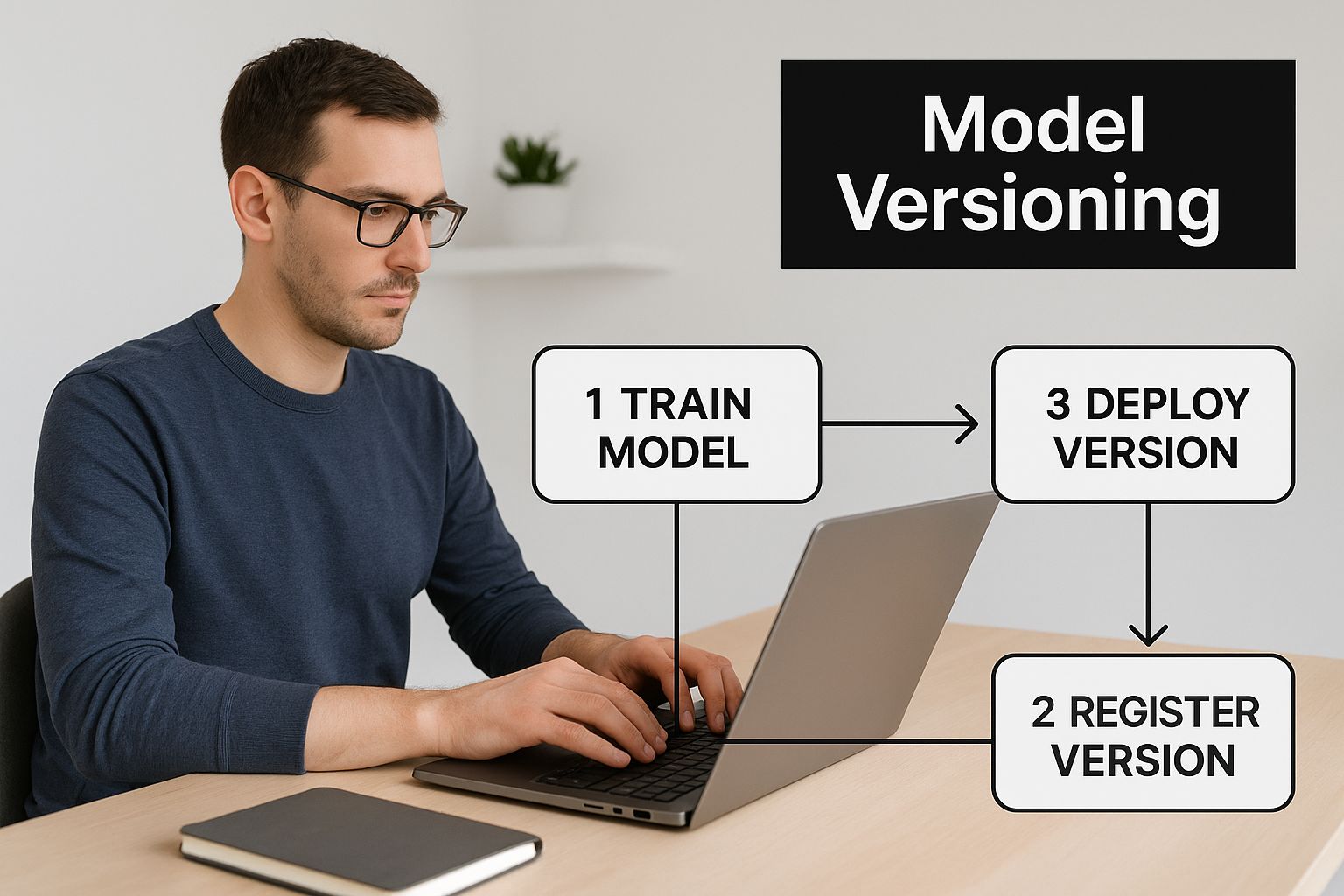
As the image shows, developers use versioning—a key part of AI model management—to keep track of updates and maintain stability. If monitoring reveals a performance dip, a newly retrained version is deployed, and the old one is archived. This cycle of monitoring, retraining, and redeploying is what keeps a model successful long-term.
Stage 5: Retirement
Sooner or later, every model reaches the end of its useful life. Maybe a better model came along, or perhaps the business problem it solved isn’t relevant anymore. When that happens, the model needs to be formally retired.
This is a planned process. It involves carefully decommissioning the model from production systems, archiving all its assets (like code, data, and documentation) for future audits, and letting all stakeholders know about the change. Proper retirement ensures a clean transition and prevents “zombie models” from sticking around, consuming resources without providing any real value.
How Versioning and Governance Build Trust
For AI to become a reliable, scalable part of your business, it needs a strong foundation of trust. But this trust isn’t built on promises; it’s built on two core operational pillars of AI model management: rigorous versioning and clear governance. Together, these elements transform AI from a high-tech experiment into a dependable, enterprise-ready system.
Think of it like the detailed batch records a pharmaceutical company keeps for a drug. It’s not enough to just have the final formula. You have to be able to trace every single ingredient, every procedural step, and every quality test result back to its origin. In AI, this means versioning is so much more than just tracking code changes.
True model versioning creates a complete, auditable snapshot. This isn’t just the model artifact—it’s also the exact training dataset, the specific hyperparameters, and its performance metrics. This complete record is the absolute bedrock of reproducibility.
The Power of Perfect Recall with Versioning
Imagine a model in production suddenly starts making bad predictions. Without versioning, your team is left scrambling, trying to diagnose a black box. But with a solid versioning system, you can instantly roll back to a previously stable version while you calmly investigate the problem.
This capability is essential for troubleshooting and accountability. A comprehensive version history allows teams to answer critical questions with total certainty:
- What data was this model trained on? This is your first stop for identifying if data drift or a corrupted dataset is the culprit.
- What were the exact parameters? Reproducing the model becomes a straightforward task, not a frantic treasure hunt.
- How did this version perform in validation? This allows you to compare what’s happening in production against your benchmark tests.
This level of detail means that when a problem pops up, you have a clear path to fix it, maintaining system stability and keeping the business running smoothly.
Without versioning, you don’t just lose track of your models; you lose the ability to trust their outputs. It provides the historical context necessary for debugging, auditing, and continuous improvement.
Establishing the Rules with Governance
While versioning tells you the “what” and “when,” governance provides the “who” and “how.” It’s the framework of rules, policies, and controls that dictates how AI models are developed, deployed, and used across your entire organization. This is where AI model management connects directly with legal, risk, and ethical considerations.
A strong governance policy isn’t about slowing down innovation—it’s about enabling it safely and responsibly. It defines clear ownership, sets up approval workflows, and establishes firm standards for ethical AI use.
Why Governance Is Non-Negotiable
Effective AI governance isn’t just a “nice to have”; it solves critical business needs. It shifts the responsibility for AI outcomes from an isolated data science team to a cross-functional group of stakeholders that includes legal, compliance, and business leaders.
This collaborative approach is vital for managing key risks:
- Access Control: Governance implements role-based access control (RBAC), making sure only authorized people can deploy or modify production models. This prevents both accidental changes and malicious activity.
- Regulatory Compliance: With regulations like the EU AI Act on the horizon, organizations must be able to prove their AI systems are fair, transparent, and accountable. Governance provides the documented proof you need for audits.
- Ethical Oversight: A core function of governance is to spot and reduce bias to ensure fairness. By establishing clear guidelines, it helps teams proactively tackle ethical issues. For instance, you can learn more about how to address the bias-variance tradeoff in our detailed guide on the topic.
Together, versioning and governance form a powerful duo. Versioning gives you the technical evidence, and governance provides the operational rulebook. This one-two punch builds the institutional confidence needed to scale AI from isolated projects into a core part of your business strategy, ensuring every model is not just effective, but completely trustworthy.
Choosing Your AI Model Management Toolkit

The right tools can absolutely make or break your AI strategy. Picking a toolkit for AI model management feels a lot like choosing a vehicle for a cross-country road trip. A zippy sports car sounds fun, but if you’re hauling a family and luggage, you really need an SUV—something with more space, features, and reliability for the long haul.
It’s the same with your AI tools. The best choice depends entirely on your team’s size, technical skills, and what you’re trying to accomplish. The market is flooded with options, from lightweight open-source libraries to massive, all-in-one cloud platforms. The key is to understand their core philosophies before you make a decision.
Understanding the Tool Categories
The landscape of AI model management tools can be broken down into a few main categories. Each one serves a different purpose and fits different stages of an organization’s AI journey.
- Model Registries: Think of these as the foundation. A model registry is your central library or catalog for every model you build, keeping track of versions, metadata, and all the associated files.
- Monitoring Solutions: These tools are the watchdogs for your models in production. They keep an eye on performance, detect drift, and send up a flare when a model’s accuracy starts to slip.
- All-in-One MLOps Platforms: These are the comprehensive, end-to-end solutions. They aim to cover the entire model lifecycle, from development and deployment all the way through to monitoring and governance.
Many teams start with a simple model registry and bolt on specialized monitoring tools as their needs evolve. Others, facing more complex requirements right out of the gate, might go for an integrated platform from day one.
Your choice of tools should be driven by the problems you need to solve today, while offering a clear path to meet the challenges of tomorrow. Don’t buy a complex platform if all you need right now is a simple versioning system.
Open-Source vs Managed Cloud Solutions
One of the biggest forks in the road is deciding between open-source tools and proprietary, managed solutions from the big cloud providers. Each path has clear pros and cons.
Open-source tools like MLflow or DVC (Data Version Control) give you incredible flexibility and are free to use. They’re a fantastic choice for teams that crave deep customization and want to avoid being locked into a single vendor’s ecosystem. The trade-off? They require more in-house expertise to set up, maintain, and stitch together into a working pipeline.
On the other side of the coin, you have comprehensive cloud platforms like AWS SageMaker, Google Vertex AI, and Azure Machine Learning. These services offer a much more integrated and managed experience, bundling registries, monitoring, and deployment pipelines into a single package. This can seriously cut down your time to market, but that convenience comes with a price tag and can tie you more closely to one cloud ecosystem.
The growth of these platforms has been massive. North America, for example, is a major force in the AI management space, with tech giants like Amazon, Google, and Microsoft pouring huge investments into their platforms to support large-scale AI. You can dig deeper into the global AI market dynamics and regional leadership on Precedence Research.
Comparison of AI Model Management Tool Categories
To make sense of the options, it helps to see them side-by-side. This table offers a high-level look at the different tool categories to help you figure out where to start your search.
| Tool Category | Key Features | Best For | Example Platforms |
|---|---|---|---|
| Model Registries | Centralized model storage, versioning, artifact tracking, metadata management. | Teams starting with MLOps, needing a “single source of truth” for models. | MLflow, DVC, Comet ML |
| Monitoring Solutions | Production performance tracking, data drift detection, concept drift alerts, explainability. | Organizations with models in production that need proactive oversight and maintenance. | Fiddler AI, Arize, WhyLabs |
| All-in-One MLOps Platforms | End-to-end lifecycle management, integrated CI/CD, automated workflows, governance. | Mature AI teams and enterprises managing a large portfolio of models at scale. | AWS SageMaker, Google Vertex AI, Azure Machine Learning |
Ultimately, the goal isn’t just to pick a tool, but to build a cohesive stack that supports your team’s workflow from start to finish.
A Framework for Making Your Decision
So, how do you decide what’s right for you? It’s not about finding the “best” tool, but the best fit. Use these factors as your guide:
- Team Size and Skillset: Is your team small and agile, or large and specialized? A smaller team might lean toward a managed platform for its simplicity, while a bigger team may have the bandwidth to build a custom stack with open-source tools. For instance, teams working on advanced models will have specific needs, and you can learn how to fine-tune LLMs in our related guide to see what’s involved.
- Budget and Cost: Think beyond just the subscription fees. You also need to factor in the operational cost—the time and people—required to maintain an open-source solution.
- Scale and Complexity: How many models are you dealing with? A handful can be managed with simpler tools. But if you have hundreds or thousands in production, you’ll need a platform built for that kind of scale.
- Integration Needs: How well does the tool play with others? Before you commit, make sure it can easily connect to your existing data warehouses, BI tools, and CI/CD pipelines.
The real goal is to choose a toolkit that empowers your team, not one that adds another layer of complexity. Start by identifying your most urgent pain point—whether it’s versioning chaos or a total lack of production visibility—and pick a tool that solves it well. You can always expand your toolset as your AI practice grows up.
How to Prevent AI Model Performance Drift
Getting a model into production isn’t the finish line; it’s the starting line. Over time, even the sharpest, most accurate models can lose their edge as the real world shifts around them. This slow decay in performance, known as model drift, is one of the biggest hidden risks in any AI project.
Think of a brand-new weather forecasting app. When it first launched, it was trained on years of historical weather data, and its predictions were spot-on. But what happens after a few years of changing climate patterns? The old data no longer reflects the new reality, and the app’s forecasts get less and less reliable. This is exactly what happens to AI models.
Understanding Data Drift and Concept Drift
This performance decay usually comes from two related problems: data drift and concept drift. They might sound similar, but they’re distinct issues that demand different solutions.
-
Data Drift: This happens when the live data being fed into your model starts to look statistically different from the data it was trained on. For instance, a fraud detection model trained on transaction data from 2021 might start to struggle in 2024 because customer spending habits and fraudster tactics have evolved. The model’s logic is still sound, but the input data has changed.
-
Concept Drift: This is a more fundamental problem where the very relationship between the inputs and the output has changed. In our weather app example, this would be like a shift in atmospheric physics itself. The patterns that once reliably predicted rain no longer hold true.
Both types of drift are silent killers of ROI. The only way to catch them before they turn a valuable asset into a hidden liability is through proactive monitoring.
Proactive Monitoring Strategies
Effective AI model management is built on a solid monitoring framework. You can’t just check performance metrics once a quarter and call it a day. You need continuous, automated oversight that acts as an early warning system.
A model that isn’t monitored is a model you can’t trust. Setting up automated alerts is like installing a smoke detector—it alerts you to a small problem before it becomes a business-wide fire.
Your monitoring strategy should track a few critical areas:
-
Prediction Accuracy: This is the most obvious one. How often is the model getting things right? You need to constantly track metrics like precision, recall, and F1-score. When these numbers dip below a predefined threshold, it’s a clear signal that something is off. For a deeper dive, check out our guide on essential LLM evaluation metrics.
-
Data Quality and Integrity: Keep a close eye on incoming data for signs of drift. This means tracking the statistical distribution of features, watching for an increase in missing values, or spotting changes in data types. If the new data doesn’t match the training data’s profile, the model’s predictions will inevitably suffer.
-
Operational Health: Don’t forget the technical side. Monitor performance metrics like latency (how fast the model responds) and throughput (how many predictions it can handle). A sudden spike in latency could point to an issue with the underlying infrastructure, not the model itself.
Given the explosive growth in AI, these practices are no longer optional. The global artificial intelligence (AI) market is on a remarkable path, with its size estimated at around $391 billion. Projections show the market surging to nearly $1.81 trillion by 2030, a growth fueled by sophisticated management and deployment techniques. You can explore more AI statistics and market insights to grasp the sheer scale of this expansion.
Setting Up a Retraining Protocol
When your monitoring system flags a problem, you need a clear, pre-defined plan. Don’t wait for a crisis to figure out what to do. A solid retraining protocol should be as automated as possible.
This protocol needs to define the exact triggers for retraining a model. For example, you could set a rule: if model accuracy drops by 5% for three consecutive days, an automated workflow kicks off. This workflow would pull fresh data, retrain the model, validate its performance against the old one, and—only if it proves superior—deploy the new version into production.
Common AI Model Management Questions
As teams start to get their hands dirty with artificial intelligence, the practical questions quickly pile up. The world of AI model management can feel like a maze at first, but once you grasp the core ideas, the path forward becomes much clearer. Let’s tackle some of the most common questions we hear from teams, with straightforward answers to help shape your strategy.
These aren’t just abstract problems; they are the real-world roadblocks that can make or break an AI initiative. Getting these fundamentals right from the beginning builds a solid foundation for everything you hope to achieve later on.
Where Should We Start with AI Model Management?
The single most impactful place to begin is with a model registry. Before you build the factory, you need an organized warehouse for your parts. That’s what a registry is—it’s the foundational step that brings instant order to what can otherwise become a chaotic mess.
A model registry is a central, version-controlled repository. It becomes the single source of truth for every approved model, all its different versions, and the critical metadata tied to each one. This simple act of organization makes everything that follows—from deployment to monitoring—dramatically simpler.
Once your models have a home in a registry, you can start layering on more sophisticated capabilities. This progressive approach is far more realistic than trying to boil the ocean by implementing a massive, end-to-end platform from day one. Start with organization, then build toward automation and oversight.
How Often Should We Retrain Our AI Models?
There’s no magic number here. The most important thing is to let your model’s real-world performance drive the decision, not a date on the calendar. The absolute worst thing you can do is retrain models on a fixed schedule, like the first Monday of every month. It’s wildly inefficient and completely disconnected from actual business needs.
A much smarter approach is to establish robust monitoring for both model drift and data drift. By tracking key performance indicators—like accuracy, precision, or fairness—in real time, you can set specific performance thresholds.
Your trigger for retraining should be a measurable dip in performance, not a calendar reminder. This data-driven approach ensures you only spend time and money on retraining when it’s genuinely needed to preserve business value.
For instance, you could set up an automated alert that fires whenever a model’s F1-score drops below 92% for more than 48 hours. That alert could then kick off a retraining pipeline using a fresh batch of data. This is not only more efficient but also ensures your models stay effective when it matters most.
How Do We Manage Model Security and Access Control?
You have to start treating your AI models like the critical IT assets they are. You wouldn’t let just anyone access your company’s financial databases, right? The same logic applies here. The gold standard for this is implementing Role-Based Access Control (RBAC).
RBAC lets you create specific, granular permissions that dictate exactly who can view, test, deploy, or even retire a model. These policies should be enforced by your central model registry, which effectively acts as the gatekeeper.
Here’s what that looks like in practice:
- Data Scientists might have permission to upload new model candidates to a staging environment.
- ML Engineers get the green light to promote a validated model from staging into the live production environment.
- Business Analysts could be granted view-only access to performance dashboards, but have no ability to alter the model itself.
This separation of duties is crucial. It doesn’t just prevent unauthorized changes or accidental deployments; it also creates a clear, immutable audit trail. Every action, from a version update to a production push, is logged and tied to a specific user. This gives you full accountability and is a lifesaver during regulatory audits.
Is AI Model Management the Same as AI Governance?
This is a really common point of confusion, but the answer is no. They are definitely related, but one is a component of the other.
Think of it this way: AI model management is the technical discipline of handling the model lifecycle. It’s the hands-on work of building, versioning, deploying, and monitoring. It’s a core piece of MLOps.
AI governance, on the other hand, is a much broader business function. It deals with the policies, ethics, risk management, and compliance frameworks that guide how AI is used across the entire organization. Governance asks the bigger-picture questions:
- Is this use of AI fair and ethical?
- Does our model comply with regulations like GDPR, CCPA, or the EU AI Act?
- If the model makes a harmful decision, who is ultimately accountable?
In short, model management is about making sure the model works correctly. Governance is about making sure the model is used correctly and responsibly. You absolutely need both working together to have a successful and sustainable AI strategy.
At DATA-NIZANT, we provide the in-depth knowledge you need to master complex topics like these. Our expert-authored articles and analyses help you build and manage effective, responsible AI systems. Explore our insights today at https://www.datanizant.com.