

Let’s be honest, “AI” can feel like an overused buzzword. But when we talk about AI business solutions, we’re not talking about science fiction. We’re talking about practical, powerful digital tools that businesses are using right now to get ahead.
Think of it this way: what if you had a team that could work 24/7, make sense of millions of data points in seconds, and anticipate what your customers want before they even know it themselves? That’s the real-world value these solutions bring to the table. They are the engine behind smarter supply chains, hyper-personalized marketing, and radically more efficient operations.
How AI Is Redefining Business Success
For years, AI was something discussed in tech labs and boardroom presentations. Now, it’s a real-world asset that’s become essential for staying competitive, no matter your industry. The focus has decisively shifted from what AI is to what AI can actually do for my business.
This isn’t just a trend; it’s a massive economic shift. The market is exploding as more and more organizations see the tangible results.
The global artificial intelligence market was valued at approximately USD 638.23 billion in 2024. It’s projected to climb to an incredible USD 3,680.47 billion by 2034, growing at a compound annual growth rate (CAGR) of 19.20%.
That kind of growth isn’t fueled by hype. It’s driven by companies making smart investments and seeing measurable returns in productivity, innovation, and customer loyalty. You can dig into the full market forecast to get a sense of just how big this opportunity is.
What’s Powering This Shift?
So, how did AI go from a futuristic concept to a must-have business tool? It’s really a perfect storm of a few key developments coming together.
- A Flood of Data: Businesses today are swimming in data. Every click, sale, and interaction provides the raw material that AI algorithms need to learn, adapt, and become incredibly smart.
- Accessible Supercomputing: Not long ago, the computing power needed for serious AI was wildly expensive. Thanks to the cloud, that power is now affordable and available on demand, allowing even smaller companies to run sophisticated AI models.
- Democratized Tools: You no longer need a PhD in data science to get started. The rise of “low-code” and “no-code” AI platforms means that people with deep business knowledge—not just technical experts—can build and deploy powerful solutions.
This evolution is a theme we’ve touched on before, especially when looking at the synergy between cloud computing and data analytics. The core idea is simple: technology is most powerful when it becomes practical. As we move forward, we’ll see exactly how these foundational elements empower specific AI business solutions to reinvent core operations and unlock brand-new paths to growth.
Finding The Right AI Solution For Your Company

Choosing the right AI business solution feels a lot like outfitting a specialized workshop. You wouldn’t use a sledgehammer to fix a watch, right? In the same way, different AI tools are built to solve very different business problems. The trick is to stop thinking about “AI” as a single monolith and start pinpointing the specific capability your business actually needs.
Getting this right is more critical than ever, especially as the market floods with new options. The global AI software market is projected to rocket past USD 126 billion by 2025—a staggering leap from just USD 10.1 billion in 2018. Looking at the bigger picture, the total AI market is on track to climb from nearly USD 400 billion in 2025 to an incredible USD 1.81 trillion by 2030.
To help you navigate this space and make a smart investment, let’s break down the AI landscape into four fundamental pillars. Each represents a distinct category of tools designed for a specific job.
To give you a quick overview, here’s a table summarizing how these AI categories map to business functions.
Types of AI Business Solutions and Their Impact
| AI Solution Category | Primary Business Function | Example Use Case |
|---|---|---|
| AI for Automation | Operational Efficiency | Automating invoice processing and data entry. |
| AI for Analytics | Strategic Insights | Forecasting customer churn based on behavior. |
| AI for Customer Engagement | Customer Experience | Powering 24/7 chatbots for instant support. |
| Generative AI | Content & Product Creation | Generating marketing copy or product mockups. |
Each of these pillars offers a unique way to enhance your operations, and understanding the differences is the first step toward finding the right fit.
AI For Automation
Think of this as your new efficiency expert, working 24/7. AI for Automation is all about taking over the repetitive, rule-based, and frankly, tedious tasks that drain your team’s time and energy. Its goal is to free up your people to focus on strategic, creative work where their human ingenuity truly shines.
A perfect example is robotic process automation (RPA). Here, software “bots” mimic human actions to perform tasks like data entry, processing invoices, or pulling together standard reports. By handing these workflows over to bots, businesses can slash errors, accelerate processes, and drive down operational costs.
AI For Analytics
If automation is about doing things faster, AI for Analytics is about thinking things smarter. This type of AI dives deep into massive datasets to spot patterns, correlations, and predictive insights that a human analyst could never uncover alone.
This is where AI graduates from a simple task-doer to a strategic advisor. It can forecast sales trends, identify which customers are about to leave, or optimize your supply chain to save on fuel.
Fueling this kind of analytical power requires a solid data infrastructure. Many companies discover that their journey into advanced analytics is closely linked with their strategy for cloud computing and data analytics.
AI For Customer Engagement
This category is focused on one thing: creating deeply personal and responsive customer interactions, but at scale. It’s the magic behind the curtain, powering the tools that make customers feel seen and understood.
- Chatbots and Virtual Assistants: These tools give customers instant answers to common questions, any time of day. This boosts satisfaction while taking a huge load off your human support agents.
- Recommendation Engines: By analyzing past behavior, these systems get spookily good at predicting what a customer might want next. It’s a direct path to higher sales and more engaged users.
- Personalization Platforms: These solutions tailor everything—website content, special offers, email campaigns—to individual user profiles, ensuring every touchpoint feels relevant.
Generative AI
The newest and most talked-about pillar is Generative AI. Unlike the other types of AI that analyze or act on existing data, Generative AI creates something brand new. Give it a prompt, and it can write a blog post, design an image, compose music, or even spit out functional code.
For businesses, this is a game-changer. It acts as a powerful co-pilot for human creativity, opening up incredible possibilities for rapid content creation, marketing campaigns, product design, and even software development. We have previously covered the importance of leveraging AI for talent acquisition and its ability to transform traditional business functions.
Real-World Examples Of AI Driving Results
Theory is great, but the real “aha!” moment with AI comes when you see it working in the wild. Let’s move past the concepts and dive into some compelling stories of how real companies are using AI to solve stubborn problems and get incredible results. These aren’t just hypotheticals; they show how specific challenges are being met with smart AI strategies.

Nowhere is the impact of AI more obvious than in retail and manufacturing, where every efficiency gain drops straight to the bottom line. The global AI market in manufacturing was already at USD 1.4 billion in 2020 and is on track to explode to USD 14.3 billion by 2027. Retail is seeing a similar gold rush: its AI market, valued at USD 11.83 billion in 2024, is forecast to hit USD 54.92 billion by 2033. It’s no wonder that 80% of retail executives plan to have AI automation in place by 2025.
Smarter Shelves and Happier Shoppers in Retail
A major retail chain was wrestling with a classic, billion-dollar headache: having too much of the wrong stuff and not enough of the right stuff. Stockouts on popular items meant lost sales and unhappy customers. Meanwhile, overstocked items gathered dust, forcing deep discounts that tanked their profits. Their old forecasting methods, which just looked at past sales, simply couldn’t predict sudden trends or local demand swings.
The fix? A sophisticated, AI-powered demand forecasting system. This was no simple crystal ball. The AI crunched a massive, constant stream of data, including:
- Social Media Buzz: Spotting products that were suddenly blowing up online.
- Weather Forecasts: Knowing to stock up on umbrellas before a rainy week or sunscreen before a heatwave.
- Competitor Sales: Adjusting stock when a rival launched a big promotion.
- Local Events: Planning for the surge in demand during regional holidays or festivals.
The results were stunning. The retailer slashed stockouts by over 30%, giving their sales a healthy lift. Even better, they cut way back on excess inventory, which meant less waste and much healthier profit margins.
Preventing Breakdowns with Predictive Maintenance
In the world of manufacturing, unplanned downtime is the enemy. When a critical machine on an assembly line suddenly dies, the whole operation can screech to a halt, costing a company hundreds of thousands of dollars per hour. One automotive parts maker was fed up with this reactive cycle of break-fix, break-fix.
They turned to a predictive maintenance AI solution. They started by outfitting their most important machinery with IoT sensors to constantly track data points like temperature, vibration patterns, and energy use.
This river of data was fed into a machine learning model. The model was trained to recognize the tiny, almost invisible signs that a machine gives off right before it fails. Think of it as an expert mechanic who can “hear” a problem developing long before it becomes a disaster.
The system would then flag a potential failure, telling the maintenance team exactly which part was at risk and roughly when it might give out. This allowed them to schedule repairs during planned downtime, completely avoiding catastrophic breakdowns. This simple shift from reactive to proactive maintenance chopped their unplanned downtime by nearly 50% and squeezed more life out of their very expensive equipment.
AI in the War on Financial Fraud
A large financial institution was in a constant, high-stakes battle against sophisticated fraud schemes. Their old, rule-based systems were too slow and rigid. They couldn’t catch complex fraud patterns in real time, and by the time they flagged a bad transaction, the money was usually gone for good.
To fight back, they brought in an AI-powered fraud detection platform. This system chews through millions of transactions every second, hunting for anomalies and patterns that don’t match a customer’s normal behavior. It can juggle hundreds of variables at once—a feat impossible for any human team.
For instance, the AI could instantly flag a transaction that was unusually large, made from a strange location, and happened at an odd time of day. When it spots a high-risk transaction, it’s blocked immediately, and an alert is sent for a human to review. This real-time defense has saved the bank millions in fraud losses while making their customers feel much more secure. This kind of advanced pattern recognition is also a game-changer in other fields, as we explore in our guide on using machine learning for recruitment.
Developing Your AI Implementation Roadmap
After seeing how other companies are getting real results, you’re probably eager to bring similar ai business solutions into your own shop. But moving from inspiration to execution demands a clear, deliberate plan. A smart AI strategy isn’t about chasing technology for its own sake; it’s about methodically solving a specific, high-value business problem.
This is where a roadmap comes in. It’s the crucial step that breaks down the big, intimidating goal of “implementing AI” into a series of manageable, logical actions. It ensures your first dive into AI is a calculated move designed for success, not just a costly experiment. A solid roadmap helps you get everyone on board, manage your resources wisely, and measure what actually matters right from the start.
Start With The Why
First things first: resist the urge to chase a shiny new tool. Seriously. The best place to start is by identifying a significant business challenge or a golden opportunity. Where are things creaking at the seams? Is it high customer churn, mind-numbing manual processes, or sales opportunities slipping through the cracks? Pinpoint a problem where a smarter, faster, or more predictive solution would make a real, tangible difference to your bottom line.
For example, instead of declaring, “We need an AI chatbot,” frame the problem. A much better starting point is, “Our customer support team is swamped, and slow response times are killing our customer satisfaction.” This problem-first approach ties your AI investment directly to a business outcome, making it far easier to justify and measure its success.
Assess Your Data Readiness
AI algorithms are incredibly powerful, but they are absolutely dependent on data. Think of data as the fuel for your AI engine—the quality of the fuel determines the performance of the engine. Your AI solution will only ever be as good as the data it learns from. Before you get too far ahead, you need to take an honest, hard look at your data situation.
Key Insight: Many AI projects don’t fail because the algorithm is bad. They fail because the underlying data is a complete mess. A successful rollout hinges on having clean, organized, and relevant data at your fingertips.
Ask yourself these critical questions:
- Is our data accessible? Is it locked away in disconnected silos, or can we actually pull it all together?
- Is our data clean? Or is it riddled with errors, duplicates, and missing values that would just confuse an algorithm?
- Is our data relevant? Are we even collecting the right information to solve the problem we identified in the first place?
Your answers will tell you if you’re ready to move forward or if you need to hit pause and invest in a data cleanup project first. For many businesses, getting their data house in order is a non-negotiable first step, a topic we explore more deeply in our guide on AI workflow automation.
Choose Your Implementation Path
Once you’ve nailed down a clear problem and sized up your data, it’s time to decide how you’ll get the AI capability you need. You generally have three options, each with its own pros and cons when it comes to cost, speed, and control.
To help you figure out the best approach, here’s a quick comparison of building it yourself, buying an off-the-shelf solution, or partnering with an expert.
Choosing Your AI Path: Build vs. Buy vs. Partner
| Approach | Best For | Pros | Cons |
|---|---|---|---|
| Build In-House | Companies with strong data science teams, unique needs, and a desire for full control over their IP. | • Total Customization: Tailored exactly to your needs. • Full Control: You own the IP and the roadmap. • Deep Integration: Can be tightly woven into existing systems. |
• High Cost & Time: Requires significant investment in talent and infrastructure. • High Risk: Success isn’t guaranteed; projects can fail. • Slow to Market: Takes the longest to develop and deploy. |
| Buy Off-the-Shelf | Businesses needing a proven solution for a common problem, with a focus on speed and lower upfront risk. | • Fast Implementation: Ready to deploy quickly. • Lower Cost: Predictable subscription or license fees. • Proven Technology: Based on established, tested models. |
• Limited Customization: May not fit your exact workflow. • Vendor Lock-in: Can be difficult to switch providers. • Data Privacy Concerns: You’re sending your data to a third party. |
| Partner with a Specialist | Organizations that want a customized solution but lack the in-house expertise or resources to build from scratch. | • Access to Expertise: Leverage specialized skills you don’t have. • Faster than Building: Quicker path to a custom solution. • Shared Risk: The partner has skin in the game. |
• Higher Cost than Buying: More expensive than a SaaS tool. • Dependency on Partner: Success is tied to the partner’s performance. • Integration Challenges: Still requires effort to connect to your systems. |
Deciding between these paths is a strategic choice. It really boils down to your company’s unique resources, how quickly you need to move, and your long-term ambitions for AI.
Launch A Pilot Project
You wouldn’t gut your entire factory based on a single blueprint, right? You’d test the new machinery on a small scale first. The same principle applies perfectly to AI. Instead of attempting a massive, company-wide rollout right out of the gate, start small with a pilot project.
A pilot project is invaluable for a few reasons:
- It tests your idea in a small, low-risk environment.
- It lets you learn and iron out the kinks in the tech and the process.
- It delivers early wins and hard data to build a strong business case for a bigger investment.
The goal is to prove the value of your chosen ai business solution quickly and efficiently. This creates the momentum and confidence you need to get the rest of the organization excited.
This visual shows some of the most common hurdles businesses run into when they adopt AI.
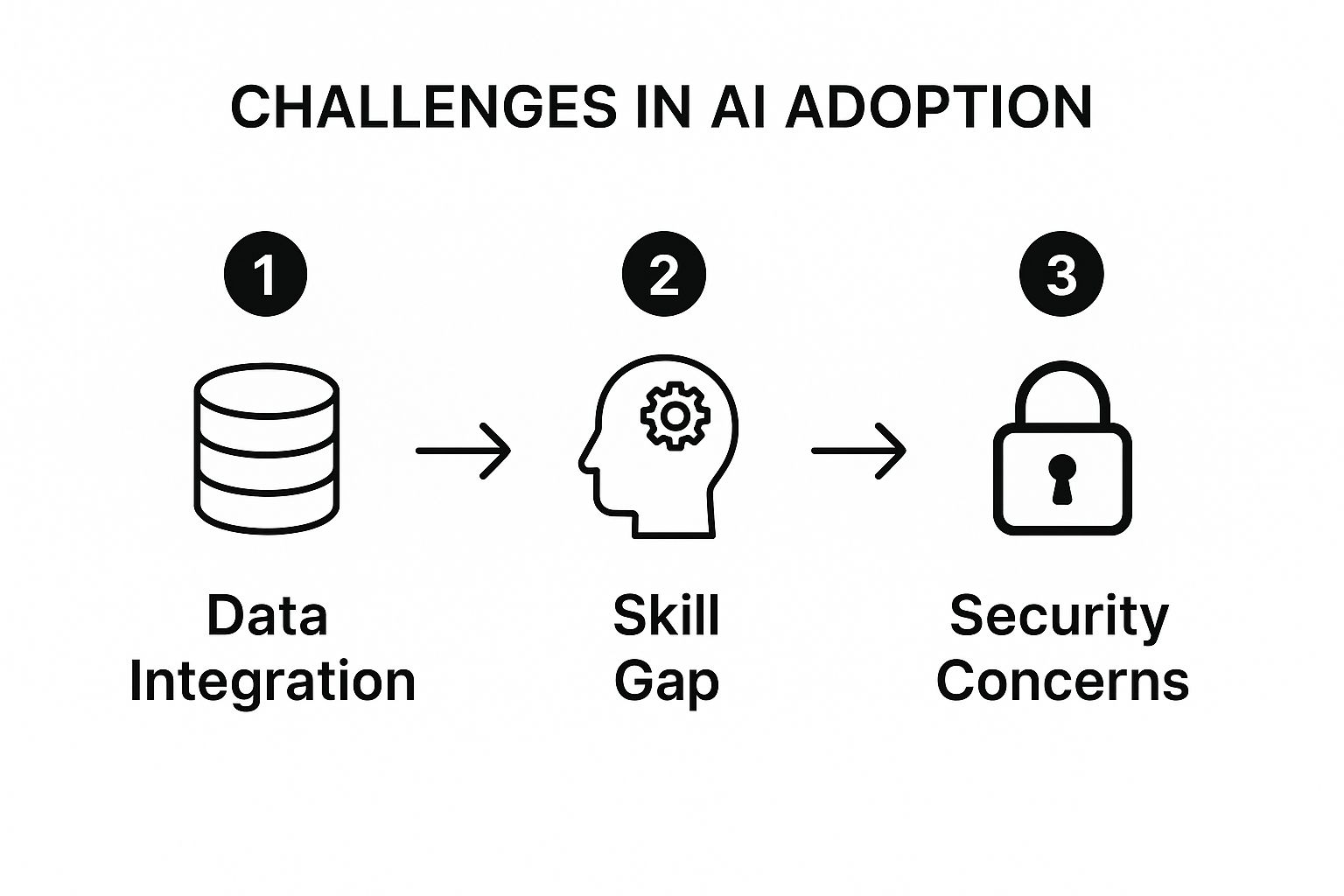
As you can see, foundational issues like messy data integration often snowball into bigger problems down the line, like skill gaps and security holes. It really drives home the need for a careful, step-by-step approach.
Scale And Integrate The Solution
Once your pilot project has delivered the goods and proven its worth, the final stage is to scale it up and integrate the solution into your daily operations. This part of the journey is less about the technology and more about people and processes. It means training your team, adjusting job roles, and making sure the AI tool becomes a natural part of how your business runs.
A successful integration depends on clear communication, excellent change management, and continuous monitoring to make sure the solution keeps delivering value as your business grows. This final step is what turns a successful experiment into a real, lasting competitive advantage.
How To Measure The ROI Of Your AI Investment

Let’s be honest: an AI project isn’t just a tech experiment. It’s a serious business investment. To get buy-in and justify the spend, you have to prove its worth in dollars and cents. Measuring the Return on Investment (ROI) for AI business solutions is about much more than just trimming costs—it’s about understanding how this technology touches every part of your operation, from efficiency gains to revenue growth.
To build a compelling business case, you need to move past vague promises and get down to concrete, trackable numbers. A solid ROI framework doesn’t just get your project the green light; it becomes the yardstick for its success down the road. This is how you champion AI initiatives with the confidence that comes from having hard data in your corner.
Beyond Cost Savings: Key Performance Indicators
The easiest win to point to is cost savings, but that’s just the tip of the iceberg. The real magic often happens in areas that are a bit harder to quantify but are critically important. A truly thorough ROI analysis looks at KPIs across four key areas.
- Operational Efficiency Gains: This is the most direct benefit. It’s all about measuring how much time and manual effort your AI tool is saving. Track metrics like hours saved per employee each week, a drop in data entry errors, or how much faster projects are getting done.
- Revenue and Growth Generation: AI can be a powerful engine for growing your top line. You’ll want to monitor things like higher lead conversion rates from AI-driven recommendations, an increase in average customer lifetime value, or new revenue streams from products developed with AI’s help.
- Customer Experience Improvements: A happy customer is a loyal customer. The right AI can dramatically reduce friction and boost satisfaction. Key metrics here are higher Customer Satisfaction (CSAT) scores, better Net Promoter Scores (NPS), and a noticeable drop in customer support tickets thanks to AI-powered self-service.
- Risk Reduction and Compliance: Sometimes, the best return is the crisis you avoided. AI can be a silent guardian for your business. Track a reduction in fraudulent transactions, improved accuracy in compliance reporting, or fewer safety incidents because of predictive maintenance alerts.
By looking at all four of these areas, you get a 360-degree view of your AI’s real impact. This holistic approach ensures you don’t undervalue a project that, say, skyrockets customer loyalty or slashes risk, which can be just as valuable as direct cost savings.
Building Your AI Business Case
A strong business case lays out the initial costs against the projected long-term value, plain and simple. This isn’t just a formality; it’s the document that aligns stakeholders and secures the budget. Think of it as telling a clear, data-driven story.
Step 1: Identify Initial and Ongoing Costs
Get granular here. The costs go way beyond the software license.
- Initial Investment: This covers software licenses, any necessary hardware upgrades, and the one-time fees for setup and integration.
- Implementation Costs: Don’t forget to account for your internal team’s time spent on the project, plus any fees for outside consultants or partners.
- Ongoing Expenses: Factor in recurring software subscriptions, maintenance costs, and the budget for training employees to use the new system effectively.
Step 2: Project The Expected Returns
Using the four KPI categories from above, start putting numbers to your predictions. For example, what’s the financial value of saving 500 employee hours a month? If an AI tool is projected to lift sales by 5%, translate that into a hard dollar amount. The more specific your projections, the more believable your case.
Step 3: Calculate The ROI
The classic ROI formula is your final, powerful step:
(Net Profit from AI / Cost of AI Investment) x 100
A positive ROI is your proof that the project will deliver more value than it costs. When you present this clear, data-backed calculation, you give decision-makers the evidence they need to say “yes” with confidence.
As AI gets woven into the fabric of daily work, understanding its true value becomes non-negotiable. We’ve previously explored how machine learning is applied to recruitment and the power of AI workflow automation, both of which show how specific tools deliver measurable results. Calculating the ROI is the final piece of the puzzle, proving these powerful tools aren’t just expenses—they’re smart, strategic investments.
Answering Your Top Questions About Business AI
As we wrap up our deep dive into AI business solutions, you probably have a few practical questions swimming around. That’s completely normal. Anytime you bring a new technology into the fold, concerns about cost, necessary skills, and potential roadblocks are bound to come up.
This final section is designed to tackle those frequent questions head-on. We want to cut through the noise and give you the straightforward answers you need to move forward with confidence.
Let’s get right into it.
Do I Need A Team Of Data Scientists To Use AI?
Not anymore. While it’s true that building a sophisticated AI model from the ground up still requires some serious technical horsepower, that’s no longer the only way to get in the game. A new wave of “no-code” and “low-code” AI platforms has completely changed the landscape.
These tools are built for business pros, not just hardcore developers. They let you deploy powerful AI for things like marketing, sales, and analytics without having to write a single line of code.
And if you have a project that needs a bit more custom work? Partnering with a specialized AI consultancy is a much smarter—and more affordable—move than trying to hire an entire in-house data science team from scratch.
What Is The Real Cost To Implement An AI Solution?
This is the big one, and the honest answer is: it varies—a lot. The price tag really depends on what you’re trying to accomplish. Think of it in tiers.
- Software Subscriptions: For an off-the-shelf AI tool, like a sales intelligence platform, you might be looking at a few hundred dollars a month.
- Pilot Projects: A focused pilot project designed to test out a specific use case typically falls in the $10,000 to $50,000 range.
- Custom Systems: If you’re building a fully bespoke AI system from scratch, that’s a major investment that can easily run into the hundreds of thousands.
The smartest way to start is with a tightly focused pilot project. It lets you prove the ROI and build a solid business case before you even think about committing to a larger, more significant investment.
What Is The Biggest Barrier To Successful AI Adoption?
You might be surprised to hear that the technology itself is rarely the biggest hurdle. More often than not, the real challenges have to do with people and data.
Poor data quality is a classic showstopper. Your AI is only as smart as the data it learns from, so having clean, organized data is absolutely non-negotiable. The other major roadblock is change management. Let’s be real—employees can get nervous about AI-driven workflows if they think it means their jobs are on the line.
Getting AI adoption right comes down to strong leadership, communicating clearly how AI will help people in their roles (not replace them), and providing solid training. We’ve actually touched on a similar theme on our blog; check out our article on how AI can assist with recruitment.
At DATA-NIZANT, our mission is to provide the expert analysis and deep insights you need to make sense of the complex world of data and AI. For more guides on machine learning, cloud infrastructure, and enterprise AI strategy, explore our resources at https://www.datanizant.com.