

Explainable AI (XAI) isn't just another buzzword; it’s a collection of tools and techniques designed to do one critical thing: make the decisions of AI systems understandable to us humans. It's the difference between an AI model just spitting out an answer and being able to explain why it arrived at that specific conclusion. This turns a mysterious "black box" into a transparent partner we can actually work with.
Lifting the Lid on the AI Black Box
Picture this: a brilliant doctor gives you a diagnosis but can't explain their reasoning. Would you trust the prescription? Probably not. This is the exact problem we face with AI's "black box"—powerful models that deliver stunningly accurate predictions but offer zero insight into their decision-making process. And this isn't just a technical curiosity; it’s a massive business risk.

In high-stakes fields like finance or healthcare, an unexplained decision can have serious consequences. A loan application denied by an opaque model might be the result of biased training data, leading to angry customers, regulatory fines, and a damaged reputation. In the same way, a medical diagnostic tool that flags a problem on a scan will never earn a clinician's trust if it can’t point to what it found concerning.
The Growing Demand for Transparency
The days of getting away with "the model just said so" are over. As we've discussed when covering AI ethics, accountability is non-negotiable, and XAI provides the framework to make it happen.
This isn't just a philosophical shift; the money is following. The global XAI market was valued at USD 7.94 billion in 2024 and is expected to rocket past USD 30 billion by 2032. This explosive growth is fueled by new laws demanding AI transparency and a public that is increasingly wary of unfair or unaccountable systems. You can dive deeper into these trends by exploring the full market analysis.
This pushes XAI from a "nice-to-have" feature to a core business requirement. Building trust with customers, staying on the right side of regulators, and even just debugging your own models all hinge on our ability to peek inside that black box.
Actionable Insight: Don't treat explainability as an afterthought you bolt on at the end. Make it a core part of your AI strategy from day one. By baking XAI principles into your development process, you'll build systems that are more robust, fair, and trustworthy—the kind that can withstand scrutiny and earn real-world adoption. A practical first step is to include a requirement for explainability in your project charters for any new AI initiatives.
Without this transparency, you're opening the door to a whole host of problems:
- Costly Errors: Hidden biases can creep in, leading to poor decisions that hurt your bottom line and alienate customers.
- Regulatory Penalties: Failing to comply with regulations like GDPR can result in fines that cripple a business.
- Breakdown in Trust: At the end of the day, people won't use or rely on systems they can't understand. It's that simple.
By embracing Explainable AI (XAI), organizations can finally move beyond building systems that are just smart, and start building ones that are also accountable and reliable.
The Building Blocks of Explainable AI
It’s easy to get caught up in flashy metrics. A model that’s 95% accurate sounds great on paper, but that number tells you what it decided, not how or why. This is where Explainable AI (XAI) comes in. It’s not just a buzzword; it's a collection of tools and methods that let us peek under the hood and make sense of a model’s reasoning.
At its heart, XAI revolves around two closely related ideas: interpretability and explainability. Think of it this way: an interpretable model is like a simple glass box. A basic decision tree for loan approvals, for instance, is inherently easy to understand. You can trace the logic from start to finish without any special tools.
On the other hand, explainability is what we do when we have a complex, black-box model. We can't see inside, so we use special techniques to get a clear answer for a specific outcome, like figuring out the exact reasons a particular loan application was rejected.
The chart below shows just how much of a difference XAI makes, especially when it comes to earning trust and being fair.
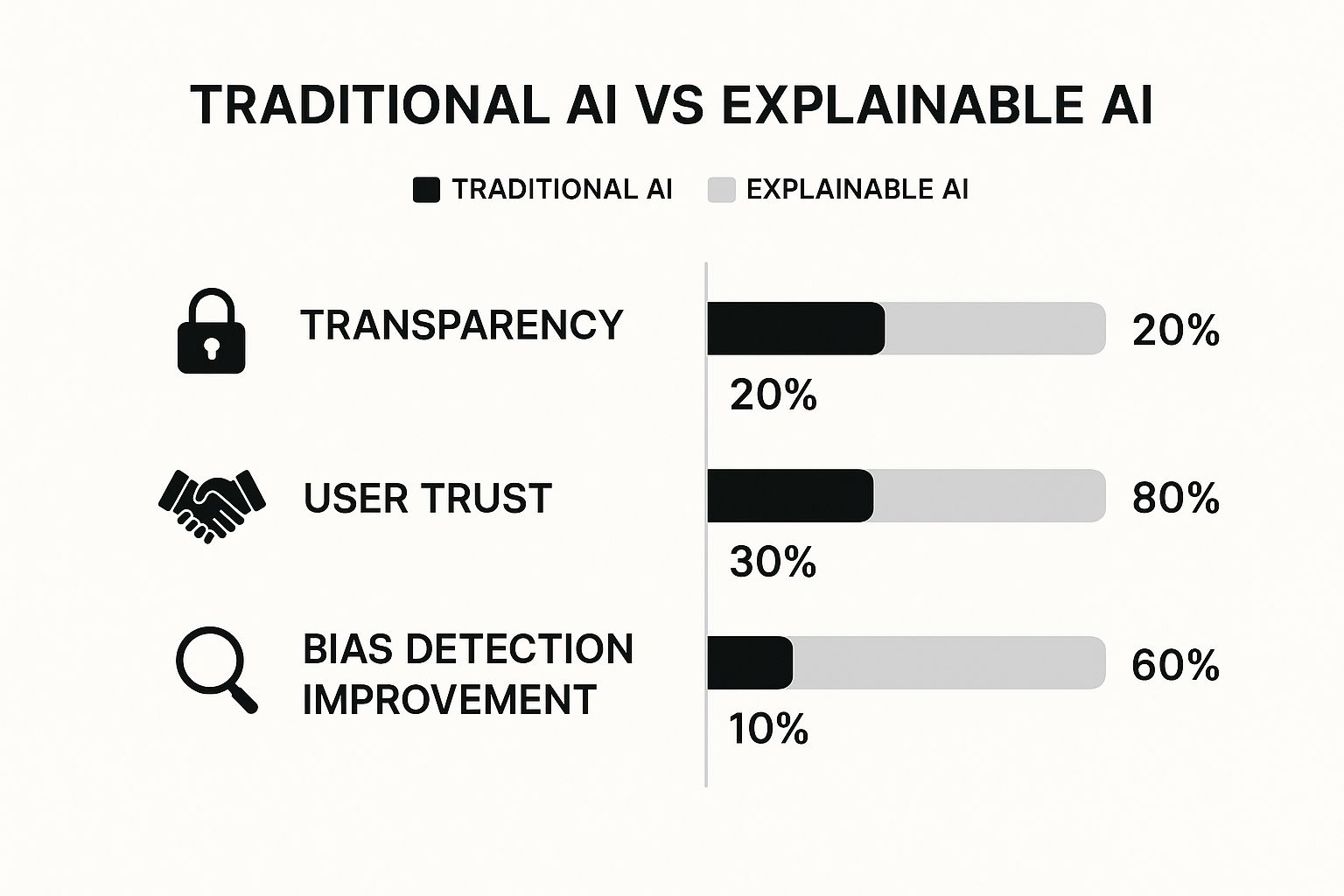
The data is pretty compelling. Moving to an explainable system can boost user trust from a mere 30% all the way up to 80%. More importantly, it dramatically improves our ability to spot and fix hidden biases.
Choosing Your Diagnostic Approach
When you start implementing XAI, you'll find the methods split into two broad camps: model-specific and model-agnostic. Knowing which one to use is key to getting the right insights for your project.
- Model-Specific Methods: These tools are built for one particular type of model. Imagine a certified mechanic who only works on BMWs—they know that specific engine inside and out. In the same way, some XAI techniques are designed exclusively to interpret something like a decision tree or a linear model.
- Model-Agnostic Methods: These are the versatile, universal tools of the XAI world. Think of a master mechanic who can diagnose any car, whether it’s a classic Ford or a brand-new Tesla. These methods treat the model as a black box, probing its inputs and outputs to figure out how it behaves, no matter how complex its internal architecture is.
Model-Specific vs. Model-Agnostic XAI Methods
To really get a feel for these two approaches, it helps to see them side-by-side. The right choice depends entirely on your specific model, your goals, and how much flexibility you need.
This table breaks down the core differences, advantages, and ideal use cases for each.
| Feature | Model-Specific Methods | Model-Agnostic Methods |
|---|---|---|
| Flexibility | Low. These are tied to a specific algorithm (e.g., linear models, decision trees). | High. They can be applied to any model (e.g., neural networks, gradient boosting). |
| Fidelity | High. The explanations are a true reflection of the model's internal logic. | Variable. The explanations are an approximation of the model's behavior, not a direct reading. |
| Ease of Use | Often simpler, as they're tightly integrated with the model's architecture. | Can require more setup and careful interpretation of the results. |
| Best For | When you need the highest possible accuracy for an explanation on a simple, transparent model. | When you're working with complex black-box models or need to compare explanations across different models. |
Ultimately, there's no single "best" approach. Model-agnostic methods are often favored in organizations that use a mix of different models, but model-specific tools provide unmatched precision when you have the right model for them. Deciding which to use is a fundamental part of good AI governance best practices, as it ensures you have the right lens to maintain transparency and accountability.
Your Toolkit for Demystifying AI Models
Moving from theory to practice is where the real power of Explainable AI (XAI) finally clicks. It’s one thing to understand why we need transparency, but it’s another thing entirely to have the tools to actually achieve it.
Fortunately, the data science community has developed some powerful, model-agnostic frameworks. This means you can apply them to almost any machine learning model you've built, no matter how complex it is under the hood.
This section is a hands-on look at two of the industry's most popular and effective XAI frameworks: LIME and SHAP. We'll get into how they work, what makes them different, and how you can use them to pull actionable insights from your own models. Think of these tools as the keys to unlocking the black box and turning opaque predictions into clear, understandable stories.
LIME: Approximating Local Truths
Imagine you're trying to describe a long, winding mountain road. Explaining the entire route in one go would be incredibly difficult. But what if you just described the small, straight section you're currently on? That's much, much simpler.
This is the core idea behind LIME (Local Interpretable Model-Agnostic Explanations).
LIME doesn’t try to understand your entire complex model on a global scale. Instead, it hones in on explaining just a single prediction. It works by taking one data point—say, a specific customer who churned—and creating thousands of tiny variations of it. It then feeds these slightly tweaked data points to your black-box model to see how the predictions change.
Finally, LIME builds a simple, interpretable model (like a basic linear regression) that just approximates how the complex model behaves in that tiny, local area. This simple model then tells you which features were most important for that one specific prediction.
Actionable Insight: LIME is your go-to tool for quick, local explanations. It's built to answer the question, "Why did the model make this specific decision for this specific customer?" It's incredibly intuitive and perfect for troubleshooting individual predictions. For example, a support agent could use a LIME-generated report to tell a customer exactly why their application was flagged, turning a negative interaction into a helpful one.
SHAP: Fairly Distributing the Credit
While LIME is fantastic for local insights, sometimes you need a more robust and consistent way to understand feature importance—both for individual predictions and for the model as a whole. This is where SHAP (SHapley Additive exPlanations) really shines.
The concept behind SHAP is borrowed from cooperative game theory. Think of a basketball team winning a game. How do you fairly distribute the credit for the final score among all the players on the court?
SHAP does something very similar for your AI model's prediction. It calculates the marginal contribution of each feature to the final outcome, considering all possible combinations of the other features. This process ensures the "payout" (the final prediction) is fairly distributed among all the "players" (the features).
The result is a mathematically sound, consistent explanation for every single prediction, which can also be aggregated for a powerful global view of your model.
- Local Explanations: Just like LIME, SHAP can tell you exactly why an individual prediction was made.
- Global Explanations: By averaging the SHAP values for every feature across your entire dataset, you get a reliable measure of overall feature importance.
This dual capability makes SHAP an incredibly versatile and powerful tool in any data scientist's toolkit. To truly see what it can do, it helps to see an output. If you're looking for a deeper dive, our practical guide to getting started with Explainable AI offers more hands-on examples.
The visualization below shows a SHAP summary plot, a common way to view global feature importance.

Each point on this plot represents a single prediction for a single feature. It shows how that feature's value pushed the prediction higher (red) or lower (blue). From this one chart, we can see not only which features are most important overall (like Glucose and BMI) but also how their values impact the model's output.
Where XAI is Making a Real-World Impact
Theory and fancy tools are great, but the real test is whether a technology actually solves problems. Explainable AI (XAI) is officially moving out of the research lab and into the core operations of major industries, where it's creating a serious competitive edge by building trust, ensuring fairness, and just plain helping people make better decisions.
By peeling back the layers of complex "black box" models, companies aren't just ticking regulatory boxes—they're building stronger relationships with their customers. From finance to healthcare, XAI is becoming essential for anyone who wants to use AI responsibly and effectively. The market is exploding, too. The global XAI market hit about USD 7.3 billion in 2024 and is expected to climb to a massive USD 27.6 billion by 2033. This isn't just hype; it shows a massive demand for AI systems we can actually understand. You can dig into the numbers in the full market forecast.
Fortifying Trust in Finance
The entire financial world runs on trust and tight regulations. When a model denies someone a loan, just saying "the algorithm said no" doesn't cut it for customers or regulators. This is exactly where XAI steps in and provides incredible value.
Think about a major bank using a deep learning model to figure out credit risk. Before, if a customer was denied, the bank could only give a vague reason, which led to frustration and claims of bias.
- The Problem: Opaque models were a huge regulatory risk and were terrible for customer relations. It was impossible to give someone specific, helpful feedback.
- The XAI Solution: By bringing in a framework like SHAP, the bank can now generate a clear, human-readable report for every single decision. It can point to the exact factors behind the denial—like a high debt-to-income ratio or a short credit history—while also proving that things like age or gender didn't play a part.
- The Business Result: The bank is now fully compliant with fair lending laws like the Equal Credit Opportunity Act. Even better, customer service reps can offer concrete feedback, turning a bad experience into a constructive one and keeping the customer relationship intact.
Enhancing Diagnostics in Healthcare
In medicine, a doctor has to be able to trust their tools. AI models are getting incredibly good at analyzing medical images like X-rays and MRIs, but clinicians are (rightfully) hesitant to act on a recommendation they can't understand. XAI is the bridge between the algorithm's output and a doctor's expert judgment.
Imagine an AI tool designed to spot early signs of pneumonia in chest X-rays. A doctor gets an alert that a scan has a high probability of infection.
Actionable Insight: The real power of XAI in medicine isn't to replace doctors, but to supercharge their abilities. By highlighting areas of concern and explaining its reasoning, the AI becomes a reliable second opinion, helping clinicians make faster, more confident, and better-informed decisions. You can implement this by integrating XAI visualizations directly into the diagnostic software clinicians already use.
The AI doesn't just spit out a percentage. Using visualization techniques like saliency maps, it highlights the exact regions in the X-ray that led to its conclusion. The doctor can instantly see the subtle patterns the model caught, confirming the finding with their own expertise. This turns the AI from a mysterious black box into a collaborative partner in diagnosis.
Personalizing the E-commerce Experience
Online stores live and die by their ability to recommend the right products to the right people. But let's be honest, sometimes those recommendation engines feel random or even a little creepy, which can damage customer trust. XAI helps make these suggestions transparent and a lot more effective.
An e-commerce site could use XAI to explain why it’s suggesting a particular item. Instead of a generic "You might also like," the recommendation could come with a note like, "Because you bought high-performance running shoes and reviewed a GPS watch, you might be interested in these moisture-wicking socks."
By clearly connecting the dots to the user's past actions, the platform builds credibility. The suggestion feels genuinely helpful, not intrusive. This transparency demystifies the algorithm, boosts user engagement, and leads to more confident purchases. For a closer look at these and other applications, check out our collection of real-world Explainable AI examples for more detailed case studies.
How to Know if an Explanation Is a Good One
Generating an explanation with a tool like SHAP or LIME is a great first step, but it immediately raises a critical question: how do you know if the explanation itself is any good? A misleading explanation can be far worse than no explanation at all, leading you down the wrong path and creating a false sense of security.
So, before you start trusting those slick visualizations, you need to have a way to validate them. Just because an explanation looks plausible doesn’t mean it’s right. This is where we move from interesting outputs to genuinely actionable insights by evaluating the quality of our XAI results.
Key Metrics for Evaluating XAI
When you get an explanation, you’re essentially getting a simplified story about how your complex model made a specific decision. To check if that story holds up, data scientists lean on a few key criteria. These metrics help ensure the insights you’re pulling are dependable enough for real-world use.
Two of the most important concepts here are fidelity and consistency.
- Fidelity: Does it Actually Match the Model? This is the single most important question you can ask. Fidelity measures how accurately an explanation reflects the model's actual logic. A high-fidelity explanation means the reasons given by your XAI tool are the true reasons the model used to make its prediction. It's not just a convenient narrative; it's the ground truth.
- Consistency: Does it Treat Similar Cases Similarly? A good explanation should be stable and predictable. If you have two nearly identical inputs—say, two loan applicants with almost the same financial profile—the explanations for their outcomes should also be very similar. If they differ wildly for no good reason, that’s a major red flag that your XAI method might be unreliable.
Actionable Insight: Always test for consistency. A great way to do this is to run your XAI tool on slightly tweaked versions of the same input. For example, change a loan applicant's income by just $100 and rerun the explanation. If small, insignificant changes to the data lead to drastically different explanations, you need to seriously question the stability of your chosen XAI method.
A Practical Checklist for Data Scientists
Beyond the hard numbers, a good explanation has to pass a common-sense check. The ultimate goal is for a human to understand and act on the information, so human feedback is non-negotiable.
Before you fully trust an XAI-generated insight, run it through this quick mental checklist:
- Is it Actionable? Does the explanation give you a clear next step? For a denied loan, an actionable explanation is "the debt-to-income ratio is too high," not a vague list of 50 different features that played some minor role.
- Is it Coherent? Does the explanation actually make sense in the context of the real world? If your model predicts customer churn and blames a feature that has no logical connection to customer loyalty, the explanation is likely pointing to a flaw in the model or the data itself.
- Is it Appropriately Detailed? The right level of detail depends entirely on who’s looking. A developer debugging the model might need a full SHAP plot with all the features. A business manager, on the other hand, might just need the top three reasons behind a decision, explained in plain language.
Ultimately, evaluating your XAI outputs is what bridges the gap between a machine's prediction and a confident, human-led decision. For a more detailed exploration of these ideas, our guide on interpretability in machine learning provides deeper context on what makes a model truly understandable. This validation process is what turns interesting XAI outputs into genuinely trustworthy insights.
The Future of Transparent AI
As Explainable AI (XAI) shifts from a niche academic topic to a core part of building machine learning systems, it's worth taking a look at the road ahead. The journey toward truly transparent AI is far from over. It means we'll have to navigate some persistent challenges while also embracing new frontiers that promise a more trustworthy, human-centric approach to AI.

One of the biggest hurdles that still trips up teams is the classic performance vs. interpretability trade-off. Data scientists often have to make a tough call: do they deploy a highly accurate but totally opaque "black box" model, or do they opt for a simpler, more transparent model that might not be quite as powerful? It's a balancing act that demands a careful look at both the technical needs and ethical lines of a project.
Another major challenge is the risk of getting misleading explanations. It’s entirely possible for an XAI tool to spit out a plausible-sounding reason for a model's decision that doesn't actually reflect its true internal logic. This is exactly why, as we touched on earlier, rigorously evaluating an explanation's fidelity isn't just a "nice-to-have"—it's critical for avoiding a false sense of security.
Emerging Trends and Innovations
Despite these bumps in the road, the future of XAI looks incredibly bright. We're seeing a significant shift toward developing inherently interpretable models. Instead of building a black box first and trying to pry it open later, researchers are designing powerful models that are transparent by design, offering clarity without giving up on performance.
On top of that, evolving regulations will only accelerate the push for transparency. As governments around the world roll out stricter rules for AI accountability, embedding XAI into the development lifecycle is quickly becoming a non-negotiable legal and business requirement.
Actionable Insight: The future of AI isn't about choosing between performance and transparency; it's about achieving both. Start prioritizing the development of inherently interpretable models whenever you can. This proactive approach doesn't just get you ready for future regulations—it helps you build more robust and reliable systems from the ground up. Start by piloting a simpler, interpretable model (like logistic regression) as a baseline before moving to more complex alternatives.
The market is already reflecting this undeniable trend. Some projections suggest the XAI market will balloon from about USD 8.1 billion in 2024 to nearly USD 20.74 billion by 2029. This growth is fueled by the need for interpretable AI in new technologies like augmented reality (AR) and connected devices. You can dig into more of the numbers on the projected market growth.
This fusion of XAI with emerging tech makes one thing clear: transparency is no longer an afterthought. It's becoming a foundational piece of innovation itself.
Common Questions About Explainable AI
As you start digging into Explainable AI, you'll naturally run into a few common questions. Let's tackle them head-on to clear up any confusion and get you on the right track.
Can I Apply XAI to Any Machine Learning Model?
Absolutely. Thanks to what are known as model-agnostic methods like SHAP and LIME, this is totally possible. These tools are specifically designed to work with just about any machine learning model you can think of—from complex neural networks to gradient boosting machines—without needing a peek at their internal wiring.
This is a huge deal. It means you no longer have to choose between a high-performing model and an understandable one. You can build the most accurate model for the job and still generate clear, human-friendly explanations for its decisions after the fact.
What Is the Real Difference Between Interpretability and Explainability?
This is a great question, and the distinction is important. Here’s a simple way to think about it.
Interpretability is when a model is so simple you can understand its logic just by looking at it. Think of a small decision tree—its rules are right there on the surface, completely transparent. For instance, a rule might be IF income > $50,000 AND credit_history > 2 years THEN approve_loan.
Explainability, on the other hand, is something we apply to more complex "black box" models. Since we can't see inside, we use XAI techniques to create a separate, simplified explanation for why the model made a particular call.
In short: Interpretability is a model's built-in transparency. Explainability is how we create transparency for a model that's otherwise a black box.
How Do I Choose the Right XAI Framework?
The right tool really depends on what you're trying to figure out. Are you trying to understand one specific, puzzling prediction, or do you need a big-picture view of the model's overall behavior?
- For quick, local insights into a single decision, LIME is a fantastic and intuitive choice. It's great for getting a fast answer to "Why did the model say that?"
- For robust, consistent explanations at both the local (single prediction) and global (entire model) levels, SHAP is often the industry standard. It's built on a solid theoretical foundation, giving its explanations a high degree of reliability.
For instance, if you're trying to understand how AI influences customer behavior, you might use SHAP to uncover the main drivers behind a successful campaign. This allows you to see exactly which customer features are moving the needle. You can dive deeper into this in our guide to machine learning in marketing.
At DATA-NIZANT, we provide the expert analysis you need to master complex topics like Explainable AI and data science. Explore our in-depth articles to stay ahead.