

Vibe coding is a simple idea at its core: you describe what you want to build in plain English, and an AI handles the heavy lifting of writing the actual code.
Think of yourself as an architect laying out the vision for a building. You're not mixing concrete or laying bricks; you're focused on the big picture. The AI, in this scenario, is your expert construction crew, turning that vision into a reality by handling all the technical nuts and bolts. Instead of getting bogged down in precise syntax, your job is to nail the 'vibe'—the end goal, the user experience, and the core functionality.
What Vibe Coding Really Means for Developers
The term "vibe coding" was first tossed around by AI expert Andrej Karpathy, and it perfectly captures a major shift in how we're starting to think about software development. This isn't about throwing away good programming principles. It’s about evolving the developer's role from a meticulous coder into more of a strategic director. You guide an AI partner to build, iterate, and refine, making sure the final product aligns with your vision.
This approach is already changing the game, allowing seasoned developers and even non-technical folks to generate working code just by describing what it should do. It cuts down massively on the time spent on repetitive, boilerplate tasks. As we saw in our guide on unleashing vibe coding with MCP Servers, this method has reported productivity boosts of up to 55% on certain projects.
From Syntax to Semantics
For decades, developers have had to communicate with machines using the rigid, unforgiving syntax of programming languages. We've all been there—a single misplaced semicolon bringing an entire application to its knees. Vibe coding peels that layer away. It lets you communicate your intent—the "what"—while the AI figures out the syntactical "how."
Vibe coding is about offloading the cognitive load of syntax and boilerplate, freeing up developers to focus on higher-level problem-solving, system architecture, and user experience design.
This approach provides immediate, actionable benefits:
- Accelerated Prototyping: You can spin up functional prototypes from raw ideas in a fraction of the time it used to take.
- Lower Barrier to Entry: People with great ideas but limited coding skills can actually start building things.
- Increased Focus on Creativity: Less energy spent on routine code means more brainpower for genuine innovation.
To get a clearer picture, let's compare vibe coding with the traditional way of doing things.
Vibe Coding vs Traditional Coding
Here’s a quick breakdown of how these two approaches stack up against each other.
| Aspect | Traditional Coding | Vibe Coding |
|---|---|---|
| Developer's Role | Writing precise, line-by-line code. | Describing outcomes and guiding an AI. |
| Primary Skill | Mastery of syntax and algorithms. | High-level problem-solving and clear communication. |
| Interaction with AI | Limited; AI used for simple autocompletion. | Collaborative; AI is an active partner in the development process. |
| Barrier to Entry | High; requires deep knowledge of specific languages. | Lower; focuses on describing functionality. |
| Speed to Prototype | Slower; involves manual coding for all components. | Rapid; ideas can be turned into code much faster. |
| Focus | On the "how"—implementing logic with correct syntax. | On the "what"—defining the end goal and user experience. |
As you can see, the shift is less about replacing developers and more about changing the nature of their work.
The Developer as a Conductor
A great way to think about this is to picture a symphony orchestra. The conductor doesn't play every single instrument. Instead, they guide a group of skilled musicians to create a cohesive and beautiful piece of music. That's the developer in the world of vibe coding. You're directing the AI, ensuring the code it produces is secure, efficient, and perfectly aligned with the project's goals.
Actionable Insight: Instead of just accepting the first code snippet, act as a conductor. If an AI gives you a Python function to process data, immediately ask it: "Can you refactor this to use a list comprehension for better readability and performance?" This forces the AI to iterate and improves the final product, putting you in a director's role rather than a passive recipient's.
This is a collaborative process, not a "set it and forget it" one. It's a constant dialogue. You might ask the AI to refactor a clunky component, suggest a few different ways to implement a feature, or even explain a complex piece of code it just generated. This back-and-forth is key to making vibe coding work well, and it still requires a solid grasp of software principles to be effective.
The Three Pillars of Effective Vibe Coding
To really get the hang of vibe coding, you have to move past just asking an AI to spit out some code. The real skill is in building a collaborative partnership, and that rests on three core pillars. Once you internalize these skills, you can guide an AI to produce code that’s not just functional, but also robust, efficient, and perfectly in sync with your project’s vision.
Think of these pillars as the foundation for a powerful development strategy.
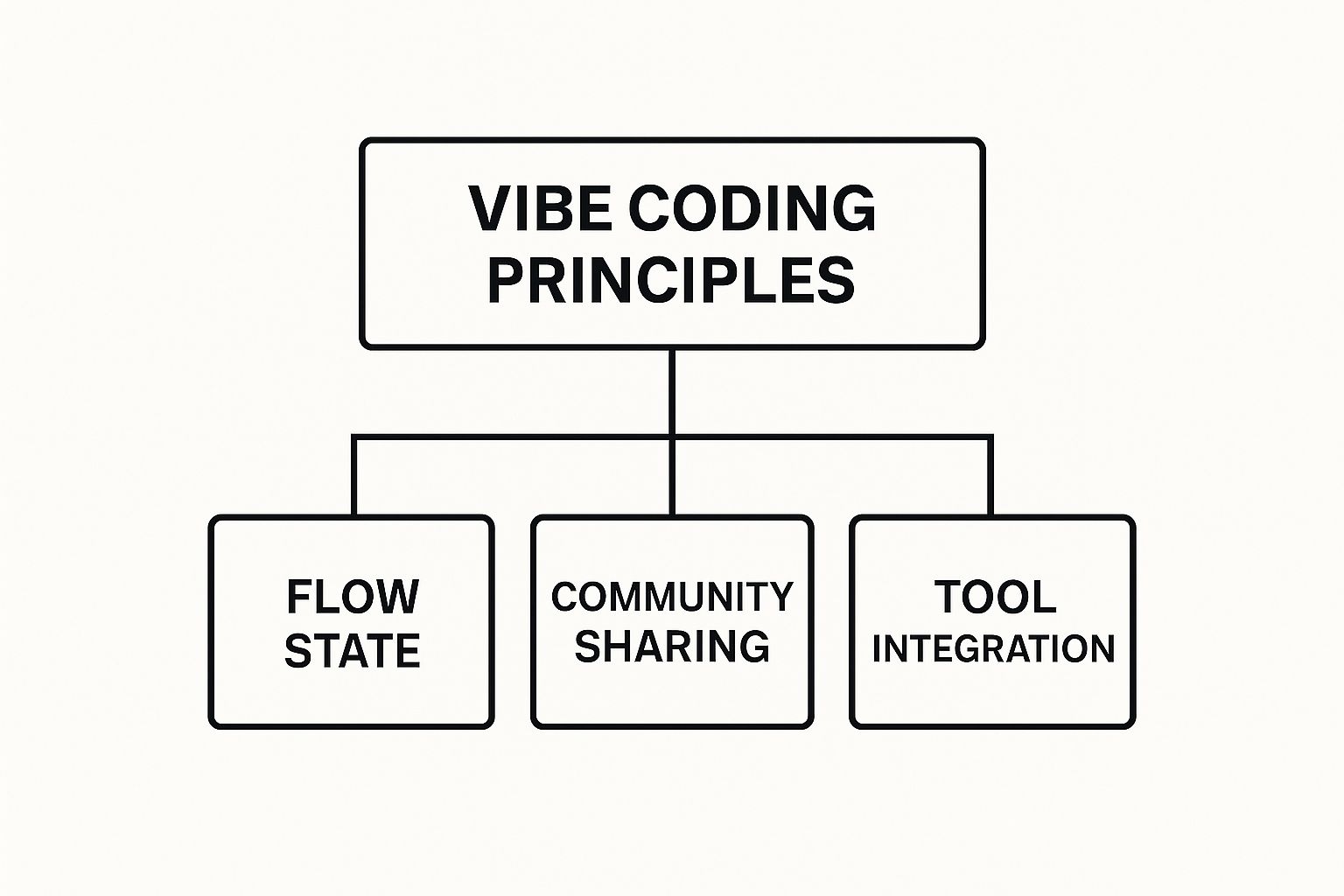
As you can see, success isn't just about one thing. It's about combining a fluid workflow—what we call the Flow State—with the right tools and a bit of community wisdom.
Intent-Driven Prompts
The first pillar is mastering Intent-Driven Prompts. This is where the magic starts. It’s the art of giving the AI crystal-clear, context-rich instructions. If you throw a vague request at it, you’ll almost always get generic or just plain wrong code back. It's a waste of time and a fast track to frustration.
You wouldn't give an architect a napkin sketch and expect a skyscraper, right? Same principle.
Practical Example:
- Weak Prompt: "Make a login form."
- Intent-Driven Prompt: "Create a responsive login form component using React and Tailwind CSS. It needs an email field with validation that checks for a valid email format, a password field with a toggle for visibility, and a 'Submit' button that stays disabled until both fields are valid. Include ARIA attributes for accessibility and handle a failed login attempt by displaying a dismissible error message above the form."
That level of detail gives the AI a solid blueprint to work from. Better input, better output. Simple as that.
Iterative Refinement
The second pillar is all about Iterative Refinement. Let’s be real: an AI rarely nails the perfect code on the first try. Vibe coding is a conversation, not a command you bark once. You have to treat the AI's first attempt as just that—a first draft.
"I didn't just let ChatGPT generate the code and call it a day. I collaborated with it. I asked for feedback, suggestions, and improvements."
Actionable Insight: After the AI generates code, copy and paste the error message directly back to it.
- Practical Example: If your generated Python script throws a
FileNotFoundError, don't just fix it yourself. Tell the AI: "The script failed withFileNotFoundError: [Errno 2] No such file or directory: 'data.csv'. Please modify the script to first check if the file exists before attempting to read it, and print a user-friendly message if it's missing." This teaches you to use the AI as a debugging partner.
This back-and-forth is where you really start cooking with gas.
Contextual Awareness
And finally, the third pillar: Contextual Awareness. The AI needs to see the bigger picture. It needs to understand your project’s architecture, its goals, and how the new piece fits into the existing puzzle. Without that context, it's just coding in a vacuum.
To make this work, feed it snippets of related code, briefly explain your file structure, or outline the specific business logic you're trying to implement. This is what turns the AI from a simple code generator into a genuine partner in development, ensuring whatever it creates slots seamlessly into your project instead of feeling like a random, disconnected part.
Practical Example: Instead of asking for a generic function, provide context. "Here is my existing Pydantic model for a User. class User(BaseModel): name: str; email: str;. Now, create a FastAPI endpoint that accepts a POST request to create a new user, validates the input against this model, and returns the created user object with a 201 Created status code."
Putting Vibe Coding into Practice
It’s one thing to talk about vibe coding in theory, but where this approach really clicks is when you see it in action. Let's move past the concepts and look at how it works in the real world. I’ll walk you through three different scenarios to show just how versatile this method can be for turning a simple idea into a working product.
Each example starts with a clear, natural language prompt that gives the AI just enough direction to generate a solid foundation. From there, it's all about iterating and refining.
Building an MVP for a Task Manager
Imagine a startup founder who has a great idea for a task manager app but isn't a seasoned developer. Their main goal is to get a Minimum Viable Product (MVP) built fast to see if the idea has legs. Instead of getting bogged down for weeks trying to learn a new framework, they can just describe what they want.
The Prompt:
"Generate a simple task manager application using React and Tailwind CSS. It should have an input field to add new tasks, a list to display them, and a button next to each task to mark it as complete. Completed tasks should be styled with a strikethrough."
That single prompt is packed with context: the tech stack (React, Tailwind), the core features (add, display, complete), and even a specific UI detail (the strikethrough). The AI can chew on that and spit out a functional starting point. The founder can then keep the conversation going, asking for new features like task deletion or saving the list to local storage.
Automating a Business Process
Next, let's think about a marketing team drowning in repetitive tasks. They get hundreds of customer support tickets every day and need a script to automatically parse and categorize them. This is a perfect use case for vibe coding because it’s all about logic, not a fancy user interface.
The Prompt:
"Write a Python script that reads text files from a specific folder. For each file, the script should scan for keywords like 'billing,' 'technical issue,' or 'feedback.' Based on the keywords found, it should move the file into a corresponding subfolder named 'Billing,' 'Technical,' or 'Feedback.'"
An automation script like this can literally save the team hours of manual work every week. The generated code becomes a reliable base that they can tweak with more advanced logic later on. This is a common entry point for businesses, and we dive deeper into similar applications in our guide to machine learning in marketing, which shows how AI can streamline all sorts of operational tasks.
Prototyping a New UI Component
Finally, picture a UI/UX designer who needs to prototype a new interactive component. They've mocked up a slick animated pricing toggle that switches between monthly and yearly plans, but they need to see it live to judge the user experience properly.
The Prompt:
"Create an animated pricing toggle component with HTML, CSS, and JavaScript. It should have two options: 'Monthly' and 'Annually.' When a user clicks the toggle, it should smoothly slide to the selected option, and a nearby text element should display a 15% discount message when 'Annually' is chosen."
With vibe coding, the designer gets a working prototype in minutes, not days. This creates an incredibly fast feedback loop, allowing for quick design tweaks to make sure the final component isn't just pretty but also feels great to use. It’s a powerful way to close the gap between a static design and an interactive reality.
How Vibe Coding Is Changing the Market
Vibe coding isn't just a quirky new technique for developers; it’s a genuine market shift. It’s fundamentally changing who can create software and how fast an idea can become a tangible product. This whole approach is prying open the world of development, welcoming a massive wave of creators who were previously shut out by the steep learning curve of traditional programming.
The real economic ripple effect comes from this new accessibility. Suddenly, small business owners, students, and entrepreneurs can build their own custom tools, spin up prototypes, and automate tedious workflows. They can do it all without a computer science degree or a huge budget for a dev team. This is unlocking innovation that was trapped in people's heads for years.
The New Creator Economy
This growth is being fueled by people who see immediate value in translating their thoughts directly into code. We're talking about non-technical founders building their first MVP, freelancers creating bespoke tools for clients, and students learning development by doing instead of just reading theory.
This flood of new creators is igniting a booming market. Industry analysts estimate the total addressable market for vibe coding tools could land somewhere between $2 billion and $12 billion for the 2025-2027 period. This isn't just a niche—it's a movement of roughly 20 million users, including 5 million non-technical founders, 3 million freelancers, and 8 million students.
With an average annual revenue per user (ARPU) between $300 and $600, the combined annual recurring revenue (ARR) had already blown past $210 million by mid-2025. It’s worth exploring these market projections to see just how big this is getting for the software industry.
Actionable Insight for Businesses
For companies, this trend is a flashing green light to adapt and innovate faster. The rise of vibe coding mirrors what we're seeing with the broader integration of AI in business, where speed and agility are everything.
By lowering the barrier to software creation, vibe coding allows businesses to test more ideas with fewer resources. This accelerates the feedback loop, enabling companies to pivot or double down on successful projects much more quickly than before.
Practical Example: A marketing department can use vibe coding to build a small tool that scrapes competitor websites for pricing changes. The prompt could be: "Write a Python script using BeautifulSoup and Requests to scrape the price of 'Product X' from competitor-url.com. Run this script daily and send an email alert if the price changes." This provides immediate competitive intelligence without waiting weeks for the internal dev team, fostering a culture of self-sufficiency and rapid innovation.
Using Vibe coding in an Enterprise Setting
While startups and solo developers have jumped on vibe coding, large enterprises are taking a more measured approach. It makes sense. In a corporate environment, the stakes are much higher—code has to meet rigid standards for security, compliance, and rock-solid reliability. This caution is all about balancing the promise of moving faster with the very real risks of deploying AI-generated code.
Tech leaders absolutely see the potential here. They're looking at vibe coding as a way to speed up internal projects and give developer productivity a serious boost. The goal isn't to replace developers, but to give them a powerful assistant. Think of it as automating boilerplate code for internal tools or whipping up initial drafts for new features. This frees up senior engineers to tackle what they do best: complex system architecture and high-stakes problem-solving.
A Measured Adoption Strategy
Successfully bringing vibe coding into an enterprise workflow isn't about letting an AI run wild. It demands a structured, human-in-the-loop process where the focus shifts from pure code generation to rigorous review and validation.
This is where a clear governance framework is absolutely critical. Enterprises are now establishing best practices to manage the unique risks that come with AI-generated code, making sure every single line is vetted before it gets anywhere near a production environment.
The enterprise goal for vibe coding is not just speed, but responsible acceleration. It's about empowering developers with advanced tools while reinforcing guardrails for code quality, security, and intellectual property protection.
Balancing Innovation with Governance
To make this a reality, organizations are putting specific strategies in place. These often include:
- Mandatory Code Reviews: Every piece of AI-generated code must be thoroughly reviewed by a human developer to catch potential bugs or logic flaws.
- Security Scanning Integration: Automated security tools are plugged in to scan AI code for common vulnerabilities, like those on the OWASP Top 10 list.
- Sandboxed Environments: Developers experiment with vibe coding tools in isolated "sandboxes" to prevent any accidental exposure of sensitive company data or systems.
Actionable Insight: An enterprise team can create a "prompt library" of pre-approved, context-rich prompts for common tasks. For example, a prompt for creating a new database migration could include company-specific table naming conventions and security requirements, ensuring the AI's output is compliant from the start.
This careful strategy is gaining traction. Projections suggest that by 2028, a stunning 40% of new enterprise software will have vibe coding mixed in. Companies like Mondelēz International are already exploring how to boost productivity while keeping accountability tight. As leaders in this detailed enterprise strategy overview emphasize, a measured rollout is key to navigating the risks. For developers keeping up, our resources on AI for developers offer further reading.
Got Questions About Vibe Coding?
As vibe coding starts making waves, it’s natural for questions—and a bit of healthy skepticism—to bubble up. It’s a pretty different way to think about building software, so let's clear the air and tackle the most common things people ask.
We'll get straight to the point on the big topics, from job security and safety risks to practical advice on which tools to use and how you can start applying these methods to projects you're already working on. The goal here is to give you the clarity you need to dive in with confidence.
Will Vibe Coding Replace Programmers?
The short answer is a hard no. Vibe coding isn't here to replace developers; it's a powerful assistant that fundamentally changes the nature of their work. Think of it less as a replacement and more as a force multiplier that automates the tedious, repetitive parts of coding.
This frees up human developers to focus on what they do best: high-level system architecture, creative problem-solving, and building elegant solutions to complex problems. Your role shifts from being a pure code writer to more of a technical director. You guide the AI, ensure the quality is top-notch, and validate the final output. If anything, your deep programming knowledge becomes even more valuable for providing effective oversight, debugging tricky issues, and handling integration.
What Are the Biggest Security Risks?
Security is a huge deal here, and for good reason. The main risks with vibe coding boil down to the AI generating code with subtle vulnerabilities, accidentally exposing sensitive data if it’s fed into a prompt, or pulling in outdated libraries with known security holes. A good rule of thumb is to treat all AI-generated code as untrusted until you've proven otherwise.
To get a handle on these risks, you need a "trust but verify" mindset.
- Rigorous Code Reviews: Every single line of AI-generated code must be scrutinized by a human expert. No exceptions.
- Security Scanning: Run the output through automated tools that scan for common vulnerabilities (like SAST tools).
- Thorough Testing: Write and run comprehensive unit and integration tests to make sure the code is not only functional but also secure.
At the end of the day, the developer is the ultimate gatekeeper. You are responsible for making sure the final code is secure, efficient, and reliable long before it ever gets near a production environment.
Which Tools Are Best for Getting Started?
Picking the right tool really depends on your specific workflow and what you’re trying to do. There's no single "best" option, but a few have emerged as excellent starting points for different kinds of tasks.
If you want real-time assistance right inside your code editor, GitHub Copilot is a fantastic choice. It plugs directly into environments like VS Code and offers up intelligent, context-aware suggestions as you type, almost like an incredibly smart autocomplete.
For generating larger chunks of code, brainstorming entire components, or working through a problem conversationally, tools like OpenAI's ChatGPT (GPT-4 and above) and Google's Gemini are powerhouse options. Many developers find a sweet spot using a combination of both—Copilot for the in-the-moment, line-by-line coding, and a conversational AI for higher-level scaffolding, refactoring, and debugging sessions.
Can I Use Vibe Coding on Existing Projects?
Absolutely. In fact, vibe coding is exceptionally good for working with established or even legacy codebases. It can dramatically speed up modernization and maintenance tasks that are notoriously time-consuming and painful.
Practical Example: You can feed an old, hard-to-read function from a legacy Java codebase to an AI and prompt it: "Refactor this Java function to improve readability. Break it down into smaller, single-responsibility methods, add meaningful variable names, and include Javadoc comments explaining what each part does." This provides an immediate, actionable improvement that would have taken significant manual effort.
This is where many businesses see an immediate return, as discussed in our posts on machine learning in business. The key is to give the AI enough context from your project—like relevant code snippets or a summary of the architecture—to make sure its suggestions are actually compatible and helpful.
At DATA-NIZANT, we are committed to providing expert-authored articles that break down complex topics into accessible, in-depth analysis. Explore our knowledge hub to stay ahead of the curve in AI, data science, and digital infrastructure. Find out more at https://www.datanizant.com.