

Imagine you had a digital librarian who could instantly read millions of customer reviews, emails, and social media posts. This isn't just any librarian, though. They don't just read; they organize everything by topic and even tell you precisely how people feel.
That’s the essence of text mining and sentiment analysis. These aren’t just buzzwords; they’re powerful tools that turn messy, raw text into a goldmine of actionable insights.
What Are Text Mining and Sentiment Analysis?
At its heart, text mining is the process of discovering meaningful patterns and information from massive volumes of unstructured text. Think of it as a form of automated reading and comprehension that goes far beyond a simple keyword search. It’s designed to understand context, relationships, and hidden themes buried in the text.
Sentiment analysis is a specialized, more focused subset of text mining. Its primary job is to identify and categorize the emotional tone expressed in a piece of writing. It acts as an emotional barometer, telling you if the underlying opinion is positive, negative, or neutral.
When used together, they create a powerful duo. You don’t just learn what people are saying, but you also understand how they feel about it.
The Digital Gold Rush for Unstructured Data
Every single day, businesses are flooded with an avalanche of text from countless sources—social media comments, support tickets, product reviews, you name it. This unstructured data is often ignored because it's just too difficult and time-consuming to analyze manually. Trying to read thousands of reviews by hand is a non-starter.
That's where text mining and sentiment analysis step in to make sense of the chaos.
This growing need has fueled some serious market growth. The global text mining market was valued at USD 3.2 billion and is projected to more than double to USD 8.1 billion by 2033. This rapid expansion underscores just how critical these technologies have become for any company that wants to stay competitive.
A Practical Example of Text Mining in Action
Let's say an e-commerce company just launched a new pair of running shoes. In the first month, they're swamped with thousands of online reviews.
- Without text mining: The product team might skim a few dozen reviews and walk away with a vague, anecdotal sense of customer feedback. They'd almost certainly miss critical, recurring issues buried in all that noise.
- With text mining: The system automatically processes all the reviews. It quickly identifies key topics that people are talking about, like "sole comfort," "durability," "sizing," and "price."
- Adding sentiment analysis: Now, the system assigns a sentiment score to each of those topics. The team might discover that "sole comfort" has an 85% positive sentiment, which is great. But they might also find that "durability" has a 60% negative sentiment, with hundreds of people mentioning that the seams are tearing after just a few weeks.
By combining these techniques, the company moves from guesswork to data-driven facts. This kind of actionable insight allows them to address the durability problem in the next production run, directly improving the product and boosting customer satisfaction.
This entire process is powered by huge strides in natural language processing (NLP) and machine learning, the same technologies that form the foundation of large language models. To see how this all connects, you can check out our detailed guide on Generative AI and LLMs.
Ultimately, these tools give organizations the ability to listen to their customers at a scale that was simply unimaginable just a few years ago.
Text Mining vs Sentiment Analysis Key Differences
While they work hand-in-hand, it's helpful to see their distinct roles side-by-side. Text mining is about casting a wide net to find all kinds of patterns, while sentiment analysis zooms in on the emotional tone.
| Aspect | Text Mining | Sentiment Analysis |
|---|---|---|
| Primary Goal | To extract meaningful patterns, topics, and structured information from unstructured text. | To identify and classify the emotional tone (positive, negative, neutral) within the text. |
| Scope | Broad. It includes topic modeling, entity recognition, and information extraction. | Narrow. It is a specific application of text mining focused solely on opinion and emotion. |
| Output | Structured data, such as keyword frequencies, topic clusters, or relationship maps. | A sentiment score or label (e.g., "Positive," "Negative," "95% Angry"). |
This table clarifies how text mining provides the broader context (the "what") and sentiment analysis adds the crucial emotional layer (the "how").
The Core Process of Unlocking Insights from Text
Turning a chaotic stream of raw text into clean, valuable data is a step-by-step workflow. It’s a lot like preparing ingredients before you start cooking; the initial steps in text mining and sentiment analysis are all about cleaning and organizing the data. Get this part right, and your final insights will be accurate and meaningful.
If you skip this foundational work, any analysis you do will be built on shaky ground, leading to skewed or just plain nonsensical results.
The whole thing kicks off with data preprocessing, a crucial cleanup phase that gets raw text into a format that algorithms can actually understand. For any business trying to make sense of customer feedback or social media chatter, mastering these steps isn't optional—it's essential.
The Cleanup Crew: Data Preprocessing
Data preprocessing is the unsung hero of text analysis. It’s a set of automated techniques that standardize and simplify text, making it much easier to spot patterns. Think of it as filtering out all the background noise so you can finally hear the signal.
The main goal here is to get the text ready for the heavy-lifting analytical methods to come. Good preprocessing can dramatically improve the accuracy of everything from topic modeling to sentiment classification. If you want to dig deeper into how this works across different applications, check out our guide to data preprocessing in machine learning.
Here are a few of the most common preprocessing techniques you'll run into:
- Tokenization: This is where it all starts. The text is broken down into individual words or "tokens." So, the sentence "The new phone is amazing!" becomes a list:
["The", "new", "phone", "is", "amazing", "!"]. - Stop-Word Removal: Next, we ditch common words like "the," "is," "a," and "in" that don't add much analytical value. Getting rid of them helps you focus on the words that matter. Our example now looks like this:
["new", "phone", "amazing"]. - Stemming and Lemmatization: These techniques boil words down to their root form. Stemming is the quick-and-dirty method, just chopping off word endings (like turning "running" into "run"). Lemmatization is smarter; it considers the word's meaning to find its true base form, or lemma (turning "better" into "good"). This helps you group related words together.
This infographic lays out a typical workflow for cleaning and prepping text data before you dive into the analysis.
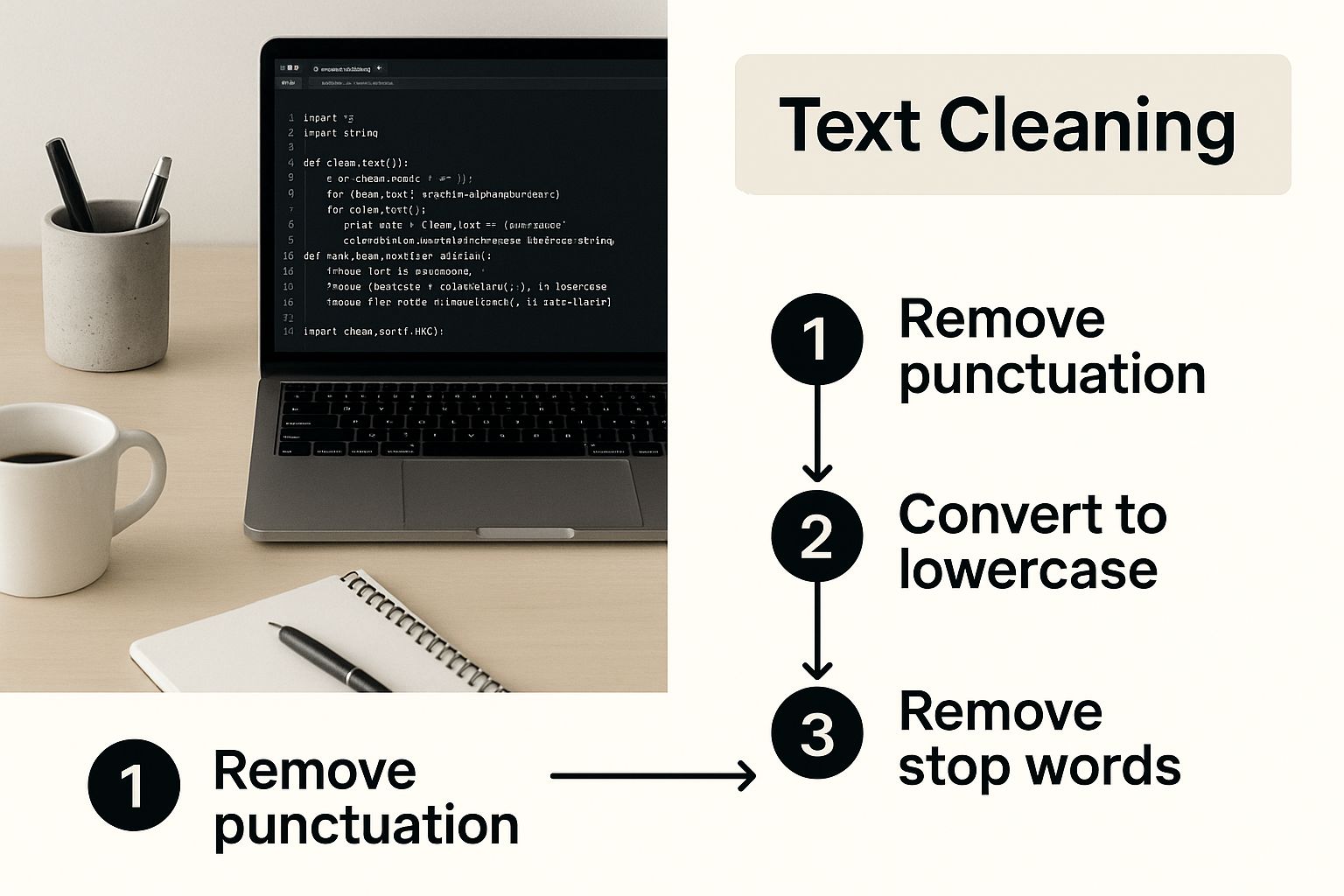
As you can see, the process systematically strips away noise, turning messy, unstructured sentences into a structured format that’s ready for pattern detection and sentiment scoring.
From Clean Text to Actionable Insight
Once the data is preprocessed, the real analysis can finally begin. With a clean foundation, we can apply more sophisticated text mining and sentiment analysis techniques to pull out hidden themes and automatically identify key information. This is where the magic happens, turning what was once just a jumble of words into a source of strategic business intelligence.
Two powerful techniques often used at this stage are Topic Modeling and Named Entity Recognition (NER).
Actionable Insight: The quality of your output is directly tied to the quality of your preprocessing. Investing time in proper data cleaning prevents the classic "garbage in, garbage out" problem and ensures your final conclusions are reliable.
Uncovering What People Are Talking About
Topic modeling is an unsupervised machine learning technique that scans a collection of documents to discover the abstract "topics" that run through them. For example, if you fed a topic model thousands of hotel reviews, it might automatically identify clusters of words related to "cleanliness," "customer service," and "amenities"—all without being explicitly told to look for them.
Finally, Named Entity Recognition (NER) is another core technique that identifies and categorizes key entities in text, such as:
- People: "Steve Jobs"
- Organizations: "Apple Inc."
- Locations: "Cupertino"
- Products: "iPhone"
By combining these methods—preprocessing, topic modeling, and NER—organizations can systematically deconstruct huge volumes of text. You can transform a sea of unstructured data into a well-organized map of key themes, entities, and, ultimately, customer sentiment.
Choosing the Right Sentiment Analysis Method
Alright, you've cleaned up your text data, and now comes the fun part: picking your analytical weapon of choice. This is a critical step in any text mining and sentiment analysis project. The method you choose will directly shape the quality and depth of your insights.
It's not a one-size-fits-all situation. The best approach depends on what you’re trying to achieve, the kind of data you're working with, and how precise you need to be. Think of it as the difference between getting a rough sketch of customer sentiment versus a detailed, actionable blueprint.
At a high level, sentiment analysis methods fall into two main camps: rule-based (or lexicon-based) systems and machine learning models. Each has its own way of looking at emotional tone, and each comes with its own pros and cons.
The Dictionary Approach: Lexicon-Based Methods
Lexicon-based sentiment analysis is the most straightforward of the bunch. Just imagine a giant dictionary where every word has a pre-assigned sentiment score. "Happy" might be a +2, "excellent" a +3, while "terrible" gets a -3 and "disappointing" a -2.
The system simply scans your text, tallies up the scores of the words it recognizes, and spits out a final sentiment rating. It's fast, simple to set up, and doesn't need any training data, which makes it great for quick, high-level snapshots.
But that simplicity is also its Achilles' heel. It really struggles to understand context and nuance.
Practical Example: A lexicon-based tool would read a sarcastic comment like, "Amazing, another three-hour flight delay," and probably flag it as positive because of the word "amazing." It completely misses the sarcasm, giving you a totally wrong read.
When you need to get past these surface-level interpretations, it’s time to bring in the heavy hitters.
Learning from Data: Machine Learning Models
Machine learning (ML) models flip the script entirely. Instead of following a fixed set of rules, they learn to spot sentiment patterns by training on huge datasets of pre-labeled examples. You essentially show an ML model thousands of positive reviews and thousands of negative ones, and it starts to figure out the subtle word combinations and contextual clues that signal a particular sentiment.
The biggest win here is a much deeper understanding of context, irony, and even industry-specific jargon. Thanks to recent AI breakthroughs, these models have become incredibly sharp. In fact, sentiment analysis accuracy has leaped from around 60% in the mid-2010s to over 90% with modern algorithms. That jump comes from models trained on massive datasets that can grasp the complexities of human expression far better than any dictionary.
Actionable Insight: You can fine-tune pre-trained models on your company’s specific data (e.g., support tickets or reviews). As we discuss in our guide on fine-tuning LLMs, this process makes the model an expert in your unique customer language, drastically improving its accuracy for your needs.
Going Deeper with Specialized Techniques
Sometimes, a simple positive or negative score just doesn't cut it. For those situations, you can turn to more specialized techniques that offer far more granular insights.
-
Hybrid Models: These models give you the best of both worlds, combining the speed of lexicon-based rules with the accuracy of machine learning. A hybrid system might use a dictionary for an initial quick scan and then pass any tricky or ambiguous sentences to an ML model for a more thorough analysis.
-
Aspect-Based Sentiment Analysis (ABSA): This is where things get really interesting for business intelligence. Instead of giving you one sentiment score for an entire piece of text, ABSA breaks it down and assigns sentiment to specific features or "aspects."
Let’s take a look at a smartphone review to see how this works:
"The camera is great, but the battery life is awful."
A standard sentiment analysis might just call this "neutral" or "mixed." Not very helpful, right? ABSA, on the other hand, would give you this:
- Camera: Positive
- Battery Life: Negative
This is the kind of detail product teams dream of. They know exactly which features customers are raving about and which ones are causing frustration. For businesses looking to implement this, there are many powerful platforms out there, as detailed in this overview of Customer Sentiment Analysis Tools.
Ultimately, choosing the right method—whether it's a simple lexicon or a detailed aspect-based model—is what ensures your text mining and sentiment analysis efforts deliver clear, impactful results.
Real-World Business and Research Applications

This is where the theory hits the road. The true power of text mining and sentiment analysis isn't in the algorithms themselves, but in how they're applied to solve real problems. Across every industry, organizations are digging into raw customer feedback, market chatter, and internal documents to find a genuine competitive edge.
It's about creating a scalable way to listen to what people are actually saying—and more importantly, to act on it. From improving product design and patient care to making smarter financial bets, the applications are incredibly diverse. Let's walk through a few concrete examples.
Boosting Product Quality in Retail
Picture a popular retail brand that just launched a new line of wireless earbuds. Sales looked great out of the gate, but the online reviews were all over the place. Sifting through thousands of comments by hand was a non-starter.
So, they pointed their text mining and sentiment analysis tools at over 100,000 product reviews from their own site and major e-commerce platforms. The system quickly spotted a pattern buried in the noise. While customers loved the sound quality (high positive sentiment), a troubling number of negative reviews kept mentioning the same specific defect: the left earbud's battery drained 50% faster than the right one.
Armed with this data-backed insight, the product team could finally take clear action:
- Isolate the problem: They traced the issue back to a faulty component in the charging case.
- Redesign the product: The next manufacturing run included a fix for the battery drain.
- Fix the relationship: They proactively reached out to affected customers with a replacement offer, turning a bad experience into a great one.
The result? A 30% jump in customer satisfaction scores for the updated earbuds within just three months. This is a perfect example of how text analysis can pinpoint critical flaws that would otherwise get lost, directly improving both product quality and brand loyalty.
Improving Patient Experience in Healthcare
This technology is just as powerful outside of retail. A large healthcare provider knew its multiple-choice surveys weren't telling the whole story about patient satisfaction. To get to the truth, they decided to analyze the open-ended comments from thousands of feedback forms.
The analysis immediately uncovered two major friction points. First, patients frequently described feeling "rushed" during their appointments. Second, the sentiment around "appointment scheduling" was overwhelmingly negative, with countless comments about long wait times and poor communication from the front desk.
By mining the actual words patients used, the provider moved beyond star ratings to find specific operational bottlenecks. They used these findings to retrain staff on communication and completely overhaul their scheduling system, cutting average appointment wait times by 15%.
These are the kinds of insights that aggregated ratings completely miss. It's the unstructured text that provides the blueprint for meaningful change. For more on how these technologies are being applied, check out our overview of natural language processing applications.
Informing Financial Investment Strategies
The financial world runs on sentiment. Analysts now use text mining and sentiment analysis to gauge market mood by processing millions of news articles, social media posts, and earnings call transcripts in real time. A sudden surge in negative chatter around a stock can be an early warning of volatility ahead.
For instance, an algorithm might detect a growing number of negative posts on Twitter and in financial forums about a company's hidden supply chain issues—long before the official news breaks. This gives analysts a chance to adjust their models and make more informed trades, effectively turning public opinion into a predictive signal.
This growing adoption is why the sentiment analytics market is booming. A recent report valued the global market at USD 5.42 billion and projects it to hit USD 10.82 billion by 2033. You can dig deeper into these trends in the full sentiment analytics report.
Industry Use Cases and Impact
To bring it all together, here’s a quick look at how different sectors are using these tools to drive real business outcomes.
| Industry | Application | Business Impact |
|---|---|---|
| Retail & E-commerce | Analyzing product reviews and social media feedback. | Identify product defects, improve features, and enhance customer satisfaction. |
| Healthcare | Mining patient feedback forms and online reviews. | Pinpoint service gaps, reduce wait times, and improve overall patient care. |
| Finance | Monitoring news, blogs, and social media for market sentiment. | Predict stock market trends and make more informed investment decisions. |
| Hospitality | Assessing guest reviews from booking sites and social platforms. | Improve hotel amenities, staff training, and guest loyalty. |
| Human Resources | Analyzing employee engagement surveys and exit interviews. | Identify sources of workplace dissatisfaction and reduce employee turnover. |
As these examples show, text mining and sentiment analysis are no longer just niche technologies. They have become essential tools for any organization that wants to understand its customers, employees, and market on a deeper level.
Navigating Common Challenges and Best Practices
While the potential of text mining and sentiment analysis is huge, the road from raw data to clean insights is rarely a straight one. Like any powerful technology, this field comes with its own set of hurdles. Knowing what to expect is what separates a successful project from a frustrating one.
The goal is to anticipate these common problems and have a toolkit of best practices ready. Getting this right ensures your analysis isn't just a neat experiment, but a source of accurate, reliable truth. The trickiest parts almost always come down to the quirks of human language and the quality of your data.
The Problem of Nuance and Context
Human language is a beautiful, complex mess—and a total nightmare for algorithms that crave black-and-white rules. Sarcasm, irony, and industry-specific jargon can easily trip up standard models that haven't been trained on that kind of language.
For example, a model might see the word "sick" and immediately flag it as negative. It completely misses the memo that a younger audience uses it to mean "excellent." This is where context is king. Without it, your sentiment scores can be wildly off base.
Practical Example: An airline analyzing social media might find a tweet that says, "Great. Another delay. Just what I needed." A basic model would see "Great" and incorrectly mark the sentiment as positive. A smarter model, however, would recognize that "Great" and "delay" appearing together is a huge red flag for sarcasm.
To get past these issues, you can't just rely on off-the-shelf tools. You need to get a bit more hands-on.
- Create Custom Dictionaries: Build out your own glossary of terms specific to your industry and assign them sentiment scores. In the gaming world, "grind" might be a neutral or even positive term, but in most other places, it’s a negative.
- Use Advanced Models: Look into modern machine learning models like BERT or other transformers. These are designed to understand context by looking at the entire sentence or paragraph, not just isolated keywords.
- Incorporate Emojis: Don't just strip emojis out! They’re often powerful clues to the true sentiment, especially when the words themselves are ambiguous. A friendly emoji can completely flip the meaning of a seemingly negative comment.
Managing Messy and Low-Quality Data
The other giant roadblock is the data itself. Text from the real world is often a chaotic mix of typos, slang, abbreviations, and other noise. This is the classic "garbage in, garbage out" scenario. If you feed messy data into your model, you'll get messy, unreliable insights back.
This is exactly why data cleaning is a non-negotiable first step in any text mining project. You simply have to do it.
The screenshot above, from our guide on data cleaning, shows how you can systematically remove punctuation, convert text to lowercase, and fix other inconsistencies before the analysis even starts. This foundational work ensures your algorithms are working with clean, standardized text, which drastically improves the reliability of your results.
To make sure your text mining projects deliver, it’s smart to adopt a set of overarching data analysis best practices that work for all kinds of data. This keeps your process structured and your data integrity high from beginning to end. By pairing solid data cleaning with context-aware models, you can sidestep the most common obstacles and finally unlock what your text data is trying to tell you.
How to Turn Your Text Insights into Action
Pulling insights from text mining and sentiment analysis is a huge win, but it’s really only half the job. The real payoff comes when those discoveries start driving smart, strategic actions. This is where raw data stops being a report and starts becoming a real business advantage—turning what you’ve learned into what you do.
To make that happen, you have to move beyond basic charts and spreadsheets. Your job is to craft a compelling data story that actually connects with people, whether they're product managers or C-suite executives. Numbers on their own can feel abstract, but a clear narrative gives them meaning and, more importantly, a sense of urgency.
From Data Points to Data Stories
Visualizing your results is the first step in building that narrative. Don't just show a pie chart of sentiment scores; create visuals that spotlight trends, patterns, and opportunities. A great data story connects the dots for your audience, showing them not just the "what" but the crucial "so what?"
For instance, you could build a dashboard that shows how negative sentiment around "shipping times" spikes during the same week every month. That’s not just a data point anymore; it's a story pointing directly to a recurring logistics bottleneck that needs fixing. When you present insights this way, the path to action becomes clear and hard to ignore.
The goal is to make your data impossible to ignore. A well-told data story doesn't just present facts; it builds a case for change, showing stakeholders exactly where the problems are and what the impact of solving them could be.
A Practical Example: Creating a Feedback Loop
Let's say a SaaS company analyzes its support tickets and finds a big cluster of negative sentiment around a new feature's "confusing user interface."
Here’s how they could turn that insight into action:
- Insight: The analysis reveals that 25% of all negative feedback in the last month mentions the new UI.
- Visualization: They create a simple timeline chart. It shows a huge spike in negative sentiment immediately after the feature was launched, visually tying the problem directly to the release.
- Action: The product team sees this data story and immediately prioritizes a UI redesign in their next development sprint.
- Feedback Loop: After the updated UI goes live, they keep monitoring sentiment. They find that negative mentions of the UI have dropped by 80%, confirming the fix was a success.
Checklist for Actionable Insights
This simple process creates a powerful, continuous improvement cycle fueled by real customer feedback. To get this going in your own organization, you need to build a systematic customer feedback loop. If you want to dive deeper into this, our guide on generating data science insights offers a more detailed look at the process.
Here’s a quick checklist to get you started:
- Centralize Your Data: Pull text from all the important places—reviews, surveys, support tickets, social media—and get it into one spot.
- Automate Analysis: Set up your text mining and sentiment analysis tools to process new data as it comes in.
- Identify Actionable Themes: Keep an eye out for recurring topics that have strong positive or negative sentiment attached to them.
- Route Insights to the Right People: Automatically flag issues and send alerts directly to the teams that can fix them (e.g., product, marketing, or support).
- Track and Measure: Once a fix is in place, keep monitoring sentiment on that theme to measure the impact of your actions and prove the value of your work.
Got Questions? We've Got Answers.
Even with a solid plan, jumping into text mining and sentiment analysis always brings up a few practical questions. Let's tackle some of the most common ones to help you smooth out the bumps on the road from raw text to real insights.
How Much Data Do I Really Need for Good Sentiment Analysis?
There’s no magic number here—it all comes down to what you’re trying to accomplish.
If you just want a directional feel for customer opinion, a few hundred documents might be enough. Think product reviews or survey responses. This is perfect for getting a quick pulse and spotting early trends.
But if your goal is to build a high-accuracy, custom machine learning model from scratch, you'll need a much bigger playground. We're talking thousands of labeled examples to get statistically meaningful results that you can actually trust.
The most important thing to remember isn't just the amount of data, but its quality. A smaller, clean, and highly relevant dataset will almost always outperform a massive, messy one.
What Are the Best Free Tools for Text Mining?
The good news is you don't need a huge budget to get started. There's a whole ecosystem of powerful, free tools out there, whether you're a coder or prefer a more visual approach.
For those comfortable writing a bit of code, the Python world is your oyster. The go-to libraries are:
- NLTK (Natural Language Toolkit): A classic. It's the perfect place to start for learning the fundamental concepts of text processing and analysis.
- spaCy: Known for being incredibly fast and production-ready. This is what you'll want when building real applications that need to perform.
- Scikit-learn: An all-in-one toolkit that offers fantastic tools for turning text into features and plugging them into machine learning models.
If you're looking for a no-code solution, plenty of platforms have generous free plans. Tools like MonkeyLearn or even Google Sheets with the right add-ons can get you doing basic sentiment analysis without touching a single line of code.
How Does Sentiment Analysis Handle Sarcasm?
Ah, sarcasm. It’s easily one of the biggest headaches in sentiment analysis.
Your basic, old-school models that rely on word dictionaries almost always get it wrong. They take everything literally. So a comment like, "Great, another two-hour meeting," would probably get flagged as positive because of the word "great."
This is where modern machine learning and deep learning models really earn their keep. Algorithms like BERT and other transformers don't just look at individual words; they analyze the entire context of a sentence. They see the surrounding words, punctuation, and sentence structure, which helps them spot the contradictions that scream "sarcasm!" and lead to a far more accurate read.
At DATA-NIZANT, we’re all about making complex AI and data science topics clear and actionable. Find more deep dives and expert analysis at https://www.datanizant.com.