

Explainable AI techniques are the tools and frameworks we use to make sense of what an artificial intelligence system is actually doing. Think of them as a translator for complex, often "black box" models. They show us why an AI arrived at a specific conclusion, which is absolutely essential for building trust, ensuring fairness, and even just debugging the system when something goes wrong.
Why Explainable AI Is a Business Imperative

Have you ever seen an expert solve a tough problem but then struggle to explain how they did it? That’s the exact challenge we face with many powerful AI models. They produce incredible results, but their inner workings are so opaque that they create significant business risks. Without understanding the 'why' behind an AI's decision, we're left flying blind.
This lack of transparency isn't just a technical headache; it's a fundamental business problem. Imagine a bank's AI model denies a loan application. If the bank can't explain the reason—was it credit history, income, or an unintended bias?—it risks losing customers and facing serious regulatory heat.
Building Trust and Ensuring Fairness
Trust is the bedrock of AI adoption. Stakeholders, from customers all the way up to the C-suite, are naturally hesitant to rely on systems they don't understand. Explainable AI (XAI) techniques are what lift that veil, turning opaque algorithms into transparent, understandable partners.
By revealing the key factors driving a decision, XAI helps us confirm that our models are not just accurate, but also fair and ethical.
Here’s how that plays out:
- Enhanced Trust: When users see the logic behind an AI's recommendation, they're far more likely to trust it and use it.
- Bias Detection: XAI can shine a light on hidden biases lurking in training data, helping organizations catch and correct discriminatory outcomes in critical areas like hiring or lending.
- Improved Debugging: When a model messes up, explainability helps developers pinpoint the cause in minutes, not days.
This urgent need for transparency is fueling massive market growth. The global Explainable AI market was valued at USD 7.79 billion in 2024 and is projected to explode to over USD 21 billion by 2030. This isn't just hype; it's driven by the real-world demand for interpretable AI in high-stakes fields like finance and healthcare.
Meeting Regulatory and Compliance Demands
Regulators are catching on fast, and new rules are emerging to hold organizations accountable for their automated decisions. This growing focus on legal frameworks makes XAI a necessity, not a "nice-to-have." For anyone in this space, getting familiar with a comprehensive guide to AI compliance and the EU AI Act is becoming non-negotiable.
Explainable AI isn't just about good practice anymore; it's about survival. In regulated industries, the inability to explain an AI-driven decision is a direct path to non-compliance, hefty fines, and lasting reputational damage.
You simply can't have effective AI governance without explainability. It provides the evidence needed to prove that models are operating fairly and within legal lines. For a deeper look at this, check out our guide on AI governance best practices. By embracing these techniques, businesses can finally move from uncertainty to confidence, building AI systems that are robust, reliable, and responsible.
Model-Agnostic vs. Model-Specific Techniques
When you start exploring explainable AI, one of the first big distinctions you'll run into is between model-agnostic and model-specific approaches. The best way to think about it is with a simple analogy.
A model-specific method is like a specialized diagnostic tool built by a car manufacturer just for their own engines. It’s incredibly precise for that one brand, digging deep into the proprietary mechanics, but it's completely useless on any other car.
On the other hand, a model-agnostic technique is like a universal mechanic's toolkit. It’s designed to work on any car, no matter the make or model. Its greatest strength is this flexibility, letting you diagnose a Ford, a Toyota, or a Tesla with the same set of tools. This makes it perfect for comparing how different models perform on the same problem.
The Precision of Model-Specific Techniques
As the name suggests, model-specific techniques are built to take advantage of the internal architecture of a specific type of model. They have "insider access" to how the model works, so they can often deliver highly accurate and detailed explanations.
For instance, a decision tree is naturally easy to understand—its explanation is the model itself. For more complex deep learning models, a popular technique is Integrated Gradients, which precisely calculates feature importance by tracking how a prediction changes as you tweak a feature's value.
These methods give you deep, granular insights. But there's a major trade-off: they lock you into a particular model family. If you wanted to compare a neural network's logic against an XGBoost model's, you'd be stuck using two completely different—and often incomparable—explainability tools.
The Flexibility of Model-Agnostic Tools
This is exactly where model-agnostic methods come in. They treat the AI model like a "black box," focusing only on the relationship between its inputs and outputs. This makes them incredibly versatile. You can apply the same method to anything from a simple linear regression to a complex neural network.
This flexibility is a huge win for data science teams. It lets them maintain a consistent approach to interpretability in machine learning, no matter which algorithm they're using. You can learn more about building this consistency in our guide on the fundamentals of machine learning interpretability.
Because they offer a unified framework, model-agnostic tools are fantastic for comparing how different models tackle the same problem. You get a fair, standardized evaluation every time.
The core advantage of the model-agnostic approach is its versatility. It empowers teams to experiment with various algorithms while using a single, consistent set of tools to explain and validate their behavior.
Modern tools like SHAP (SHapley Additive exPlanations) and LIME (Local Interpretable Model-agnostic Explanations) have become the cornerstones of this approach. They are critical for bringing clarity to complex models, which in turn helps drive more transparent decision-making. In fact, the software segment of the XAI market is on track to hold nearly 75% of the market share, showing a clear industry preference for scalable, ready-to-use XAI solutions—especially in sensitive fields like healthcare and finance where accountability is non-negotiable.
This infographic gives a high-level comparison of the computational demands of some popular model-agnostic techniques.
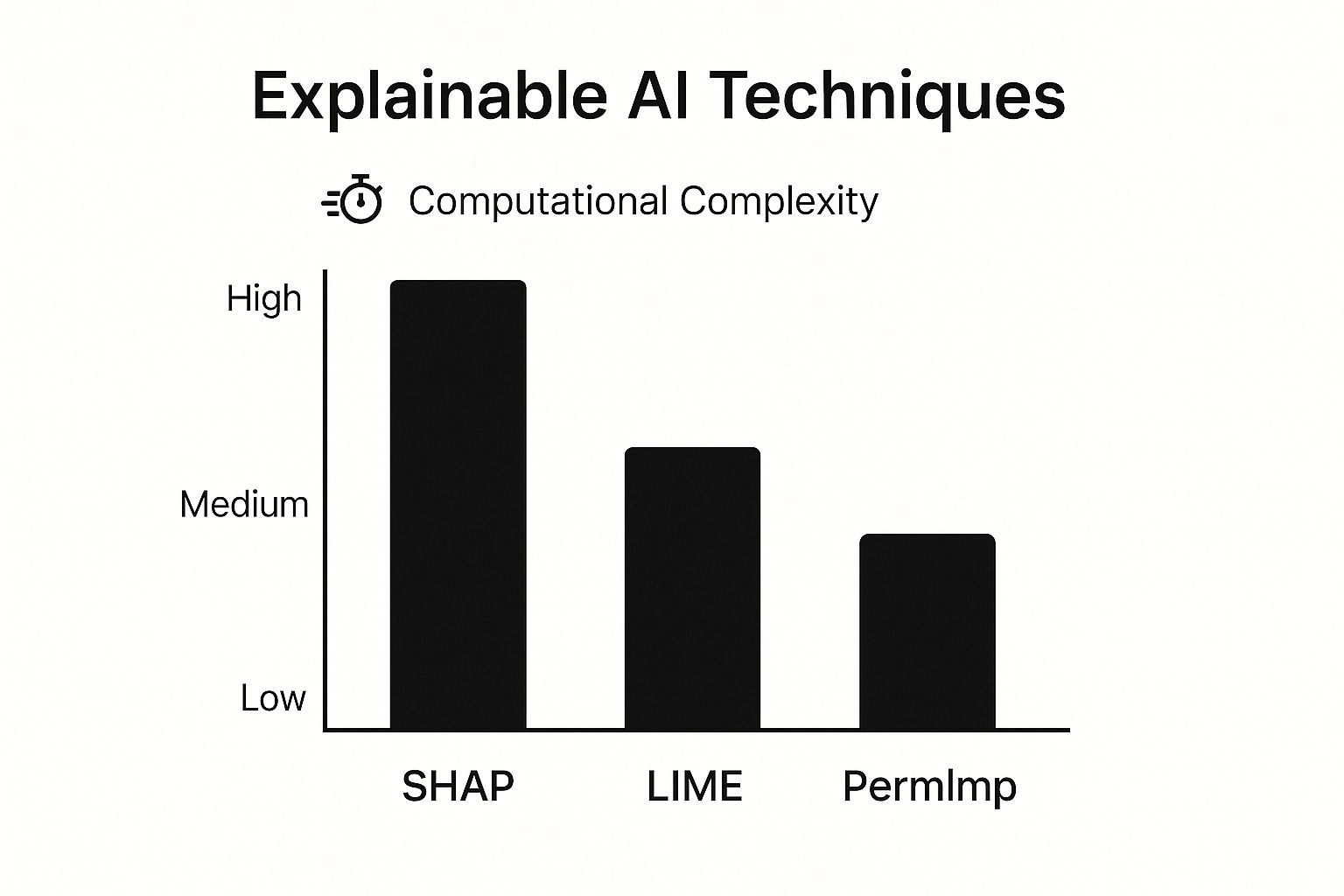
As the visualization shows, while a method like SHAP provides robust theoretical guarantees, it often comes with a higher computational cost. This contrasts with the faster, more approximate nature of LIME or Permutation Importance.
To help you decide which path to take, this table breaks down the core differences between the two approaches.
Comparing Model-Agnostic and Model-Specific XAI
| Attribute | Model-Agnostic Techniques | Model-Specific Techniques |
|---|---|---|
| Flexibility | High. Works with any model (e.g., neural networks, decision trees, SVMs). | Low. Tied to a specific model architecture (e.g., only for tree-based models). |
| Consistency | High. Provides a uniform framework for comparing different models. | Low. Explanations are not comparable across different model types. |
| Ease of Use | Generally easier to apply, as they don't require deep knowledge of the model's internals. | Can be more complex, often requiring intimate knowledge of the model's structure. |
| Accuracy | May be less precise as they treat the model as a black box. | Often more accurate and detailed due to "insider access" to the model's logic. |
| Use Case | Ideal for comparing models, validating behavior across an organization, and when using diverse algorithms. | Best when you're committed to one model type and need the deepest possible insights. |
| Examples | SHAP, LIME, Permutation Feature Importance | Integrated Gradients (for Neural Networks), TreeSHAP (for Tree Models), Feature Importance from Coefficients (for Linear Models) |
Ultimately, choosing the right approach comes down to your specific needs. If you're working exclusively with one type of model and require the deepest possible insight into its mechanics, a model-specific tool might be the perfect fit. However, if your goal is flexibility, model comparison, and a standardized explanation framework across your organization, then model-agnostic techniques are the clear winner.
Local and Global Explanations

To really get a feel for how an AI model behaves, you have to look at it from two different altitudes: the close-up, individual decision and the 30,000-foot, panoramic view. These two vantage points map directly to local and global explanations, a core concept in the world of explainable AI.
Think about a self-driving car for a moment. Asking why it slammed on the brakes at a specific intersection is a local question. The answer might be, "It detected a pedestrian stepping off the curb." That’s a local explanation—it clarifies one specific decision, right here, right now.
But if you ask about the car’s overall driving philosophy, that's a global question. The answer would sound more like, "The system is programmed to always prioritize pedestrian safety over maintaining speed." This is a global explanation. It gives you the model's general rules of thumb across all possible situations. You absolutely need both to build a complete picture.
Why You Need Local Explanations
Local explanations are your boots-on-the-ground tool for debugging and digging into specific cases. They’re what you reach for when a model does something you didn't expect and you need to know why for that single instance.
Imagine a fraud detection system flags a totally legitimate transaction. A local explanation would pinpoint exactly what raised the red flag—maybe an unusually large purchase amount combined with a new shipping address. This kind of immediate, granular insight is invaluable for:
- Customer Service: When you can tell a customer exactly why their transaction was flagged or their loan was denied, you build trust and give them clear, actionable feedback.
- Debugging: When a model messes up, local explanations are like a diagnostic report. They point developers straight to the features that caused the error for that one case.
- Auditing: For high-stakes decisions in finance or healthcare, having a documented, explainable reason for every single outcome is non-negotiable.
The Strategic Value of Global Explanations
While local explanations zoom in, global explanations zoom out. They show you the model’s overall strategy and reveal the major forces driving its predictions across the entire dataset. This is where you get the insights needed for big-picture strategic planning and risk management.
For example, a global explanation of a customer churn model might show that poor customer support interactions and infrequent product usage are, by far, the two biggest predictors of a customer leaving. That kind of high-level insight is pure gold for:
- Business Strategy: It can drive broad company decisions, like investing more in customer support training or launching a campaign to re-engage inactive users.
- Bias Detection: By looking at the model's general tendencies, it becomes much easier to spot if it's systematically penalizing a certain demographic, even if each individual decision looks okay on its own.
- Model Validation: Global explanations confirm that your model learned the patterns you actually expected it to. It’s a sanity check that ensures the AI’s logic aligns with your own domain knowledge and business goals.
A model isn't truly understood until you can articulate both its specific actions (local) and its general philosophy (global). One without the other provides an incomplete and potentially misleading picture of its behavior.
Many of the most powerful explainable AI techniques are built to give you both types of insight. For instance, a method like SHAP is famous for its ability to deliver detailed local explanations for one prediction and then roll them up into a high-level global summary of what features matter most. If you want to see how that works in the real world, check out our guide on using SHAP for both global and local interpretability.
Mastering both views is what allows a team to go from just using a model to truly understanding and trusting it.
Getting Your Hands Dirty with LIME and SHAP
Alright, we've covered the theory. Now it’s time to see how two of the most popular and powerful explainable AI techniques, LIME and SHAP, actually work in the wild. These model-agnostic tools are the go-to workhorses for any data scientist trying to peek inside a "black box" model.
Think of LIME and SHAP as two expert investigators, each with their own unique style. LIME is like a detective zooming in on the evidence around a single, specific event. SHAP, on the other hand, is like a meticulous auditor who accounts for every single factor's contribution to the final outcome.
How LIME Generates Local Explanations
LIME, which stands for Local Interpretable Model-agnostic Explanations, is built on a brilliantly simple idea. Instead of trying to figure out the entire, overwhelmingly complex model all at once, it just focuses on explaining one prediction at a time. It does this by building a simple, temporary "proxy" model that mimics the bigger model's behavior right around that single data point.
Imagine your complex AI model is like a winding, hilly road that’s impossible to describe with one simple equation. LIME's approach is to pick a single spot on that road—one prediction—and lay a short, straight ruler down next to it. That ruler is a simple, interpretable model (like a linear regression) that gives you a very accurate approximation of the road's direction, but only for that tiny segment.
The process is pretty intuitive:
- Pick a Prediction: You choose a single instance you want to understand. For example, why was this specific customer flagged as likely to churn?
- Jiggle the Data: LIME creates hundreds of tiny variations of that customer's data—slightly changing their monthly bill, their tenure, and so on. These are called perturbations.
- Get New Predictions: It then runs all these slightly-off data points through the original complex model to see how the predictions change.
- Train a Simple Model: Finally, LIME trains a simple, easy-to-understand model on this new dataset of variations and their outcomes. The feature weights of this simple model tell you exactly which factors were most important for that one specific customer.
The genius of LIME is its focused simplicity. By approximating a small slice of a complex model with a simple one, it delivers fast, intuitive, and localized explanations that are easy for anyone to grasp.
This method is perfect for quick, on-the-spot debugging or explaining a single decision to a manager or customer. If you want to see this in action, our guide on applying LIME for local interpretability has hands-on code examples to get you started.
Unpacking Predictions with SHAP
While LIME is fast and local, SHAP (SHapley Additive exPlanations) takes a more mathematically rigorous route, with its roots in cooperative game theory. It aims to fairly distribute the model's "payout" (the final prediction) among all the "players" (the input features).
The core idea comes from Shapley values, a concept designed to assign credit to each player on a team based on their marginal contribution to the team's overall success. In the world of AI, this means every feature gets a SHAP value for every single prediction, quantifying exactly how much it pushed the prediction higher or lower compared to the average.
This allows SHAP to provide both stunningly detailed local explanations and incredibly powerful global summaries. You can see precisely why one customer was flagged as high-risk, then zoom out and aggregate thousands of these explanations to see which features are driving risk across your entire customer base.
One of the most powerful visuals in the SHAP library is the summary plot, which visualizes global feature importance at a glance.
Here’s a SHAP summary plot for a model predicting a medical outcome.
This one chart tells a rich story. We can immediately see that higher Glucose levels (the red dots on the right) strongly push the model's output higher. At the same time, lower Age and BMI values (the blue dots on the left) push the prediction lower.
Choosing Between LIME and SHAP
When you're deciding which tool to reach for, it helps to understand their core strengths and weaknesses. There's no single "best" tool; the right choice depends entirely on your specific goal—whether you need a quick local check or a comprehensive global analysis.
Here’s a quick breakdown to help you decide:
| Feature | LIME | SHAP |
|---|---|---|
| Primary Goal | Provides fast, intuitive local explanations for individual predictions. | Offers both local and global explanations with strong theoretical guarantees. |
| Methodology | Approximates the black-box model locally with a simple, interpretable model. | Based on Shapley values from cooperative game theory to fairly attribute predictions. |
| Consistency | Explanations can sometimes be unstable if you change the data perturbations slightly. | Mathematically consistent and reliable; provides the only additive feature attribution method. |
| Speed | Generally faster for explaining a single instance, as it only looks at a local region. | Can be computationally expensive, especially for large datasets or complex models. |
| Visualizations | Simple and focused, primarily showing feature importance for one prediction. | Rich set of visualizations, including summary plots, force plots, and dependence plots. |
| Best For | Quick debugging, explaining single decisions to stakeholders, building trust in specific cases. | Deep model analysis, understanding global feature effects, regulatory compliance, and bias detection. |
Ultimately, many data scientists use both. LIME is fantastic for a quick gut check on a single prediction, while SHAP is the tool you bring out for a deep, comprehensive audit of your model's behavior.
Interpreting SHAP Visualizations for Business Value
Let’s bring this back to a business problem. Imagine you've built a model to predict customer churn. After running your data through SHAP, you generate a summary plot.
- You might see that high values for "monthly charges" (red dots) are clustered on the right side, telling you they strongly push the prediction toward "churn."
- Conversely, high values for "customer tenure" (red dots) might be clustered on the left, showing that long-term customers are far less likely to leave.
These aren't just academic findings; they're immediately actionable insights. The business can now consider creating loyalty discounts for long-tenured customers or investigate whether recent price hikes are driving people away. This is where explainable AI techniques stop being theoretical and start creating real business value.
For an even more granular view, a SHAP force plot visualizes the push-and-pull of each feature for a single prediction. It's like a tug-of-war, with red features pushing the prediction higher (e.g., toward "churn") and blue features pulling it lower. It gives you a complete, transparent story for every single case.
Embedding XAI into Your MLOps Workflow

If you're serious about operationalizing machine learning, explainability can't be an afterthought. It has to be a core component of your MLOps pipeline. Just running a SHAP analysis right before you push to production is a huge missed opportunity.
To build models that are truly robust and trustworthy, explainable AI techniques need to be woven into every single stage of the ML lifecycle. This isn't just about checking a compliance box; it's about creating a powerful feedback loop that drives continuous improvement. You shift from reactive debugging to proactively making your models better, fairer, and more transparent from the very start.
From Development to Deployment
A mature MLOps practice treats explainability as a critical quality gate. Before a model can advance to the next stage, it has to pass transparency checks, just like it passes accuracy tests. This approach ensures explainability is baked in, not just bolted on at the end.
Here’s a practical look at how to operationalize XAI:
- During Development: As soon as you have a baseline model, use global explanations like SHAP summary plots. These give you a bird's-eye view of feature importance, helping you make smarter choices about feature engineering. You can quickly see which signals are driving predictions and which are just noise.
- During Validation: Before a model sees the light of day, use XAI tools to actively hunt for bias. You can analyze feature importance across different demographic groups to make sure the model isn't unfairly penalizing users based on things like location or gender.
- In Production: Your job isn't done at deployment. Set up automated monitoring that tracks for "explanation drift." If the features driving your model's predictions suddenly change, that's a massive red flag for data or concept drift, signaling it's time to investigate.
When you integrate XAI into MLOps, your pipeline stops being a simple model factory and becomes an insight-generation engine. Every stage is a chance to learn more about your data and your model's behavior.
A Practical Example: The Explanation Dashboard
Let's make this more concrete. Imagine a bank deploys a model to predict loan defaults. Instead of just tracking its accuracy, they build an "Explanation Dashboard" for the risk management team.
This dashboard doesn't just spit out a prediction. It tells a story. For every loan application that gets denied, it generates a simple LIME explanation highlighting the top three reasons, like "High debt-to-income ratio" or "Short credit history."
This simple integration accomplishes three things:
- Empowers End-Users: Loan officers can now give clear, actionable feedback to applicants.
- Builds Trust: The risk team gains confidence because they can audit the model's logic on demand.
- Creates a Feedback Loop: If the team notices the model consistently penalizes a certain feature unfairly, they can flag it for the data science team to retrain the model.
The Business Case for Operationalizing XAI
The push to embed explainable AI techniques into daily operations is growing fast. The Explainable AI market is projected to hit USD 30.26 billion by 2032, driven largely by the need for transparency in high-stakes industries. As global regulations demand more accountability, having XAI built into your workflow is becoming non-negotiable. You can learn more from this detailed industry report on StellarMR.com.
Operationalizing XAI gives you a clear audit trail, keeps regulators happy, and—most importantly—helps you build better models. For a solid foundation on structuring these workflows, our guide on MLOps best practices is a great place to start. By making XAI a part of the process, you ensure every model you ship is not just accurate, but also responsible, fair, and completely understood.
Building a Future with Transparent AI
We've covered a lot of ground, and it's clear that explainable AI techniques are much more than just a box of tools. They represent a fundamental shift in how we build AI—moving toward systems that are responsible, trustworthy, and ultimately, far more effective. We've gone from just knowing what a model predicts to understanding why, unpacking key ideas like model-agnostic versus model-specific approaches and local versus global explanations.
Through hands-on examples with LIME and SHAP, we saw firsthand how these methods can translate a model's complex, internal logic into insights we can actually use. This isn't just about ticking a compliance box; it's about building better products and earning the trust of the people who use them. As AI gets more powerful, our need to verify its outputs only grows.
Of course, a truly transparent AI is also a reliable one. Part of building that trust involves making sure the model's outputs are sound. For instance, understanding strategies to reduce LLM hallucinations is a great complementary step toward building AI you can depend on.
The key takeaway is this: integrating explainability isn't a final step but a continuous practice. It's the bridge between powerful algorithms and real-world impact, ensuring that innovation remains firmly in human hands.
I encourage you to start weaving these powerful explainable AI techniques into your own projects. When you do, you'll unlock a deeper understanding of your models, build confidence with your stakeholders, and help lead the way in responsible, human-centric innovation.
Have Questions About XAI? We've Got Answers.
As you start weaving explainable AI techniques into your projects, you're bound to run into a few common questions. Let's tackle some of the big ones to clear things up and help you move forward with confidence.
What's the Real Difference Between Interpretability and Explainability?
Though people often use these terms as if they're the same, they actually describe two different paths to understanding your model.
Interpretability is about models that are simple enough to be understood just by looking at them. Think of a classic linear regression or a small decision tree. Their logic is right there on the surface, and you don’t need any special tools to see how they work.
Explainability, on the other hand, is what you do when you have a complex "black box" model. It involves using external techniques, like LIME or SHAP, to create a human-friendly explanation for why the model made a certain decision.
An easy way to think about it: an interpretable model is like an open-book test—you can see all the logic laid out. An explainable model is more like a closed-book test, where an expert has to come in afterward and walk you through how a specific answer was reached.
Can Explainable AI Tools Actually Be Misleading?
Yes, and it's crucial to be aware of this. Explanation methods are often just approximations of a model's true, complex behavior. Sometimes they can oversimplify things to the point of being misleading, or even be unstable.
For instance, a local explanation from LIME might not be representative of the model's overall logic. You might even get a different explanation if you run it again with slightly different settings.
The key is to treat XAI outputs as investigative clues, not as the absolute truth. The best approach is to combine multiple explainable AI techniques, apply your own critical thinking, and build a more complete, reliable picture of what your model is really doing. As we've covered in our guide to MLOps best practices, rigorous validation is non-negotiable.
How Do I Pick the Right XAI Technique for My Project?
There's no single "best" tool—the right choice always comes down to your model and your specific goal. But here’s a quick, practical breakdown to get you started:
- For simple, inherently transparent models (like logistic regression), you often don't need a separate tool. The model's own coefficients can tell you most of what you need to know.
- For complex models like XGBoost or neural networks, SHAP is a fantastic place to start. It’s built on solid theoretical ground and gives you both local and global insights.
- If you need fast, on-the-fly local explanations for a live application, LIME can be a great choice. It's generally less computationally intensive for explaining a single prediction.
Before you pick a tool, always ask yourself: who needs this explanation, and what decision will they make with it? Answering that question will almost always point you to the most effective technique for the job.
At DATA-NIZANT, our mission is to make complex topics in AI and data science accessible. To keep building your expertise, explore more of our in-depth articles at https://www.datanizant.com.