

Artificial Intelligence is no longer a futuristic concept; it is a core driver of competitive advantage and operational efficiency. However, moving from AI hype to tangible return on investment requires more than just technology acquisition. It demands a clear, well-structured plan. Many organizations stumble, facing significant challenges that range from inadequate data readiness and fragmented infrastructure to cultural resistance and a lack of clear business alignment. Successful implementation is not about simply plugging in new software; it is about strategically embedding an AI-first mindset into the very fabric of your business operations.
This article cuts through the noise to provide a definitive blueprint. We will break down eight essential AI adoption strategies that offer a comprehensive framework for organizations of any size or maturity level. Drawing on insights from industry leaders and real-world applications, we will explore actionable models, from starting with small, focused pilot projects to building scalable, enterprise-wide AI platforms.
Each strategy presented here offers a unique pathway to success, covering critical pillars like governance, data management, and human-centric design. As we have detailed in previous blogs like our guide to building a data strategy framework on datanizant.com and the importance of human-centered AI on datanizant.com, a holistic and integrated view is non-negotiable for sustainable success. This guide is designed to be your practical resource, equipping you with the knowledge to navigate the complexities of AI adoption and transform ambitious goals into measurable achievements. Let's dive into the proven strategies that will define your organization's AI journey.
1. Start Small and Scale Gradually
One of the most effective and widely endorsed AI adoption strategies is to begin with focused, manageable projects and expand over time. This "start small, scale gradually" approach involves launching pilot programs or proofs-of-concept (PoCs) in specific, low-risk business areas. This method allows organizations to test AI's potential, learn from initial deployments, and build internal expertise and confidence without committing to a massive, high-risk overhaul from the outset.
This incremental strategy minimizes initial investment and contains potential failures, turning them into valuable learning experiences rather than catastrophic setbacks. It’s a pragmatic way to navigate the complexities of AI implementation, championed by thought leaders like McKinsey & Company and integrated into frameworks from IBM and MIT Sloan School of Management.

Why This Strategy Works
Starting small provides a controlled environment to understand the nuances of AI technology, from data requirements to model integration. For instance, Walmart didn't attempt to revolutionize its entire supply chain at once. Instead, it initiated projects in inventory management, using AI to predict demand for specific products in certain stores. The success and insights gained from these smaller projects provided the foundation and business case for broader, more complex supply chain optimization initiatives. Similarly, JPMorgan Chase first applied AI to the well-defined problem of fraud detection before leveraging it for highly complex algorithmic trading.
Actionable Insight: The goal of a pilot project isn't just technical success; it's about demonstrating tangible business value to secure executive buy-in and build organizational momentum for wider AI adoption.
How to Implement This Strategy
To successfully apply this AI adoption strategy, a methodical approach is essential. Follow these actionable steps to ensure your initial projects lay a strong groundwork for future scaling.
- Identify High-Impact, Low-Complexity Use Cases: Begin by brainstorming potential AI applications across departments. Prioritize those that can deliver a clear, measurable business impact (e.g., cost reduction, efficiency gain) but are technically feasible with your current resources and data. A practical example: a marketing team could pilot a simple AI tool to automate the categorization of customer feedback emails, freeing up hours of manual work.
- Establish Clear Success Metrics: Before writing a single line of code, define what success looks like. Key Performance Indicators (KPIs) could include reducing manual processing time by 30%, improving sales forecast accuracy by 15%, or increasing customer engagement by 10%. These metrics are crucial for evaluating the pilot's ROI.
- Ensure Data Readiness: AI models are only as good as the data they are trained on. Focus on a use case where you have access to clean, well-structured, and sufficient data. The pilot phase is an excellent time to identify and rectify data quality or accessibility issues on a small scale, a lesson learned in many projects highlighted in our data strategy framework on datanizant.com.
- Involve End-Users Early: Engage the employees who will ultimately use the AI tool. Their feedback during the development and testing phases is invaluable for ensuring the final product is practical, user-friendly, and effectively integrated into their workflow.
- Document Everything: Treat the pilot as a learning exercise for the entire organization. Meticulously document the process, challenges, failures, and successes. This knowledge repository will become a critical guide for accelerating and de-risking future AI projects as you scale.
2. Center of Excellence (CoE) Approach
Establishing a dedicated AI Center of Excellence (CoE) is a powerful strategy for centralizing expertise and driving coordinated AI adoption. This approach involves creating a formal, cross-functional team of AI specialists who set the direction, establish best practices, and provide governance for all AI initiatives across the organization. The CoE acts as an internal consultancy, accelerating projects and ensuring alignment with overarching business goals.
This centralized model prevents siloed efforts, reduces redundant work, and ensures that AI deployments are secure, ethical, and scalable. It's a strategic framework advocated by major consulting firms and research bodies like Gartner and Deloitte, designed to build a sustainable AI capability rather than executing one-off projects.

Why This Strategy Works
A CoE provides the critical mass of expertise needed to tackle complex AI challenges that individual departments cannot handle alone. It standardizes tools, platforms, and methodologies, creating a consistent and efficient AI development lifecycle. A practical example: Procter & Gamble (P&G) established an analytics CoE that developed reusable data models and visualization tools. This enabled various brand teams to launch data-driven marketing campaigns much faster, without each team needing to build its own analytics infrastructure from scratch.
Actionable Insight: The primary role of an AI CoE is to enable and empower business units with the right tools, knowledge, and governance, not to control or dictate every project. It acts as a catalyst, not a gatekeeper.
How to Implement This Strategy
A successful AI CoE requires a deliberate structure and a clear mandate. Follow these actionable steps to build an effective central team that drives your AI adoption strategies forward.
- Define a Clear Charter and Governance Model: Start by defining the CoE’s mission, scope, and decision-making authority. Outline its responsibilities, including strategy development, technology standards, data governance, and ethical guidelines. This charter ensures everyone understands the CoE's role.
- Assemble a Cross-Functional Team: The CoE should not be purely technical. Include data scientists, ML engineers, data architects, and business strategists, as well as representatives from legal, ethics, and key business units. This diversity ensures a holistic perspective.
- Focus on Creating Reusable Assets: Direct the CoE to build and maintain a repository of reusable components, such as data pipelines, pre-trained models, and code libraries. For example, the CoE could create a standardized customer segmentation model that the marketing, sales, and product teams can all leverage.
- Establish Communication and Training Programs: The CoE must actively share knowledge. Create regular communication channels like newsletters, workshops, and office hours. Develop training programs to upskill employees across the organization, fostering a data-literate culture. This aligns with the principles we discuss in our articles on building a robust data strategy framework on datanizant.com.
- Measure Success with Business-Oriented KPIs: Track the CoE's impact through metrics tied to business outcomes. Focus on KPIs like the number of successful AI deployments, project ROI, reduction in operational costs, or speed-to-market for new AI-powered features.
3. Data-First Strategy
A data-first strategy prioritizes data infrastructure, quality, and governance as the non-negotiable foundation for any successful AI initiative. This approach treats high-quality, accessible, and well-governed data not as a prerequisite, but as the central pillar of the entire AI adoption process. It means an organization focuses on collecting, cleaning, organizing, and securing its data assets before attempting to deploy complex AI models.
This foundational approach is championed by AI pioneers like Andrew Ng and is central to the modern data stack concepts popularized by platforms like Snowflake and Databricks. By treating data as a primary strategic asset, organizations ensure their AI models are built on a solid, reliable bedrock, preventing the common "garbage in, garbage out" pitfall that derails many ambitious AI projects.
This summary box visualizes the key performance indicators for a successful data-first initiative, tracking improvements in data audit coverage, quality, and governance policy implementation.
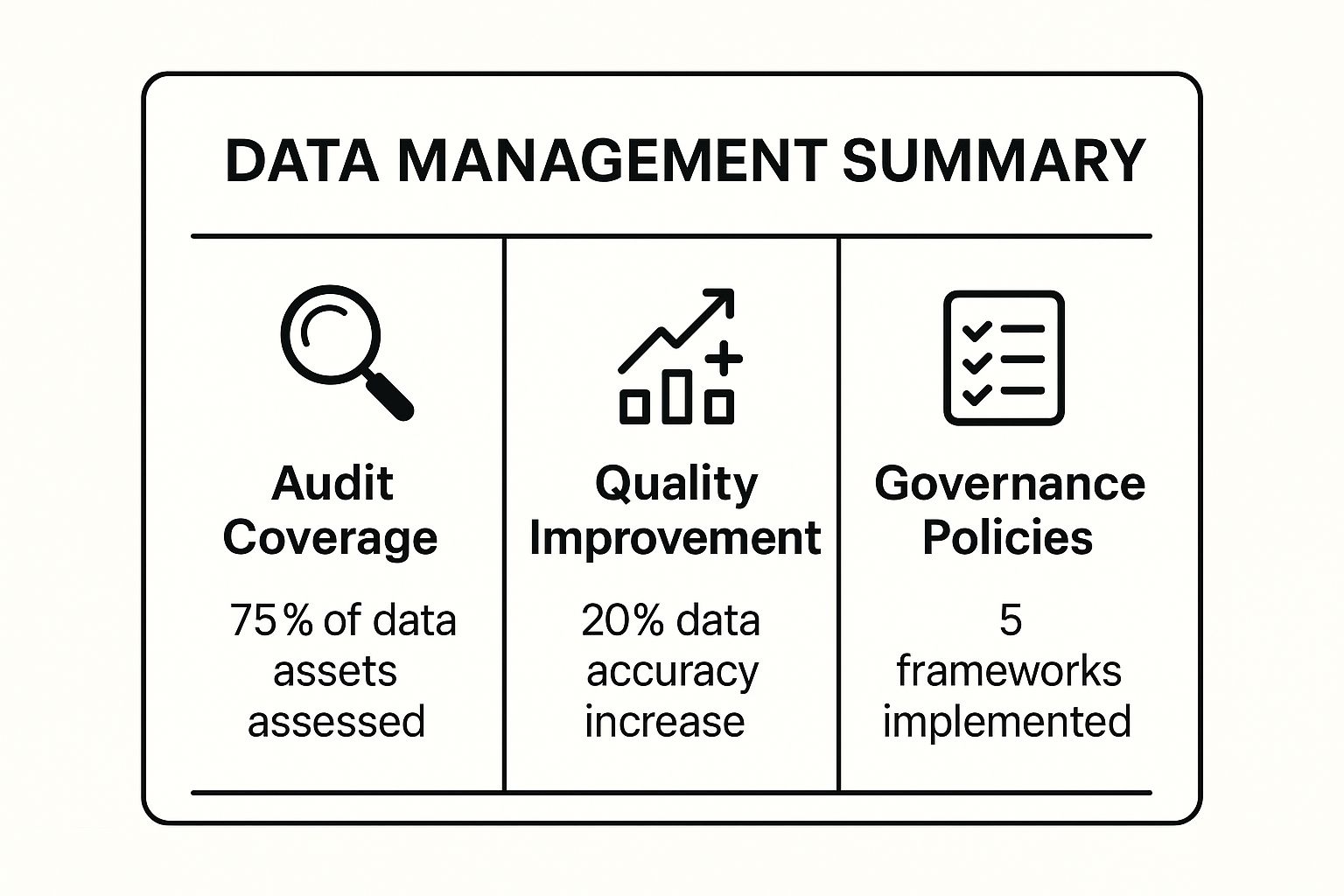
These metrics provide a clear, quantifiable view of how data-first efforts directly translate into a more robust and trustworthy data ecosystem ready for advanced AI applications.
Why This Strategy Works
AI models are fundamentally dependent on the data they are trained on; their performance and reliability are a direct reflection of data quality. A practical example: Netflix’s world-class recommendation engine is only possible because the company first invested heavily in building a unified data platform to ingest and process trillions of events, from user viewing habits to interaction times. This high-quality data foundation allows them to train models that deliver highly personalized and accurate suggestions.
Actionable Insight: Adopting a data-first mindset shifts the focus from chasing the latest AI models to building the sustainable data capabilities that make those models effective, reliable, and scalable in the long run.
How to Implement This Strategy
Implementing a data-first approach requires a systematic commitment to data management excellence. Follow these steps to build a strong foundation for your AI adoption strategies.
- Start with a Data Inventory and Quality Assessment: You cannot manage what you do not measure. Begin by cataloging all organizational data sources and performing a thorough audit to assess their quality, completeness, and accessibility. A practical first step is to use a data profiling tool on a key customer database to identify and quantify issues like missing fields or inconsistent formatting.
- Implement Robust Data Governance Policies: Establish clear rules and processes for data ownership, access control, usage, and security from the outset. A strong governance framework ensures data remains consistent, trustworthy, and compliant with regulations like GDPR or CCPA. For a deeper dive, explore how to build a comprehensive data strategy framework on datanizant.com.
- Invest in Data Engineering Capabilities: Your data-first strategy will rely heavily on skilled data engineers. This team is responsible for building and maintaining the "data pipelines" that ingest, transform, and serve data to AI models and analytics teams, making their role critical to success.
- Create a Centralized Data Catalog: As your data assets grow, discoverability becomes a major challenge. Implement a data catalog, a metadata management tool that acts as an inventory of all data, making it easy for data scientists and analysts to find and understand the data they need.
4. Partnership and Ecosystem Strategy
Another powerful AI adoption strategy is to forge external collaborations rather than attempting to build all capabilities in-house. This approach involves partnering with AI vendors, technology providers, research institutions, and industry consortiums to accelerate development and deployment. By leveraging an ecosystem of external expertise and pre-built solutions, organizations can focus on their core competencies while tapping into cutting-edge AI advancements.
This collaborative model reduces the immense pressure on internal teams to master every facet of the rapidly evolving AI landscape. It allows businesses to access specialized skills, sophisticated platforms, and validated models that would otherwise require prohibitive time and investment to develop. This strategy is heavily promoted by major tech players like Google Cloud, Microsoft, and IBM, who have built extensive partner ecosystems to facilitate AI adoption across industries.
Why This Strategy Works
A partnership strategy provides a shortcut to sophisticated AI capabilities and domain-specific knowledge. A practical example: instead of building its own conversational AI from scratch, Domino's Pizza partnered with Nuance Communications to create "Dom," a voice-ordering AI assistant. This allowed Domino's to quickly launch an innovative customer service feature by leveraging Nuance's deep expertise in speech recognition, a capability that would have taken years to develop internally.
Actionable Insight: Strategic partnerships are not about outsourcing responsibility; they are about augmenting internal strengths with external expertise to achieve business outcomes that would be unattainable or take too long to achieve alone.
How to Implement This Strategy
Successfully navigating an ecosystem of partners requires a clear vision and structured management. Follow these actionable steps to build a powerful and secure partnership strategy.
- Define Clear Objectives and Roles: Before engaging any partner, clearly articulate the business problem you are solving and what success looks like. Define the specific roles, responsibilities, and expected contributions of each party to avoid misalignment and ensure accountability.
- Leverage Complementary Capabilities: Identify partners whose strengths fill your internal gaps. If your team excels at business process knowledge but lacks deep machine learning expertise, find a partner who brings that technical depth. This symbiotic relationship is a hallmark of successful AI collaborations.
- Establish Robust Governance and IP Agreements: Partnerships inherently involve sharing data and intellectual property. It is crucial to establish clear agreements on data ownership, usage rights, security protocols, and IP from the outset. As collaborations often involve multiple vendors, mastering third-party risk management is non-negotiable for protecting sensitive assets and ensuring compliance.
- Maintain Strategic Control: While leveraging partner capabilities, ensure your organization retains strategic oversight and control of the core AI initiative. This prevents over-dependence and ensures the final solution remains aligned with your long-term business goals.
- Integrate with Your Broader Tech Stack: Effective partnerships ensure that the AI solutions can be seamlessly integrated with your existing systems. This often involves aligning with your broader cloud computing strategies to ensure scalability, data flow, and operational efficiency.
5. Human-Centric AI Adoption
A truly successful AI adoption strategy places people at its core, focusing on augmenting human capabilities rather than simply replacing them. This human-centric approach prioritizes change management, transparent communication, and employee empowerment. It ensures that AI tools are designed to enhance human judgment, creativity, and problem-solving skills, leading to greater acceptance and more impactful outcomes.
This philosophy moves beyond pure technological implementation to consider the cultural and ethical dimensions of AI. It is championed by leaders like Microsoft's Satya Nadella, who advocates for AI that empowers every person, and Stanford's Fei-Fei Li, a proponent of human-centered AI design. By putting people first, organizations can mitigate fear, foster a culture of collaboration with new technologies, and unlock the full potential of their workforce.
Why This Strategy Works
A human-centric approach directly addresses the primary obstacle to AI adoption: employee resistance and fear of obsolescence. By framing AI as a collaborative partner or a "co-pilot," organizations can build trust and encourage adoption. A practical example: Autodesk developed its "generative design" software to act as a creative partner for engineers. The engineer inputs design goals and constraints (like materials and cost), and the AI generates thousands of potential design options. The engineer then uses their expertise to evaluate and refine the best options, creating a final product that combines the best of machine computation and human intuition.
Actionable Insight: The most powerful AI is not one that replaces human intellect, but one that amplifies it. This strategy focuses on creating a symbiotic relationship where technology handles computation and data analysis, freeing humans to focus on strategy, creativity, and complex decision-making.
How to Implement This Strategy
Adopting a human-centric AI strategy requires a deliberate and empathetic approach. Follow these actionable steps to ensure your AI initiatives empower your team.
- Involve Employees in the Design Process: Co-create AI solutions with the people who will use them every day. Host workshops and feedback sessions to understand their pain points and identify opportunities where AI can be most helpful. This turns employees into stakeholders rather than subjects of a top-down mandate.
- Communicate Benefits Clearly and Transparently: Articulate how AI will improve specific job roles, not just the company's bottom line. For instance, explain that an AI tool will automate report generation, freeing up 5 hours per week for analysts to focus on interpreting data and advising stakeholders.
- Invest in Comprehensive Training and Reskilling: Proactively identify skills gaps and provide robust training programs. This not only equips employees to use new AI tools effectively but also demonstrates a commitment to their long-term career growth within the company. This approach is critical in areas like talent acquisition, where leveraging AI in recruitment and intelligent assessment requires new skills in data interpretation and strategic sourcing.
- Establish Clear Ethical AI Guidelines: Develop and communicate a framework for responsible AI use, addressing concerns about privacy, bias, and decision-making transparency. This builds trust and ensures AI is applied in a manner consistent with your organization's values. You can learn more about human-centered AI on datanizant.com.
- Create Feedback Loops for Continuous Improvement: Launching an AI tool is not the final step. Implement channels for ongoing feedback to understand how the tools are performing in the real world and identify areas for refinement. This iterative process ensures the AI evolves to better serve its human users.
6. Adopt a Domain-Specific AI Strategy
A domain-specific AI strategy involves developing or deploying artificial intelligence solutions that are deeply tailored to a particular business function or industry vertical. Instead of using generic, one-size-fits-all AI models, this approach leverages specialized data, algorithms, and deep domain expertise to solve highly specific and complex problems unique to an industry. This targeted application ensures higher accuracy, relevance, and impact.
This method prioritizes depth over breadth, creating AI that understands the specific nuances, regulations, and terminology of a field like finance, healthcare, or agriculture. This focus is a cornerstone of effective AI adoption strategies, as highlighted in sector-specific reports by firms like PwC and Boston Consulting Group, which emphasize that true value is unlocked when AI is customized for industry-specific challenges.
Why This Strategy Works
Generic AI models often fail to capture the intricate details and context required for high-stakes professional environments. A domain-specific strategy works because it embeds expert knowledge directly into the technology. For example, Zebra Medical Vision (now part of Nanox) developed AI algorithms trained exclusively on millions of medical imaging scans, enabling it to detect specific diseases with a precision that general-purpose image recognition models could never achieve. Similarly, Kensho provides market analysis and insights for financial services by using models trained on vast, specialized financial datasets and economic reports.
Actionable Insight: A domain-specific strategy transforms AI from a general-purpose tool into a specialized expert, capable of performing tasks that require deep, industry-specific knowledge and understanding. This is how you build a true competitive moat.
How to Implement This Strategy
Successfully applying a domain-specific AI adoption strategy requires a dedicated and focused approach. Follow these actionable steps to build AI solutions that deliver expert-level performance in your field.
- Identify High-Value Domain Challenges: Pinpoint critical business processes or pain points that are unique to your industry and could be significantly improved with specialized AI. In manufacturing, this might be predictive maintenance for specific machinery; in legal, it could be contract analysis for a particular type of agreement.
- Leverage Industry-Specific Datasets: The power of domain-specific AI comes from specialized data. Prioritize the collection, cleansing, and annotation of high-quality datasets that are directly relevant to your industry. As discussed in our data strategy framework on datanizant.com, the model's expertise is directly tied to the data it learns from.
- Partner with Domain Experts: Collaborate closely with industry veterans, specialists, and professionals who possess deep subject matter expertise. Their knowledge is invaluable for defining the problem correctly, annotating data accurately, and validating the performance of the AI model in real-world scenarios.
- Address Regulatory and Compliance Needs: Many industries, such as healthcare (HIPAA) and finance (FINRA), have strict regulatory requirements. Build compliance directly into your AI models and workflows from the very beginning to ensure the solution is not only effective but also legally and ethically sound.
- Build or Acquire Deep Expertise: Invest in building an in-house team with a combination of AI and domain-specific skills, or partner with specialized vendors who already have a proven track record in your industry. This ensures your AI initiatives are guided by people who understand both the technology and the business context.
7. Platform-Based AI Strategy
For organizations committed to enterprise-wide AI integration, a platform-based AI strategy offers a powerful path to scalability and efficiency. This approach involves building or adopting a centralized AI platform that provides foundational capabilities, standardized tools, and reusable services that can be leveraged across multiple business units and use cases. It shifts the focus from building bespoke, siloed solutions to creating a robust, shared infrastructure that accelerates development and ensures consistency.
This strategy democratizes AI by equipping diverse teams with the tools they need to build, deploy, and manage machine learning models without reinventing the wheel each time. It’s a core component of the AI adoption strategies used by tech giants like Google with its AI Platform, Amazon with SageMaker, and Microsoft with Azure ML, who have demonstrated how a unified platform can foster innovation at scale.
Why This Strategy Works
A platform-based approach directly combats the fragmented and often redundant efforts that can plague large organizations. Instead of each department sourcing its own tools and building custom data pipelines, a central platform provides a "single source of truth" for AI development. A practical example: Uber developed its Michelangelo platform to manage the entire ML workflow. This allowed teams working on everything from ETA predictions to fraud detection to use the same standardized infrastructure, dramatically cutting development time from months to weeks and ensuring operational consistency.
Actionable Insight: An AI platform isn't just a collection of tools; it's an operational model that enforces best practices in MLOps, governance, and collaboration, creating a scalable "AI factory" for the entire enterprise.
How to Implement This Strategy
Deploying a platform-based strategy is a significant undertaking that requires careful planning and a long-term vision. The goal is to build a foundation that serves the entire organization.
- Establish a Central AI/ML Team: Form a dedicated team responsible for building, maintaining, and governing the platform. This team will define the architecture, select the core technologies, and provide support and training to business units, ensuring the platform meets evolving organizational needs.
- Design for Flexibility and Extensibility: The platform must support a variety of frameworks (e.g., TensorFlow, PyTorch), data types, and deployment patterns. Design with a modular architecture using APIs so that new tools and capabilities can be integrated easily as technology advances.
- Prioritize MLOps Capabilities: A successful platform must have robust Machine Learning Operations (MLOps) features. This includes tools for data versioning, experiment tracking, automated model training and validation, CI/CD for ML, and performance monitoring, concepts which are explored in detail in our article on agile for data science.
- Provide User-Friendly Interfaces: To encourage widespread adoption, the platform should cater to various skill levels. Include low-code/no-code interfaces for business analysts and citizen data scientists, alongside powerful SDKs and notebooks for expert data scientists and ML engineers.
- Embed Governance and Security: Build in robust security, access control, and governance features from the start. The platform should manage model lineage, ensure compliance with data privacy regulations, and provide clear audit trails for all AI/ML activities.
8. Agile AI Development and Experimentation
Adopting an agile methodology for AI development is a powerful strategy that prioritizes rapid experimentation, iterative progress, and continuous learning. Unlike traditional, linear software development, AI projects are inherently uncertain, making them a perfect fit for an agile approach. This strategy involves creating environments that support fast prototyping, testing, and iteration to quickly discover what works and discard what doesn't.
This approach transforms AI development from a monolithic, high-risk endeavor into a series of small, manageable experiments. It embraces the principles popularized by Eric Ries' Lean Startup methodology and is a core component of the innovative cultures at companies like Netflix and Google. By focusing on learning and adaptation, organizations can navigate the complexities of AI and deliver value more quickly.
Why This Strategy Works
Agile AI development works because it aligns with the exploratory nature of machine learning. AI models are not just coded; they are trained and discovered through experimentation with data, algorithms, and parameters. A practical example: Spotify uses its "squad" model to rapidly develop and test new AI-powered recommendation features. A small, autonomous team can quickly build a prototype for a new playlist algorithm, A/B test it on 1% of users, analyze the engagement metrics, and decide within a week whether to iterate, expand the test, or abandon the idea. This prevents wasting months on a feature that users don't value.
Actionable Insight: Agile AI isn't just about speed; it's about accelerating the learning cycle. The goal is to minimize the time between having an idea and getting real-world data on its impact, which reduces risk and finds business value faster.
How to Implement This Strategy
Applying agile principles to AI requires a blend of cultural mindset and technical infrastructure. The following steps provide a clear path for implementing one of the most dynamic AI adoption strategies.
- Establish Clear Experimentation Guidelines: Define what a "sprint" looks like for an AI project. Set clear hypotheses (e.g., "We believe using feature X will improve model accuracy by 5%"), success criteria, and a defined scope for each iteration. This brings structure to the creative process.
- Implement Robust MLOps Practices: Machine Learning Operations (MLOps) is the backbone of agile AI. Implement tools and processes for automated data pipelines, model training, version control (for both code and data), and rapid deployment. This technical foundation enables teams to move from idea to production quickly and reliably.
- Create a Safe Environment for Failure: Not every experiment will succeed, and that's okay. Foster a culture where "failed" experiments are treated as valuable learning opportunities. Amazon's famous "two-pizza team" structure empowers small teams to take calculated risks, knowing that learning from failure is part of the innovation process.
- Balance Speed with Governance: While speed is a goal, it cannot come at the expense of quality, ethics, and compliance. Integrate governance checkpoints into the agile workflow without stifling innovation. This includes model validation, bias checks, and security reviews as part of the iteration cycle. For a deeper dive, DataNizant offers insights into applying agile methodologies specifically for data science.
AI Adoption Strategies Comparison Table
| Strategy | Implementation Complexity 🔄 | Resource Requirements ⚡ | Expected Outcomes 📊 | Ideal Use Cases 💡 | Key Advantages ⭐ |
|---|---|---|---|---|---|
| Start Small and Scale Gradually | Low to medium; iterative pilot projects | Low initial investment | Measurable small wins; gradual scaling | Low-risk departments; proof-of-concept testing | Low risk; faster initial value; easier buy-in |
| Center of Excellence (CoE) Approach | High; requires organizational change and setup | High; dedicated AI experts team | Standardized practices; coordinated AI ops | Large organizations seeking governance | Consistent standards; efficient resource use |
| Data-First Strategy | High; complex data infrastructure overhaul | High upfront investment | Strong AI foundation; improved model accuracy | Organizations prioritizing data quality | Better accuracy; reduced bias; scalable data ops |
| Partnership and Ecosystem Strategy | Medium; coordination with multiple external parties | Medium; leverage external expertise | Accelerated adoption; shared risks | Firms needing specialized AI capabilities | Access to cutting-edge tech; faster time-to-market |
| Human-Centric AI Adoption | Medium to high; cultural and change management | Medium to high; training investments | Higher employee acceptance and ethical AI | Employee-focused AI transformations | Better adoption; ethical compliance; sustainability |
| Domain-Specific AI Strategy | Medium to high; specialized AI development | Medium to high; domain expertise | High relevance and accuracy for industry | Industry verticals with unique AI needs | Competitive edge; better compliance; domain fit |
| Platform-Based AI Strategy | High; complex platform design and maintenance | High initial development cost | Scalable AI infrastructure; reuse of assets | Organizations aiming for AI at scale | Economies of scale; faster deployment; democratized AI |
| Agile AI Development and Experimentation | Medium to high; requires cultural shift and MLOps | Medium to high; DevOps maturity needed | Fast prototyping; continuous learning | Innovation-driven teams; fast-paced environments | Faster time-to-value; risk reduction; continuous improvement |
Choosing Your Path to Intelligent Transformation
Navigating the complex landscape of artificial intelligence is not about finding a single, magic-bullet solution. As we've explored through the eight distinct AI adoption strategies, the journey toward intelligent transformation is a strategic endeavor, tailored to your organization's unique DNA. Your path forward will likely not be a single lane but a multi-lane highway, blending several of these approaches to create a powerful, customized roadmap.
The strategies we've detailed, from starting small with pilot projects to establishing a centralized Center of Excellence, are not isolated choices but interconnected components. A successful initiative might begin with an agile experimentation mindset to quickly test hypotheses, which then informs a broader, platform-based strategy for scalability. This platform, in turn, must be built upon a robust data-first foundation, ensuring the quality and accessibility of the fuel that powers every algorithm.
Synthesizing Your Strategy: From Theory to Action
The most critical takeaway is that these strategies are not mutually exclusive. True mastery lies in the artful synthesis of these frameworks. Consider how they can complement one another:
- Human-Centric & Data-First: A human-centric approach ensures your AI solutions are adopted and valued by your team, while a data-first strategy guarantees those solutions are built on a foundation of trust and accuracy. Without clean data, even the most user-friendly AI tool will fail; without user buy-in, the most powerful model will gather dust.
- CoE & Agile Experimentation: A Center of Excellence can provide the governance, best practices, and ethical guardrails necessary for responsible AI. Within this secure framework, an agile experimentation culture can flourish, empowering teams to innovate rapidly without introducing unacceptable risk. This creates a "safe sandbox" for creative problem-solving.
- Partnership & Domain-Specific: For organizations venturing into new territory, a partnership strategy can provide immediate access to specialized expertise. This external knowledge can be used to jumpstart a domain-specific strategy, helping your internal teams build deep, targeted capabilities in areas critical to your competitive advantage.
Ultimately, the most effective AI adoption strategies are dynamic and responsive. They are not static plans set in stone but living frameworks that evolve with your organization's maturity, market shifts, and technological advancements. As we've seen in our analysis of various data maturity models, the goal is to create a perpetual motion machine of improvement, where each successful AI implementation generates new data, new insights, and new opportunities for innovation.
The journey is an iterative one. It demands a commitment to continuous learning, a culture that embraces calculated risks, and a leadership team that champions a data-driven vision. By thoughtfully selecting and blending these strategic elements, you are not just implementing technology; you are fundamentally re-architecting your organization to be more agile, insightful, and prepared for the future. The choice is not whether to adopt AI, but how to do it intelligently and sustainably. Your deliberate, strategic approach today will define your competitive edge for years to come.
Ready to move from strategy to execution? The complexities of building a data foundation, implementing governance, and scaling AI initiatives can be daunting. At DATA-NIZANT, we specialize in crafting and implementing bespoke data and AI adoption strategies that align with your unique business goals. Visit DATA-NIZANT to learn how our expertise can accelerate your journey to becoming an intelligent, data-driven enterprise.