
So, you want to become a machine learning engineer? It all starts with a rock-solid foundation in programming (think Python), data structures, and algorithms. From there, it's about getting your hands dirty building and, most importantly, deploying models. The journey is a blend of mastering the tech, creating a portfolio that proves you can do the work, and then acing those tricky, specialized interviews.
Your Machine Learning Engineer Career Roadmap
Jumping into a machine learning engineering career isn't a straight line—it's more like building a stack of interconnected skills, mixing theory with a ton of practical, hands-on work. It's not about one single credential. It's about proving you can build models and get them running in a real production system. That's where the real demand is, and it's what makes this path both challenging and incredibly rewarding.
This guide is your roadmap. We're breaking the whole thing down into clear, manageable steps. Forget the purely academic stuff; we're focusing on the actionable insights and real-world experience that hiring managers are actually looking for.
Everything starts with the fundamentals. These are non-negotiable.
- Actionable Insight: Don't just learn Python syntax. Your first step should be to build a small script that automates a daily task. For example, write a Python script that scrapes a website for weather data and sends you a morning summary. This immediately applies your programming knowledge to a real problem.
- Data Structures & Algorithms: This isn't just for passing interviews. To make this practical, try implementing a hash map from scratch to understand how it efficiently stores and retrieves data, a common task when building feature stores for ML models. This is a critical skill for writing optimized code that can handle massive datasets.
- Cloud Computing Basics: Get comfortable with at least one major cloud platform—AWS, Google Cloud, or Azure. Actionable Insight: Sign up for the AWS Free Tier and use it to deploy a simple Flask API. This hands-on experience is far more valuable than just reading documentation, as modern ML systems are built and deployed in the cloud.
Key Milestones on Your Journey
To help you see the bigger picture, here are the major milestones you'll hit on your way to landing that first ML engineer role. It's a clear progression: foundation first, then application, then getting hired.
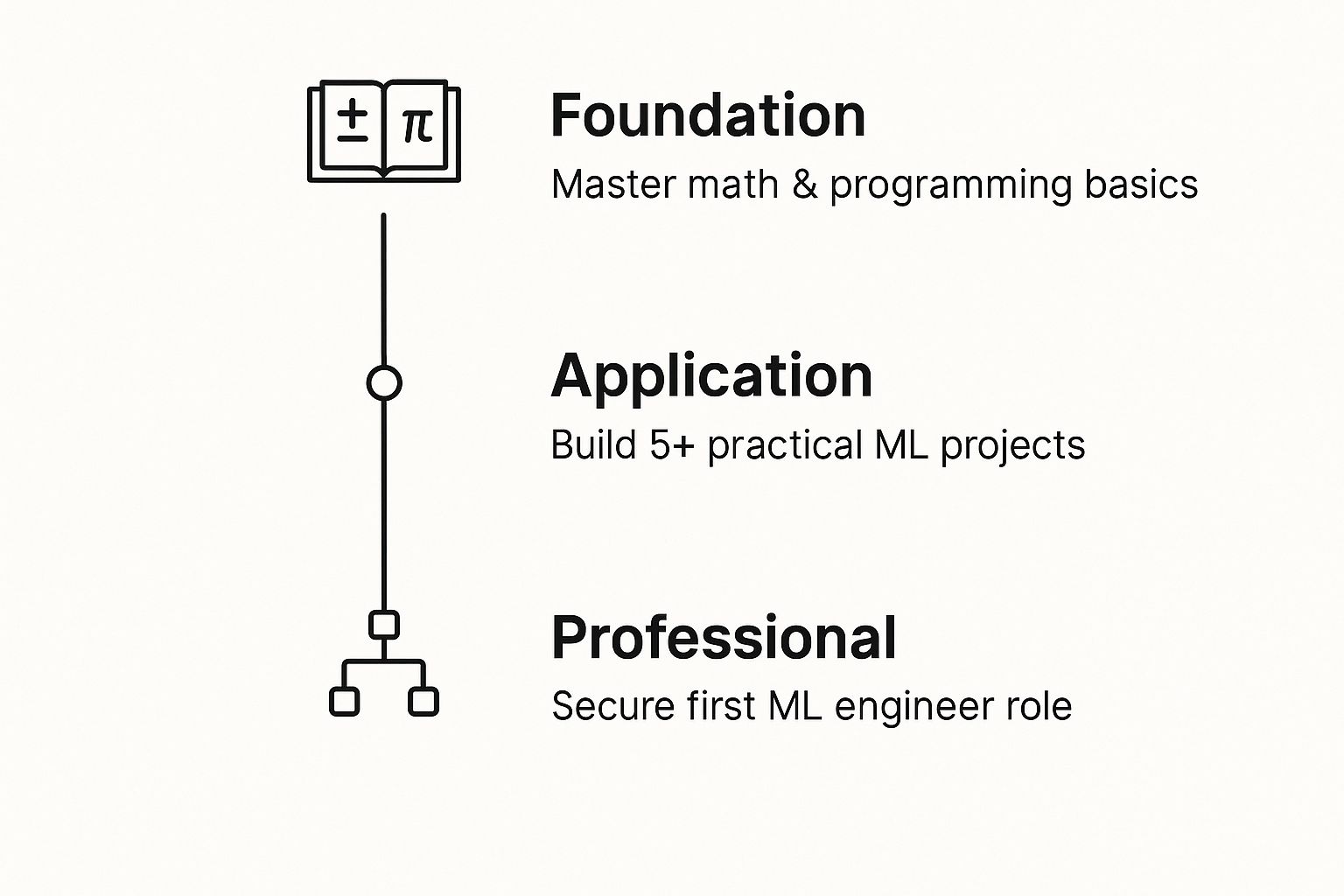
As you can see, a solid base is the launchpad for everything else. As we move through this guide, we’ll dive deep into each of these stages with practical steps and examples. Just like we map out learning paths for data science fundamentals, having a structured approach is what separates success from guesswork.
To give you an even clearer checklist, the table below breaks down the key stages, what you should be focusing on, and a realistic timeline for each phase.
Machine Learning Engineer Career Milestones
Here's a high-level look at your journey, mapping out each stage with its core focus, essential skills, and a rough timeline to keep you on track.
| Stage | Core Focus | Key Skills | Estimated Timeline |
|---|---|---|---|
| Foundation Building | Grasping theoretical and programming fundamentals. | Python, SQL, Linear Algebra, Calculus, Statistics, Probability | 3-6 Months |
| Practical Application | Building and training machine learning models. | Scikit-learn, TensorFlow/PyTorch, Feature Engineering | 6-12 Months |
| Production & Deployment | Deploying models and building end-to-end systems. | Docker, Kubernetes, Cloud (AWS/GCP), MLOps Principles | 6-9 Months |
| Career Launch | Portfolio refinement and interview preparation. | GitHub, Resume Building, System Design, Communication | 2-4 Months |
Think of this table as your quick-reference guide. It highlights that the process is a marathon, not a sprint, with distinct phases dedicated to learning theory, applying it, and finally, getting it into production.
Mastering the Core Technical Skills
A top-tier Machine Learning Engineer is built on a strong technical foundation. This is where you move from theory to practical application, mastering the tools that turn raw data into intelligent systems. Forget long, boring lists of technologies—let's talk about how these skills actually solve real-world problems.
Your journey into the practical side of ML engineering starts with Python. It's the undisputed language of the field, not just because it's clean and simple, but because of its powerful ecosystem of libraries. These are your essential tools for getting things done.
Python and Its Essential Libraries
Think of Python's libraries as specialized toolkits. For any ML engineer, a few are completely non-negotiable.
- NumPy: This is the bedrock for numerical work. Practical Example: When you convert an image into data, it becomes a 3D matrix of pixel values (Height x Width x Color Channels). NumPy's arrays allow you to perform mathematical operations on this entire matrix at once, which is drastically faster than looping through each pixel individually.
- Pandas: If NumPy is for raw numbers, Pandas is for structured data. You'll live inside its DataFrame object. Practical Example: You have a CSV file with 1 million customer transactions. With a single line of Pandas code (
df.groupby('region')['sales'].mean()), you can instantly calculate the average sales per region, a task that would be complex and slow with standard Python lists. - Scikit-learn: This is your go-to for "traditional" machine learning. It provides simple, efficient tools for everything from classification to clustering. Practical Example: You can build and train a logistic regression model to predict customer churn in less than 10 lines of code, importing the model, fitting it to your training data (
model.fit(X_train, y_train)), and making predictions (model.predict(X_new)).
These libraries are designed to work together seamlessly. A very common workflow is using Pandas to load and tidy up a CSV file, then converting a key column into a NumPy array to feed into a Scikit-learn model. This process is central to almost every ML project. As detailed in our blog on Data Engineer vs Data Scientist, handling this data pipeline is a core competency.
Demystifying Core Math Concepts
Don't worry, you don't need a Ph.D. in mathematics. What you do need is an intuitive feel for how certain concepts drive machine learning models.
The goal isn’t to solve complex equations by hand on a whiteboard. It's about understanding the why behind the algorithms—why a model is failing, why a small adjustment boosted performance, or why one algorithm is a much better fit for a problem than another.
For instance, linear algebra is quite literally the language of data. It’s how neural networks perform massive calculations on tensors (which are just multi-dimensional arrays).
Meanwhile, calculus—specifically derivatives—is the engine behind gradient descent. That’s the core process models use to "learn" and improve by systematically minimizing their errors.
And finally, probability and statistics help you make sense of uncertainty and properly evaluate your model's performance. Concepts like p-values or confidence intervals are critical for figuring out if your model's results are genuinely significant or just a random fluke.
The Unsung Hero: SQL
While Python and fancy algorithms get all the spotlight, SQL (Structured Query Language) is the silent workhorse operating behind the scenes. The reality is that most of the world's data is stored in relational databases, and SQL is the only way to get it out.
Practical Example: Before building a recommendation engine, you need to extract user interaction data. This requires writing a SQL query with a JOIN to combine a users table with a product_views table and a purchases table, filtering for activity within the last 90 days. This raw data extraction is step one for any real-world model. Strong SQL skills aren't just a "nice-to-have"—they're a must.
Software Engineering Best Practices
This is what truly separates a great ML engineer from a good one. A model that only works on your laptop is just a cool science experiment; a model that works reliably at scale in a production environment is a product. Getting there requires solid software engineering discipline.
- Git and Version Control: You absolutely have to be proficient with Git. It’s how you’ll collaborate with a team, track changes to your code and models, and—most importantly—roll back to a previous version when something inevitably breaks. It's the safety net for all development.
- Cloud Computing: Your journey to becoming a machine learning engineer will involve a big shift toward specialized skills, and cloud platforms are a huge part of that. Understanding services from providers like Amazon Web Services is crucial because that's where models are actually trained and deployed in the real world. This expertise pays off—ML engineers in tech hubs like San Francisco and Seattle can see top salaries exceeding $245,000 annually, often tied directly to their cloud skills. For anyone looking to validate their expertise, an in-depth AWS Certified Machine Learning Specialty study guide is an invaluable resource.
Building a Portfolio That Gets You Hired
Let's be blunt: theoretical knowledge and a list of skills on a resume are just the price of admission. A powerful, hands-on portfolio is what actually gets you through the door and into an interview. This is your single most important asset. It's the tangible proof that you can step away from a tutorial and solve a genuine, messy, real-world problem.
Hiring managers are looking for evidence. They want to see that you can do more than just build a model; they need to know you can grasp a business problem, wrestle with imperfect data, and ultimately ship a working solution. Your portfolio tells that story, separating you from the hundreds of other applicants who all list the exact same skills.
Moving Beyond Generic Datasets
Starting with classic datasets like Iris or Titanic is a rite of passage. It's fine for learning the fundamentals, but a portfolio that truly stands out has to move beyond these well-trodden paths. Relying on a generic Kaggle dataset for your main project basically tells a recruiter you followed a guide, not that you solved a unique problem.
The real value—the stuff that makes hiring managers take notice—comes from projects that show initiative and a spark of creativity.
The goal isn't just to hit a high accuracy score on a clean, pre-packaged dataset. It's to prove you can navigate the entire machine learning lifecycle—from wrangling messy, unstructured data to deploying a functional application.
Actionable Insight: Find a public API for a topic you love, like the Spotify API for music or the Strava API for fitness. Write a script to collect data over a few weeks. This act of creating your own dataset is a massive differentiator and showcases valuable data engineering skills before you even write a single line of modeling code.
Designing End-to-End Projects
An impressive portfolio project is always "end-to-end." This means it covers every single stage, from the initial idea all the way to a live deployment. A hiring manager isn't interested in another Jupyter Notebook. They want to see a functioning system.
Here's a practical way to think about structuring your projects:
- Problem Formulation: Define the why behind your project. Instead of something generic like "predicting housing prices," frame it with a business purpose: "building a tool to help first-time buyers in Austin, Texas, identify undervalued properties based on real-time listings and neighborhood data." This shows you can think like a problem-solver.
- Data Sourcing and Cleaning: Get specific about how you got your data. Did you use the Zillow API? Scrape Zumper? This phase is all about data cleaning and feature engineering, which will realistically take up 80% of your project time. Showcasing this grunt work is critical.
- Modeling and Experimentation: This is where you get to build and train. But don't just present the final, perfect model. Document your journey. Why did you pick a gradient boosting model over a linear one? What hyperparameters did you tune, and what was the impact? Show your thought process.
- Deployment: This is the most important step, and it's the one most people skip. Actionable Insight: Wrap your trained model in a simple API using Flask or FastAPI. Then, create a
Dockerfileto containerize your application and deploy it on a free service like Heroku or AWS Elastic Beanstalk. Provide a link to the live API in your project's README.
A Practical Project Example
Let's walk through how this framework applies to a real-world idea. Imagine you love fitness and want to build a workout recommendation app.
- Problem: Create a simple web app that suggests a daily workout routine based on a user’s goals (like strength or cardio) and whatever equipment they have on hand.
- Data: You could scrape workout descriptions, muscle groups, and equipment needs from a few fitness websites. This raw text data will be messy, requiring significant cleaning and structuring.
- Model: This is a perfect use case for Natural Language Processing (NLP). You could build a content-based filtering model that takes user preferences and recommends exercises with similar text descriptions.
- Deployment: Build a simple API with FastAPI. One endpoint might accept a user's goals (e.g.,
{"goal": "strength", "equipment": ["dumbbells", "pull-up bar"]}) and return a JSON object with a list of exercises. Then, you can build a basic HTML/CSS front-end that calls this API to display the results.
This project is infinitely more compelling than another Kaggle submission. Why? Because it demonstrates data acquisition, NLP, API development, and product thinking—all essential skills for a machine learning engineer.
Documenting Your Work on GitHub
Your GitHub profile is your professional showroom. A repository containing just a single, uncommented Jupyter Notebook is a major red flag. Every project needs a comprehensive README.md that serves as its official report.
Think of the README as the first thing a recruiter or hiring manager will see. It needs to be professional, clear, and easy to scan.
- Project Overview: Kick things off with a tight summary of the project and the problem it solves.
- Installation and Usage: Give clear, step-by-step instructions on how to set up the project environment and run your code. Actionable Insight: Include a
requirements.txtfile and a single command (pip install -r requirements.txt) to make it effortless for someone to replicate your setup. - Methodology: Explain your approach. Detail your data source, the preprocessing steps you took, the models you experimented with, and the logic behind your choices.
- Results: Show off your work! Include key metrics, charts, and visualizations. Most importantly, explain what these results mean in the context of the original problem.
- Live Demo: If you deployed your project, this is the mic drop. A link to a live, working application is the ultimate proof of your skills.
By building and meticulously documenting just two or three high-quality, end-to-end projects, you create undeniable evidence of your abilities. This isn't just a collection of code—it's a powerful narrative that will get you hired.
Navigating the ML Engineer Job Market
Alright, you've built some skills and have a portfolio shaping up. Now for the hard part: landing that first ML engineer role. It's about more than just knowing how to code; you need a solid strategy for getting your foot in the door.
Think of it as a campaign. You need to find the right internships, build connections, and learn how to get past the automated screening bots. Let’s break down how you can actually do that.

Your first move should be hunting for targeted internships that are heavy on real machine learning applications. A good internship isn't just about getting coffee; it's about adding legitimate, real-world projects to your resume and learning how a professional team operates—code reviews, sprints, and all.
Finding Relevant Internships
Start by scouring online job boards, your university's career portal, and company career pages. Don't just search for "internship"; filter for roles that specifically mention skills you have, like Python, TensorFlow, or experience with data pipeline development.
One of the best ways to get an edge is to talk to alumni from your school who have already interned on ML teams. They can give you the inside scoop on what the experience was really like.
- Look for companies that have well-defined ML mentorship programs. You'll learn a lot more.
- Prioritize roles with clear project goals and deliverables. Vague job descriptions are a red flag.
- Don't forget to check for remote opportunities to broaden your options.
Contributing to Open Source
Want to build credibility before you even land an interview? Start contributing to open-source projects. This is one of the most underrated ways to hone your collaboration skills and get your code in front of experienced engineers. Seriously, even a few merged pull requests can make a huge impression on a hiring manager.
Actionable Insight: Go to the GitHub page for a library you use, like Scikit-learn or Pandas. Click on the "Issues" tab and filter by the "good first issue" label. These are bugs or small improvements specifically set aside for new contributors. Fixing one is a fantastic way to get started.
An active GitHub profile is a powerful signal to recruiters. It shows initiative, technical depth, and a genuine passion for the field.
Networking for Hidden Roles
Here's a statistic that should get your attention: over 85% of jobs are filled through networking and are never publicly posted. If you're only applying online, you're missing out on the vast majority of opportunities.
Building genuine relationships is the key to unlocking these unadvertised roles. Start by attending local tech meetups, ML conferences (even virtual ones), and hackathons. It's your chance to meet peers, mentors, and potential hiring managers.
- Actionable Insight: Find 3-5 ML engineers on LinkedIn who work at companies you admire. Send them a personalized connection request mentioning a specific project they worked on that you found interesting. Ask for a 15-minute "virtual coffee" chat to learn about their career path. Most people are happy to help.
- Always follow up with a thank-you note that summarizes your conversation and suggests a next step.
- Keep a simple spreadsheet to track who you've met and when you should follow up. It works.
Tailoring Your Resume
Most companies use Applicant Tracking Systems (ATS) to scan resumes before a human ever sees them. These systems are looking for specific keywords and skills. If your resume doesn't have them, it gets filtered out.
For every single application, you need to customize your skills section to mirror the language in the job description. If they ask for API deployment experience, make sure that exact phrase is on your resume.
skills:
- Python
- TensorFlow
- Scikit-learn
- Flask
- Docker
Keep the layout clean and simple. Fancy columns and graphics can confuse the automated parsers, so stick to a standard format.
Interview Stage Breakdown
The interview process for an ML engineer role is usually multi-staged. A phone screen will test your general coding and problem-solving abilities. Next, you'll likely face a live coding challenge focused on common algorithms or implementing a basic ML model from scratch.
Finally, the system design interview is where you'll be asked to architect a scalable ML pipeline. This is where they separate the candidates who just know models from those who know how to build real products.
| Round | Focus | Key Preparation |
|---|---|---|
| Phone Screen | Basic Coding | LeetCode Mediums, Data Structures & Algorithms |
| Coding Challenge | Algorithmic ML | Implement K-Means, Logistic Regression from scratch |
| System Design | Architecture | Diagram pipelines, discuss monitoring & trade-offs |
Don't forget the behavioral rounds. They want to see how you communicate, work in a team, and take ownership of problems. Use the STAR method (Situation, Task, Action, Result) to structure your answers around your past projects.
Practice, practice, practice. Get on a whiteboard (or a virtual one) with a friend and work through real ML interview questions.
Practical Example: For a system design interview, be prepared to draw the architecture for a "real-time fraud detection system." You'll need to discuss data ingestion (e.g., Kafka), feature engineering, model serving (low-latency APIs), and a feedback loop for retraining. This demonstrates your ability to think from first principles under pressure.
Now, let's talk numbers. A machine learning engineer role typically requires a degree in a related field, but what really matters is progressive experience in computer science, data science, or math. Entry-level salaries start around $118,000, jumping to $134,000 with just a couple of years of experience, and can climb over $191,000 for senior engineers.
Once you feel ready, make sure you're looking at all your options. Don't limit yourself geographically. Check out curated lists of remote ML jobs to see what's available globally. Working remotely can expose you to different types of datasets and distributed systems much faster.
It can also be helpful to understand how the ML Engineer role differs from related positions. To get a clearer picture, check out our guide on the differences between data roles here: Data Engineer vs Data Scientist.
This whole process is a marathon, not a sprint. Track your applications, set weekly goals for outreach, and tweak your approach based on the feedback you get.
Consistent follow-up and an adaptable strategy are what turn applications into offers.
Breaking into this field takes patience and persistence. Use this playbook to build your plan and execute it with confidence. Your hard work will pay off when you're sitting in interviews, confidently showcasing your expertise.
Stay hungry, keep learning, and remember that every connection you make and every line of code you write is a step toward that offer letter.
Growing Your Career Beyond the First Job
Landing your first machine learning engineer role is a massive achievement—but it's the starting line, not the finish. The real journey begins now. This is where you focus on sustained growth, find your niche, and evolve from building models to architecting complex, high-impact systems.
The field moves incredibly fast. What got you your first job won't be enough to secure your next one.
Continuous learning isn't just a buzzword here; it's a core requirement of the job. Actionable Insight: Set aside 3 hours every Friday to read and implement a new research paper from arXiv. Pick one that's relevant to your work and try to reproduce its results on a small scale. Attending a major conference like NeurIPS or ICLR, even virtually, can expose you to groundbreaking ideas long before they become mainstream.
Finding Your Niche
As you gain experience, you'll naturally start gravitating toward certain areas of machine learning. Now is the time to lean into that and think about specializing. Instead of being a jack-of-all-trades, developing deep expertise in a high-demand subfield will dramatically accelerate your career.
Here are a few popular specializations you could pursue:
- MLOps (Machine Learning Operations): This path is for engineers who love building robust, scalable infrastructure. You'll spend your time automating the entire ML lifecycle. Practical Example: On your next project, build a complete CI/CD pipeline using GitHub Actions that automatically retrains, tests, and deploys your model whenever new data is tagged. If that sounds like you, a great next step is to explore our detailed guide on MLOps best practices.
- Computer Vision: Fascinated by how machines interpret images and video? This is your domain. Roles here involve building systems for object detection or image recognition. You'll need a deep understanding of convolutional neural networks (CNNs).
- Natural Language Processing (NLP): This specialization is all about teaching computers to understand and generate human language. You could find yourself working on anything from large language models (LLMs) and chatbots to sentiment analysis and machine translation.
Transitioning From Junior to Senior
The leap from a junior to a senior ML engineer has less to do with your coding ability and more to do with your strategic impact. Senior engineers don't just execute tasks; they own entire systems, lead projects, and mentor others. It requires a deliberate shift in how you approach your work.
A senior ML engineer's value is measured not just by the models they build, but by the complexity of the problems they solve and their ability to elevate the entire team.
To make that jump, start concentrating on developing skills that go beyond just building models:
- System Design: You need to be able to architect end-to-end ML systems. This means thinking through the trade-offs between latency, cost, and accuracy and considering everything from data storage and feature stores to model serving infrastructure and monitoring pipelines.
- Project Leadership: Take initiative. Actionable Insight: Volunteer to lead the next "proof of concept" project on your team. Create the project plan, define the milestones, and be the point person for communication with stakeholders. This shows ownership and proves you can see the bigger picture.
- Mentorship: Actively start helping the junior engineers on your team. Answering their questions, reviewing their code, and guiding their technical decisions are all hallmarks of a senior-level contributor.
This career progression mirrors many technical fields where experience is a strong indicator of both responsibility and compensation. Data from early 2025 shows entry-level salaries around $96,000, which climbs to an average of $113,000 for those with 1-4 years of experience. Mid-career professionals with 5-9 years' experience average $143,641, with senior roles easily exceeding $150,000 annually.
By focusing on these growth areas, you're not just doing your job—you're strategically building a roadmap for a long and successful career.
Common Questions About Becoming an ML Engineer
Jumping into machine learning engineering brings up a lot of questions. It's a field that's still being defined, so it's natural to wonder what it really takes. Getting straight answers helps you focus on what actually matters on this path. Let's clear up some of the most common questions I hear from aspiring engineers.

Do I Need a Master's or PhD?
This is the big one, and the answer is a firm "not necessarily."
An advanced degree can definitely give you a leg up, especially if you're aiming for a research-heavy role developing brand-new algorithms. But for most applied ML engineering jobs out there? It’s not the dealbreaker you might think.
Today, companies are laser-focused on practical, demonstrable skills. A solid portfolio with two or three compelling, end-to-end projects often speaks louder than an advanced degree. Your GitHub profile, showcasing your ability to solve real problems, can be way more powerful than a diploma. A bachelor's in something quantitative like Computer Science or Statistics is a great foundation.
Data Scientist vs. ML Engineer
The line between these two roles can get pretty blurry, but their core functions are different. I like to think of it as the difference between a research chemist who discovers a new compound and the chemical engineer who designs the factory to produce it at scale.
A data scientist is usually more focused on analysis, running experiments, and building initial models to pull insights from data. They live in the world of statistical inference, trying to find the "why" in the numbers.
On the other hand, an ML engineer takes those proven models and gets them ready for the real world. Their job is to build robust, scalable systems that serve up the model's predictions to users. They're thinking about APIs, containerization, deployment pipelines, and monitoring—the whole production lifecycle.
The data scientist discovers the formula; the machine learning engineer builds the factory that mass-produces the product using that formula. Your goal as an ML engineer is to deliver reliable, automated intelligence at scale.
How Much Math Do I Really Need?
You don’t need to be a pure mathematician, but a solid, intuitive grasp of a few key areas is non-negotiable. The key word here is applied. You need to know how the math works in practice, not just in theory.
Here’s the breakdown of what you can’t skip:
- Linear Algebra: This is the language of data. Vectors and matrices are everywhere, from representing simple data points to the inner workings of massive neural networks. You have to be comfortable with them.
- Calculus: You don’t need to solve complex integrals by hand, but you absolutely need to understand derivatives and gradients. This is the engine behind model optimization—it's how models "learn" by minimizing their mistakes.
- Probability & Statistics: This is your toolkit for everything from understanding your data and selecting features to knowing if your model's performance is actually meaningful or just a lucky guess.
The goal isn't to be a human calculator. It's to build a strong enough intuition to choose the right tools for the job, understand what's happening under the hood, and—most importantly—debug your models when things go wrong. Trust me, they will.
At DATA-NIZANT, we provide expert analysis on the latest in AI, machine learning, and data infrastructure to help you stay ahead. For more deep dives into data science and ML careers, visit us at our official website.