
Picking the right AI model isn't about falling for marketing hype; it's about a clear-eyed AI model comparison focused on what works for you. The "best" model is simply the one that aligns with your goals, whether that's churning out creative text, untangling complex problems, writing code, or just keeping costs in check. This guide will walk you through the heavy hitters—OpenAI's GPT series, Google's Gemini, Anthropic's Claude, and Meta's Llama—to help you make the right call.
Understanding the Current AI Model Landscape
The AI field is a crowded and fiercely competitive arena. Today, a few major players really dominate the conversation, but each brings something unique to the table. Choosing between them isn't about finding a single winner. It's about understanding which model's architecture, training data, and core philosophy best fit your specific application.
This decision carries real strategic weight. Opting for an API-based model from OpenAI or Anthropic gets you up and running quickly with access to powerful, off-the-shelf features. On the other hand, going with an open-source model like Meta's Llama gives you total control for deep customization and can be far more secure if you host it yourself.
The Key Contenders
Before we dive deep, let's get a feel for what each major model family is known for. Think of this as a quick rundown of their reputation and what sets them apart in the market.
- OpenAI's GPT Series (GPT-4o) is the seasoned all-rounder. It’s widely recognized for its robust general reasoning, creative flair, and solid performance across a huge range of tasks. It pretty much set the bar for what modern LLMs are capable of.
- Anthropic's Claude Series (Claude 3.5 Sonnet) is built with safety, ethics, and long-form content in mind. It really shines in professional writing, summarizing dense documents, and coding tasks where you need high precision and a deep understanding of context.
- Google's Gemini Family (Gemini 1.5 Pro) was designed from the ground up to be multimodal. Its biggest advantage is its native ability to process and reason across text, images, audio, and video all at once.
- Meta's Llama Series (Llama 3.1) is the flag-bearer for the open-source community. It gives developers the freedom to fine-tune the model on their own private data and deploy it wherever they want, offering maximum control and customization.
Market Dynamics and User Adoption
The popularity of these tools speaks for itself, with some models capturing a massive slice of the market. For instance, data heading into mid-2025 shows that ChatGPT, which runs on OpenAI's models, still has a dominant but slowly shrinking market share, holding around 74.8% in June 2025. This gradual shift points to a maturing market where competitors are carving out distinct niches, giving users more specialized tools to choose from. You can dig into the specifics in this generative AI chatbot market report from firstpagesage.com.
The key takeaway is that market leadership doesn't automatically mean a model is the best for your specific task. The growing competition is beneficial, forcing specialization and providing a wider array of tools tailored to different needs.
Before we get into the nitty-gritty details, the table below offers a quick summary of what each model family does best. We'll explore these strengths in much greater detail throughout this guide.
Quick AI Model Strengths Overview
Here’s a snapshot of the primary strengths and ideal use cases for the leading AI models. This table serves as a quick reference to help you frame the more detailed comparisons that follow.
| AI Model Family | Primary Strength | Best For |
|---|---|---|
| OpenAI GPT Series | General-Purpose Reasoning & Creativity | Versatile applications, creative content, rapid prototyping |
| Anthropic Claude Series | Safety, Long-Context, & Coding | Enterprise applications, legal and financial analysis, coding |
| Google Gemini Family | Native Multimodality | Analyzing video, images, and audio; cross-format tasks |
| Meta Llama Series | Open-Source & Customization | Specialized fine-tuning, research, on-premise deployment |
With this high-level overview in mind, you're now ready to dive deeper into the specific benchmarks, costs, and features that define each of these powerful AI platforms.
How to Actually Compare AI Models

A proper AI model comparison has to go deeper than the marketing hype and shiny feature lists. If you really want to know which model is right for you, you have to dig into the core criteria that define how they perform, how they’re built, and how they’ll work in the real world. This means looking past the sales pitch and at the specific benchmarks that test their limits.
Without this, you’re basically picking a tool in the dark. Once you understand these evaluation pillars, you can stop asking "which model is best?" and start asking the right question: "which model is best for what I need to do?"
Performance Benchmarks Unpacked
The AI world uses standardized tests to objectively measure a model's skills across different areas. No single benchmark gives you the full story, but looking at them together creates a pretty detailed picture of what a model can and can't do.
- MMLU (Massive Multitask Language Understanding): This is the big one. It tests a model's general knowledge and problem-solving chops across 57 different subjects, from math and U.S. history to computer science and law. A high MMLU score is a good sign of strong, well-rounded reasoning abilities.
- HumanEval: This benchmark is all about code. It measures how well a model can write functional code from just a text description (a docstring). For any developer-focused use case, this is a non-negotiable metric.
- MATH: Just like it sounds, this one is all about mathematical reasoning. It covers everything from basic arithmetic to advanced calculus, making it a key indicator of a model's capacity for logic and complex problem-solving.
Knowing what these benchmarks measure helps you cut through the noise in technical papers and see what the performance numbers actually mean.
The global AI race is heating up, and performance gaps are closing fast. The lead once held by top American models over their Chinese rivals on benchmarks like MMLU and HumanEval has shrunk dramatically. The Elo score difference between the #1 ranked model and the #10 model dropped from 11.9% in 2023 to just 5.4% in early 2025, showing just how competitive the field has become. You can dig into the specifics in the 2025 AI Index Report.
Architectural and Functional Differences
How a model is built is just as important as its test scores. These architectural choices directly affect its performance, speed, and cost, so they’re a critical part of any serious AI model comparison.
At the heart of most modern LLMs is the Transformer. This architecture uses "attention mechanisms" to understand language in context, but small variations in how it's put together create massive differences between models. You can get the full rundown on how it works in our complete guide on Transformer architecture.
Beyond the core architecture, here are a few other critical factors to watch for:
- Mixture of Experts (MoE): This is a clever design. Instead of one giant, monolithic network, an MoE model uses a collection of smaller, specialized "expert" networks. For any given task, it only activates the most relevant experts, which makes it much faster and more efficient without a big drop in quality.
- Context Window: This is the amount of information (measured in tokens) a model can remember and process at one time. A bigger context window is a game-changer for tasks involving long documents, complex multi-turn conversations, or anything that requires a lot of background information.
- Multimodality: This is a model's ability to understand more than just text. True multimodal models can process and interpret images, audio, and even video. If you need to analyze visual data, transcribe meetings, or work with mixed media, this capability is essential.
When you're trying to pick the right AI model, theoretical benchmarks only tell part of the story. The real test is seeing how these models stack up against each other in practical, real-world situations. This is where we move beyond the numbers and look at the specific strengths and weaknesses that define each model.
Our goal here isn’t to declare one model the absolute winner. Instead, it's to help you understand the subtle but crucial differences that make a particular model the perfect fit for your specific job.
We'll break down how OpenAI | HumanEval Score (%) | Max Context Window (Tokens) | Primary Differentiator |
| :— | :—: | :—: | :—: | :— |
| GPT-4o | 88.4 | 90.2 | 128,000 | Versatile, creative, and fast performance across mixed tasks. |
| Claude 3 Opus | 86.8 | 84.9 | 200,000 | Exceptional accuracy and reasoning for complex, long-form content. |
| Gemini 1.5 Pro | 81.9 | 74.4 | 1,000,000 | Native multimodality for seamless analysis of text, image, and video. |
| Llama 3 | 82.0 | 81.7 | 8,000 | Open-source flexibility for custom fine-tuning and self-hosting. |
These benchmarks confirm the general consensus: GPT and Claude are top contenders in reasoning and coding, while Gemini’s massive context window is in a league of its own. Llama 3 holds its own remarkably well for an open-source model. But again, these scores don't capture the full picture.
OpenAI GPT Series: The Versatile All-Rounder
OpenAI's GPT models, especially the newer ones, are widely seen as the industry's jack-of-all-trades. They have strong reasoning skills across a huge range of topics, making them a safe bet for tasks that don't fall into one neat little box.
For instance, a marketing team could lean on GPT-4o to brainstorm campaign slogans, draft social media posts, write a blog article, and even mock up a simple script for a promo video. Its core strength is its creative fluency and versatility, producing text that feels human and often requires very little editing for common business needs.
A key differentiator for GPT models is their robust ecosystem and ease of use. The well-documented API and widespread integration make it incredibly fast to prototype and deploy AI-powered features, making it a go-to for startups and teams focused on speed to market.
But being a great generalist has its trade-offs. While GPT performs well across the board, it might not be the absolute best for highly specialized jobs. If you need the highest possible level of safety or need to analyze an extremely long and technical document, another model might just have the edge.
Anthropic Claude: The Precision Specialist
Anthropic's Claude series has built its reputation on being the meticulous, detail-oriented expert. It consistently scores at the top for complex reasoning, professional writing, and especially coding. This makes it a perfect match for enterprise environments where accuracy and safety are non-negotiable.
Imagine a legal team reviewing hundreds of pages of contracts. Claude's massive 200,000-token context window lets it swallow the entire document set in one go, spotting key clauses, potential risks, and inconsistencies with incredible precision. Its "Constitutional AI" training, which focuses on safety, also helps minimize the chance of it generating misleading or harmful content—a must-have for any regulated or customer-facing application.
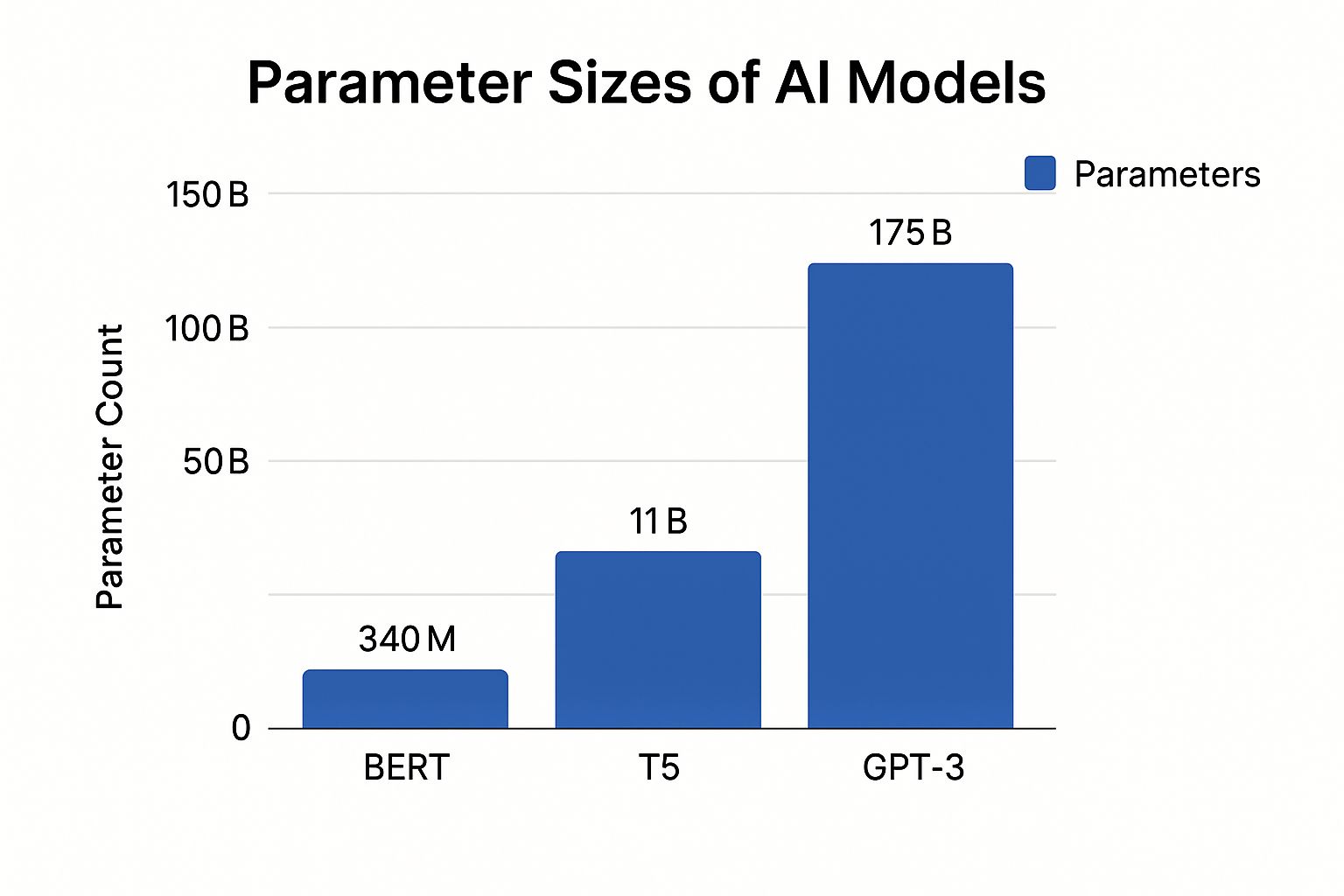
The chart above really drives home how the massive growth in model parameters, from early models like BERT to giants like GPT-3, has fueled these incredible leaps in capability.
Google Gemini: The Multimodal Native
Google built Gemini from the ground up to be natively multimodal, and that’s its killer feature. While other models can process images or audio, Gemini was designed to think across these different data types at a much deeper level.
A perfect real-world example is a field technician pointing their phone at a piece of equipment. They could ask Gemini to identify the machine from the live video, pull up the right manual, and then verbally walk them through the repair—all within a single, fluid conversation. This ability to understand and combine information from video, images, and text unlocks new applications that feel clunky or are downright impossible with models that only think in text.
Meta Llama: The Open-Source Powerhouse
Meta's Llama series is the undisputed champion of the open-source world. Its biggest advantage isn't just that it's free to use, but the complete control it gives developers. You can take a Llama model, fine-tune it on your own private data, and create a completely bespoke tool.
For example, a healthcare company could fine-tune Llama on millions of anonymized research papers and patient records. The result would be a diagnostic assistant that deeply understands their specific terminology and data patterns. Since it can be self-hosted, it offers maximum security and data privacy—a deal-breaker for many industries. This level of customization is something you just can't get with a closed, proprietary API.
As we've seen, the competitive landscape is getting more specialized every day. An analysis of the top AI models being compared in 2025 shows this trend clearly. Claude might lead in coding with a 72.7% on the SWE-bench, while another model is better for real-time information. The lesson is clear: choosing the best AI model depends entirely on what you're trying to accomplish.
By understanding these distinct "personalities," you can move beyond a generic feature list. The best choice is rarely about picking the model with the highest benchmark score, but the one whose fundamental design matches your goals.
Benchmarks and metrics are a great starting point, but they never tell the whole story. The true test of an AI model isn’t its score on a leaderboard; it’s how well its unique strengths solve a real-world business problem.
Think of it this way: you wouldn't use a sledgehammer to hang a picture frame. The goal is to pick the right tool for the job. This section moves beyond the head-to-head analysis and offers practical advice for matching these powerful models to your specific needs.
For Customer Service and Support Chatbots
When you put a chatbot in front of your customers, the stakes are high. You need it to be helpful, accurate, and completely on-brand. Most importantly, it has to be safe. You can't risk it giving out bad advice or generating harmful responses.
This is where a model like Anthropic's Claude 3.5 Sonnet really shines. Its entire architecture was designed with safety and ethical guardrails at its core, making it a reliable choice for direct customer interactions. Claude's large context window is another key advantage, allowing it to hold long, coherent conversations and remember important details from earlier in the chat.
- Scenario: A financial services firm wants a chatbot to handle questions about account policies and transaction histories.
- Why Claude is a good fit: The built-in safety features drastically reduce the risk of it giving incorrect financial advice. Plus, its ability to process long conversation histories means it won't get lost during complex, multi-step customer queries. The result is a more trustworthy and effective customer experience.
For Content Generation and Marketing
For creative work—drafting ad copy, brainstorming blog topics, or firing off social media posts—you need a different kind of partner. Here, creative fluency and speed are everything. You need a model that can jump between different styles and tones without missing a beat. This is the natural home of OpenAI's GPT-4o.
GPT-4o is a fantastic general-purpose creative engine. It’s been trained on such a vast and diverse dataset that it has a deep understanding of language, nuance, and cultural context. This allows it to generate compelling content with very little hand-holding. Its speed is also a massive plus for marketing teams that need to iterate and produce content at a high volume.
While other models can write, GPT-4o's real power is its combination of creativity and speed. It can go from a professional email to a witty tweet to a detailed product description in seconds, making it a priceless asset for any fast-moving marketing team.
For Financial and Legal Document Analysis
When you're sifting through dense legal contracts or complex financial reports, precision is non-negotiable. You need a model that can not only handle massive amounts of text but also understand domain-specific jargon. For this kind of heavy lifting, both Claude 3.5 Sonnet and Gemini 1.5 Pro bring some serious firepower.
Claude’s huge 200,000-token context window is a major advantage, allowing it to digest entire contracts or lengthy reports in a single pass. But if you need to go even bigger, Google's Gemini 1.5 Pro can handle a massive 1 million token window, making it perfect for large-scale analysis projects involving thousands of documents.
- Scenario: A law firm needs to review a mountain of discovery documents to find key pieces of evidence.
- Why Gemini or Claude work well: Their ability to process and reason over huge text volumes is like having a super-powered paralegal. They can find the needle in the haystack—flagging specific clauses, dates, and names that a human might miss—slashing review time while keeping accuracy high.
For Custom Research and Development Tools
Sometimes, an off-the-shelf model just won't cut it. When you need a highly specialized tool that’s trained on your own proprietary data or built for a unique internal workflow, open-source is the way to go. This is where Meta's Llama 3.1 comes in, giving developers total control and flexibility.
The beauty of an open-source model like Llama is that you can self-host it and fine-tune it to your heart's content. A company can train it on its internal knowledge base, private research, or years of customer feedback to create a truly bespoke AI assistant. This is non-negotiable for industries with ironclad data privacy requirements, like healthcare or defense.
By hosting Llama on your own infrastructure, you guarantee that your sensitive data never leaves your environment. This makes it the perfect foundation for building secure, custom tools that are simply beyond the reach of public, pre-trained models. Ultimately, your AI model comparison should always come back to matching these distinct strengths with your unique operational goals.
Analyzing Cost, Performance, and Scalability
A cutting-edge AI model is great, but not if it sinks your budget. Let's shift our focus from raw performance to the financial realities of running these models. This isn't just about the sticker price of an API call; it's about understanding the total cost and whether your chosen path can grow with you.

You're essentially facing two very different financial roads: using a proprietary API or self-hosting an open-source model. APIs give you predictable, pay-as-you-go pricing. Self-hosting, on the other hand, means significant upfront investment and ongoing operational overhead. A clear-eyed look at both is vital to making a smart, sustainable choice.
Proprietary API Pricing Models
Commercial models like GPT-4o and Claude 3.5 Sonnet operate on a per-token pricing model. You pay for the number of tokens (which are like pieces of words) you send as input and the number of tokens you get back in the response.
This approach is fantastic for startups and teams that need to get off the ground quickly without a massive capital outlay. No servers to buy, no infrastructure to patch. Just sign up and start building.
- GPT-4o: Tends to be the leader in cost-efficiency for high-speed, general-purpose tasks. Its pricing is aggressive, especially given its performance, making it an excellent default choice for many projects.
- Claude 3.5 Sonnet: While also cost-effective, its true value emerges when you're tackling complex tasks that require a deep understanding of long contexts. The cost is easily justified when precision and nuance matter more than sheer speed.
The pay-as-you-go structure is a huge win for managing operational expenses. In one of our tests, we asked each model to generate 10 complex business hypotheses. GPT-4o cost us just $0.065, while Claude came in at $0.069. This shows just how affordable these powerful tools can be for specific, targeted use cases.
This model scales beautifully. As your demand surges, you just send more API calls, and the provider handles all the heavy lifting on the backend. The catch? At extremely high volumes, those per-token costs can add up fast and become a serious line item on your monthly bill.
The Total Cost of Open-Source Ownership
Going with an open-source model like Meta's Llama 3.1 flips the cost equation entirely. The model itself might be free, but the total cost of ownership (TCO) is a far more complex picture than simple API fees.
You're now on the hook for the entire infrastructure stack:
- Compute Costs: This is your biggest expense by a long shot. Running a large model like Llama-3.1-70B requires hefty GPU instances (think an AWS g5.12xlarge), and you're billed by the hour—whether the model is processing requests or just sitting idle.
- Maintenance and Talent: You need people who know what they're doing. ML engineers or DevOps experts are essential for deploying, optimizing, and maintaining the model and its environment. This human capital is a major, and often underestimated, cost.
- Scalability Challenges: An API scales with a credit card swipe. A self-hosted model scales with architectural planning. You have to build for redundancy and load balancing yourself, which adds complexity and cost as your app grows.
For instance, at low request volumes, running Llama 3.1 on a dedicated instance could easily cost more than 50% higher per request than using a comparable API. Why? Because that expensive instance is always on. The economics of self-hosting only start making sense at a massive and consistent request volume, where API fees would become astronomical.
Moreover, once you're running your own model, performance tracking becomes your responsibility. This is where understanding the principles of effective machine learning model monitoring is no longer a "nice-to-have" but a core competency for your team.
Ultimately, the right choice comes down to your expected usage and how much control you need. APIs offer simplicity and predictable costs for small-to-medium scale operations. Open-source gives you total customization and potential long-term savings at a massive scale—but only if you have the resources to manage it.
Making the Right AI Model Choice
You’ve seen the performance data, explored the use cases, and crunched the numbers on cost. Now comes the hard part: bringing it all together to make a final decision. This isn't just about picking a winner from a leaderboard; it's about synthesizing all that information into a clear, actionable choice that fits your specific needs.
Choosing the right AI is far more than just picking the model with the highest benchmark score. It's a strategic decision that requires you to balance raw performance, budget realities, and your team's operational capabilities. By taking a structured approach, you can move forward confidently, knowing you’ve selected a model that will deliver real value.
A Framework for Your Decision
To make a truly informed choice, you need to approach the decision methodically. Breaking the process down into a few key evaluation stages will clarify your priorities and naturally highlight the most suitable model for your situation.
-
Define Your Primary Objective: What is the single most important thing you need this AI to do? Is it churning out creative marketing copy? Performing high-stakes data analysis? Writing complex code? Or is it interacting safely with your customers? Get specific here—this is your north star.
-
Establish Performance Non-Negotiables: Think about your absolute, must-have requirements. This could be a minimum accuracy threshold for financial analysis, a massive context window for reviewing legal documents, or native multimodal support for an interactive app. These are your deal-breakers.
-
Assess Budget and Resources: Be brutally honest about what you can afford. This isn't just about API fees. If you're considering an open-source model, you need to factor in the cost of infrastructure and the talent to manage it. This is often the deciding factor in the proprietary vs. open-source debate.
-
Consider Future Needs: Fast forward a year or two. Where will your project be? Do you anticipate needing deep customization down the line? Will your usage scale dramatically? Your choice should support your long-term vision, not just solve today's problem.
The best choice harmonizes your primary goal with your operational reality. A technically superior model is worthless if it breaks the budget or requires a skillset your team doesn't possess. The goal is sustainable, effective implementation.
Situational Recommendations
With that framework in mind, we can boil our findings down into some clear, situational recommendations. Use these as starting points to guide your final selection based on common business goals.
- For maximum ease of use in creative tasks and rapid prototyping: Go with GPT-4o. Its blend of speed, creative fluency, and a dead-simple API makes it a fantastic choice for marketing teams and developers who need to iterate quickly.
- For enterprise-grade accuracy and safety: Claude 3.5 Sonnet is a top contender. Its impressive performance in complex reasoning and coding, combined with a safety-first design, makes it ideal for regulated industries or customer-facing apps where precision is non-negotiable.
- For full control and deep customization: Llama 3.1 is your best bet. If your goal is to fine-tune a model on your own proprietary data or deploy it in a secure, self-hosted environment, its open-source nature offers flexibility you just can't get anywhere else.
Ultimately, picking an AI model is just the first step. The real work begins when you integrate it into your workflows. Effective deployment demands a solid strategy for versioning, monitoring, and governance. To learn more, check out our guide on the essentials of AI model management. This framework will help you make a choice that aligns with both your immediate goals and your future growth.
AI Model FAQ: Answering Your Top Questions
When you're comparing AI models, a lot of specific questions pop up. Instead of getting tangled in technical weeds, let's get straight to the answers for some of the most common queries. This will help you make a much more grounded decision.
Which AI Model Is Best for Creative Writing?
While plenty of models can churn out text, not all of them have a creative spark. Models from OpenAI's GPT series are often the go-to for their creative flair and knack for producing prose that feels genuinely human and nuanced. That said, Anthropic's Claude is another heavyweight, especially for longer stories where keeping the style consistent is a must.
Ultimately, your choice boils down to the task at hand. If you need quick brainstorming or versatile content, GPT is a fantastic starting point. But for detailed storytelling or professional writing that demands precision, Claude’s consistency gives it a serious edge.
The "best" creative model is always subjective and depends entirely on the job. The only way to know for sure is to test your specific prompts on a few top contenders. See for yourself which one nails the tone and style you're aiming for.
What Is the Main Advantage of an Open-Source Model?
The biggest win with an open-source model like Meta's Llama is, without a doubt, control and customization. It gives you a degree of flexibility that you just can't get from a closed, proprietary API.
Here’s what that really means for you:
- Fine-tuning: You can train the model on your private data. This creates a specialized tool that understands your company’s unique lingo and business context.
- Enhanced Privacy: When you host the model on your own servers, you guarantee that sensitive data never leaves your control. This isn't just a "nice-to-have"; for many industries, it's a critical requirement.
- Cost Control: Yes, there are initial setup costs for infrastructure. However, you completely avoid the recurring API fees that can balloon into major expenses at high volumes.
How Do I Choose an AI Model if My Priority Is Low Cost?
If your primary concern is keeping costs down, you have a couple of great paths to explore. The first is to look into smaller, more efficient open-source models that you can host yourself on less powerful—and therefore cheaper—hardware. The second option is to tap into newer, cost-effective APIs from providers like DeepSeek, which often provide very competitive performance at a fraction of the price of the big names.
Just remember, it's always a balancing act between cost and performance. Before you commit to a lower-cost model, run some tests to make sure it still clears your minimum quality bar.
At DATA-NIZANT, we deliver the expert analysis needed to navigate these complex trade-offs. Our in-depth articles and guides are designed to help you select the right AI tools to achieve your strategic goals. You can explore all our insights at https://www.datanizant.com.