
Causal inference is what takes a machine learning system from simply recognizing patterns to actually understanding cause and effect. This leap is critical. It's how we build models that can answer "what if" questions and make decisions that are more robust, fair, and reliable when they meet the real world.
Why AI Needs to Understand Cause and Effect

Let's be honest: standard machine learning models are masters of finding correlations, but they are dangerously naive when it comes to causation. They excel at telling you that two things happen together, but they have no idea why. This blind spot creates brittle, untrustworthy AI that can fail in completely nonsensical ways.
Think about a model trained on city data that finds a strong correlation between ice cream sales and shark attacks. A purely predictive model would conclude that to reduce shark attacks, you should ban ice cream. It's a ridiculous conclusion, but the model doesn't know any better. It's mistaking correlation for causation, completely missing the hidden confounding variable—hot summer weather—that drives both trends.
This isn't just a silly example; it points to a fundamental weakness in many AI systems. Models that can't tell the difference between a real cause and a coincidence can lead to disastrous business decisions, biased outcomes, and a general lack of trust. This is where causal inference machine learning comes in. It's the essential next step for building truly intelligent systems.
To put the distinction in sharp relief, let's break down the core differences.
Correlation vs Causation at a Glance
This table offers a quick summary of how these two concepts diverge, especially in a machine learning context.
| Concept | Correlation | Causation |
|---|---|---|
| Definition | A statistical relationship where two variables move together. | A relationship where a change in one variable directly causes a change in another. |
| Example | Ice cream sales and shark attacks both rise in the summer. | Flipping a light switch causes the light to turn on. |
| ML Implication | Models find spurious patterns that may not hold up in new situations. | Models learn robust, real-world relationships that are more reliable. |
| Question It Answers | "What is happening?" | "Why is this happening?" and "What if we did X?" |
| Risk | Can lead to flawed, nonsensical, or biased recommendations. | Provides a foundation for fair, explainable, and effective interventions. |
Understanding this distinction is the first step toward building models you can actually trust to make decisions.
Moving Beyond Simple Predictions
Causal models arm us with the ability to ask much deeper, more powerful questions that are completely out of reach for a standard predictive model. Instead of just forecasting what will happen, we can start to explore the "why" behind it all.
This shift allows us to:
- Estimate the true impact of a specific action, like launching a new ad campaign or tweaking product pricing.
- Build fairer algorithms by identifying and correcting for biases that are buried deep within the data.
- Create robust models that don't fall apart when the world changes, because they're built on stable, underlying causal links.
Causal inference gives us the framework to separate coincidence from consequence. It's the difference between an AI that just observes the world and one that can reason about how to change it for the better. For any serious data scientist, this is no longer optional.
The Problem With Spurious Correlations
The heart of the issue is that predictive models are optimized to find any pattern that minimizes error on historical data, whether that pattern makes any logical sense or not. When a model latches onto a spurious correlation—a pattern that looks causal but isn't—it bakes that flawed logic right into its decision-making process.
For example, a healthcare model might learn that patients who receive a new, expensive treatment have better health outcomes. It might then recommend that treatment for everyone. What it fails to see is that perhaps only wealthier patients, who likely have better healthcare access and fewer underlying issues to begin with, could afford the treatment in the first place.
Causal inference techniques are designed specifically to untangle these complex webs. They give us the mathematical tools to isolate the true effect of one variable, leading to insights you can act on with real confidence. This guide will be your roadmap to integrating this powerful way of thinking into your work.
Of course. Here is the rewritten section, crafted to sound like an experienced human expert and match the provided style examples.
Tracing the Roots of Causal AI
The idea of combining causal inference with machine learning wasn't a single "aha!" moment. It was a slow burn, the result of two powerful fields developing on separate, parallel tracks for decades. To really get why their merger is such a big deal, you have to understand where each one came from.
On one side, you have the long, thoughtful history of causal inference, a field with deep roots in statistics, econometrics, and even philosophy. Its entire existence has been dedicated to answering one profoundly tricky question: what is the true, isolated effect of a specific action? This is the world of "why" and "what if," all backed by mathematical rigor.
On the other side, machine learning grew up on a completely different path. Its journey was a rollercoaster of "AI winters" and sudden, explosive breakthroughs, all fueled by Moore's Law and an avalanche of data. ML’s goal was predictive power. It was built to find patterns at a scale humans could never dream of, even if it had no clue why those patterns existed in the first place.
The Rise of Formal Causality
The formal study of causality started taking its modern shape long before the deep learning craze. In fact, you can trace the history of causal inference back more than five decades, with foundational work on probabilistic causality emerging in the 1970s.
But the 1990s were the real turning point, thanks in large part to computer scientist Judea Pearl. He’s the one who gave us a formal language for causality, built on structural causal models (SCMs) and graphical tools. If you're curious, you can explore the historic progression from basic probability to the formal models that underpin Causal AI today.
Pearl's work provided a shared toolkit—Directed Acyclic Graphs (DAGs)—that let researchers visually map out cause-and-effect relationships. Most importantly, he introduced the do-operator, a formal way to represent an intervention.
This wasn't just about passively observing the world anymore. It was about creating a mathematical language to describe what would happen if you actively changed something. This framework laid the theoretical bedrock that moved causality from a philosophical debate to a computational science.
For a long time, though, these elegant causal theories were stuck in a small-data world. They were typically applied to clean, well-understood systems where you could count the variables on one hand. They had the right questions but lacked the raw power to answer them in the messy, high-dimensional reality of big data.
Machine Learning Provides the Engine
While causal theorists were perfecting their frameworks, machine learning was having its superstar moment. The 2010s brought the deep learning explosion, giving machines a jaw-dropping ability to learn from vast, unstructured data like images, text, and complex sensor feeds.
Suddenly, AI could tackle tasks that felt like science fiction just a decade earlier. But there was a huge piece missing. These models were brilliant at finding patterns but terrible at reasoning. They could predict customer churn with scary accuracy but couldn't confidently tell you why customers were churning or what specific action would be the best way to convince them to stay.
This is where the two paths finally crossed. The causal inference machine learning movement sparked when practitioners realized each field held the key to the other's biggest weakness.
- Causal inference brought the theoretical framework to ask the right questions and structure problems with logical clarity.
- Machine learning supplied the powerful, flexible algorithms needed to actually estimate the answers from complex, real-world data.
It was a perfect match. Machine learning’s knack for handling millions of features and messy, non-linear relationships gave causal inference the engine it always needed to work at scale. In return, causality gave machine learning a path toward building systems that are more robust, fair, and genuinely intelligent—models that don't just predict the future but help us understand how to actively shape it.
Understanding the Language of Causality
To really get your hands dirty with causal inference machine learning, you have to learn to speak its language first. This isn't about rote memorization of academic terms, but about building an intuition for the core ideas that form the backbone of the entire field. Think of it as learning the grammar of cause and effect.
The first and most critical concept is the Structural Causal Model (SCM). An SCM is simply a formal way to describe how data is generated in the real world. It’s like a blueprint that spells out exactly which variables cause changes in others.
To make these blueprints easy to read and reason about, we visualize them with Directed Acyclic Graphs (DAGs). These are the cause-and-effect roadmaps of our system. Each node is a variable, and each arrow points from a cause to its direct effect. It’s a simple but powerful way to state our assumptions about how we think the world works.
The Power of "What If?"
With a map in hand, we can start asking much more interesting questions. This brings us to our next key concept: interventions. In standard machine learning, we're passive observers of data. In causal inference, we want to know what happens when we actively step in and change something.
This idea is captured by the do-operator. When you see notation like do(X=x), it's asking a powerful "what if" question: "What would happen to the entire system if I forced variable X to take on value x, breaking all of its usual incoming causal links?"
This is a huge leap beyond just observation. It’s the difference between noticing that people who take a certain vitamin tend to be healthier (observation) and asking what would happen to the population's health if we gave everyone that vitamin (intervention). This conceptual shift is the key to estimating true causal effects.
The infographic below shows how these ideas all fit together.
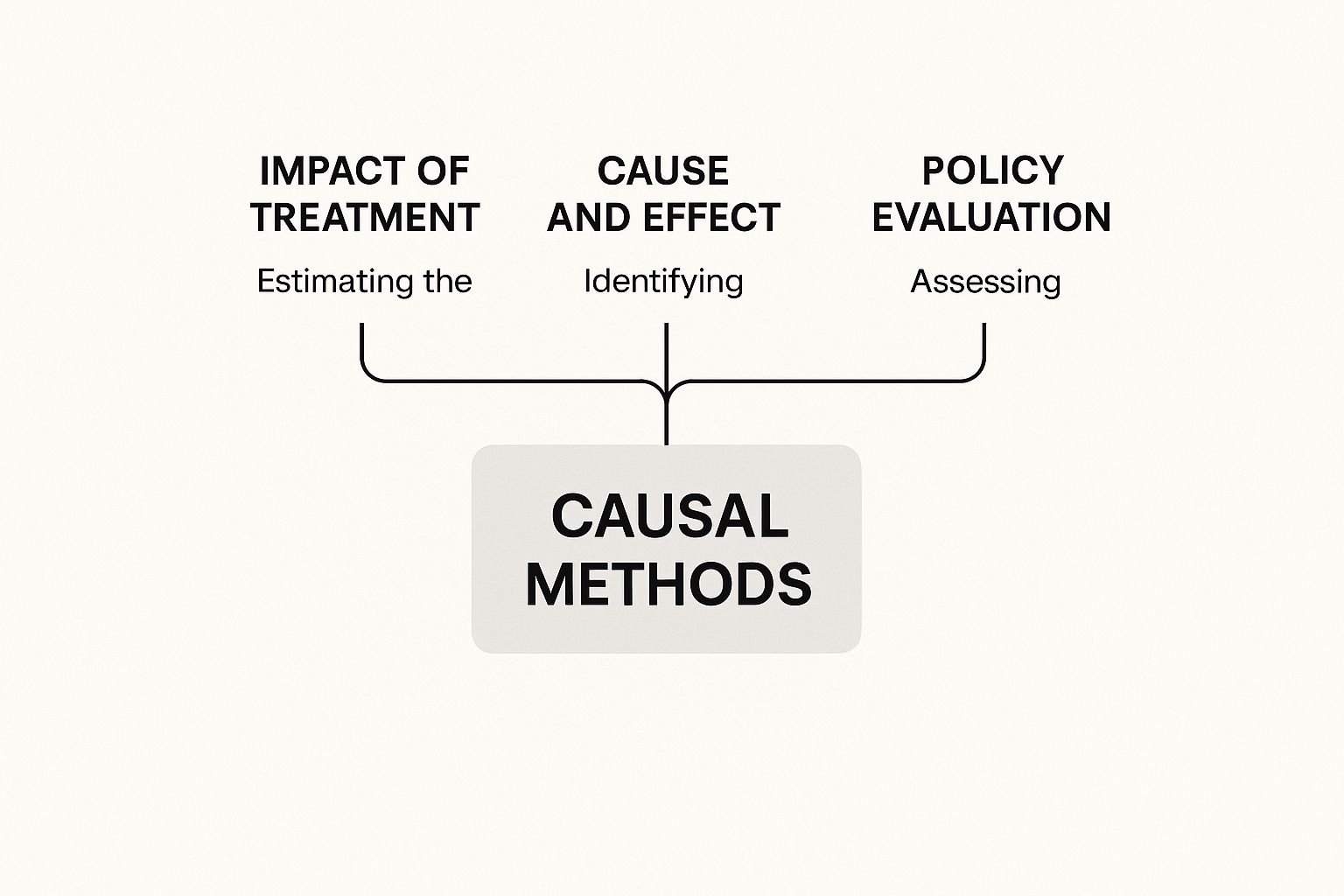
As you can see, all causal methods are built on a foundation of structured assumptions (our DAGs) and targeted questions (our interventions), all working together to get past simple correlations.
Untangling Hidden Influences
One of the biggest headaches in any real-world analysis is dealing with confounding variables. A confounder is a hidden, or unmeasured, variable that influences both the "cause" you're studying (the treatment) and the "effect" (the outcome). This creates a sneaky, misleading association between them.
A classic example makes this crystal clear. Imagine you observe that people with yellow-stained fingers have a higher rate of lung cancer.
- Treatment: Yellow Fingers
- Outcome: Lung Cancer
A naive model might jump to the conclusion that yellow fingers cause lung cancer. We know that’s absurd. The real culprit—the confounder—is smoking. Smoking causes both yellow fingers and lung cancer.
Smoking → Yellow Fingers
Smoking → Lung Cancer
This hidden backdoor path creates a spurious correlation. If you don't account for smoking, your analysis will be completely wrong. Causal inference gives us the tools to identify these confounders and statistically "block" their influence, letting us see the true relationship between our variables of interest. A well-drawn DAG makes these confounding paths obvious.
Asking About Alternate Realities
Finally, we arrive at the most mind-bending but powerful concept of all: counterfactuals. Counterfactuals are questions about alternate realities that never happened. They push beyond interventions to ask highly specific "what if" questions for a single individual or event.
Imagine a patient who took a new drug and recovered. The counterfactual question is: "What would have happened to this specific patient if they had not taken the drug?" We can never actually observe this alternate reality, but causal models give us a way to estimate it.
Counterfactuals represent the peak of causal reasoning. They allow us to move from understanding the average effect of a treatment on a population to explaining outcomes for specific individuals. This opens the door to things like personalized medicine, tailored marketing, and truly explainable AI.
Once you’ve got a solid handle on these four concepts—SCMs/DAGs, interventions, confounding, and counterfactuals—you have the conceptual toolkit you need. They are the building blocks for all the practical methods we’ll explore next.
Of course. Here's the rewritten section, crafted to sound like it was written by an experienced human expert, following all your specified requirements.
Putting Causal Theory Into Practice
Knowing the theory behind causality is one thing, but the real magic happens when you apply it to real-world data with actual code. This is where we bridge the gap between a causal diagram on a whiteboard and a reliable, actionable insight that can drive decisions. The field of causal inference machine learning has a growing arsenal of methods, each designed to answer those tricky "what if" questions under different circumstances.
These techniques allow us to move beyond just passively observing correlations in our data. Instead, we can start to rigorously quantify the impact of specific actions or interventions. Let's walk through some of the most important methods, from foundational approaches that build intuition to the modern techniques at the forefront of Causal AI.
Foundational Methods to Build Intuition
Before we jump into the deep end with complex algorithms, it's incredibly helpful to start with a technique that perfectly illustrates the core challenge of causal inference: making an "apples to apples" comparison. That’s exactly what Propensity Score Matching (PSM) is all about.
Imagine you want to figure out if a new employee training program actually boosts productivity. You can't just compare the folks who took the training (the treated group) with those who didn't (the control group). Why? Because the groups are probably different from the start—maybe the most motivated and ambitious employees were the first to sign up.
PSM tackles this problem head-on. It calculates a "propensity score" for every employee, which is simply the probability they would have received the training based on their observable traits (like their role, years of experience, or past performance reviews). The method then matches each person from the treated group with one or more people from the control group who had a nearly identical propensity score.
- What it solves: It helps you create a balanced comparison group from observational data, effectively mimicking the conditions of a randomized experiment.
- Core Idea: Find treated and untreated individuals who looked almost identical before the treatment was ever administered.
- Result: By comparing the outcomes between these carefully constructed pairs, you get a much cleaner, more reliable estimate of the training program's true effect.
Even though it’s a relatively simple idea, PSM perfectly captures the goal of so many causal methods: to systematically eliminate the selection bias that riddles real-world data.
Advanced Methods Using Machine Learning
While matching is a powerful concept, today's methods take it a step further by integrating machine learning models directly into the estimation process. This gives us far more precision and flexibility, and one of the most important developments here is Double Machine Learning (DML).
DML is a standout technique because it uses a clever, two-stage process to control for confounding variables in a really robust way. It basically works by training one ML model to predict the outcome and a second ML model to predict the treatment assignment. Through a slick technique called cross-fitting, DML neutralizes the bias from these "nuisance" predictions, letting it zero in on the isolated causal effect with impressive accuracy.
Another powerful approach born from this world is the Causal Forest, which cleverly adapts the popular random forest algorithm for causal questions. Instead of just predicting an outcome, it’s trained to predict a causal effect directly. This is fantastic for understanding how the impact of a treatment varies across different subgroups in your population—a crucial concept known as heterogeneous treatment effects.
A causal forest doesn’t just give you a single average effect. It can tell you for whom a marketing campaign is most effective or which patient profiles benefit most from a new drug. This granular insight is critical for personalization and targeted decision-making.
The Frontier of Causal Deep Learning
The latest wave of innovation is happening at the intersection of causality and deep learning. Models like CausalGANs, which are based on Generative Adversarial Networks, are pushing the boundaries of what’s possible. They can learn to generate highly realistic counterfactuals—simulating "what would have happened" to a specific individual if they had received a different treatment.
If you want to get a better handle on how these advanced models work, you can explore our collection of articles and tutorials on deep learning using TensorFlow.
To help you navigate these different approaches, here's a quick comparison of some popular causal inference methods.
Comparing Causal Inference Methods
| Method | Primary Use Case | Core Idea | Strengths & Weaknesses |
|---|---|---|---|
| Propensity Score Matching (PSM) | Estimating the average effect of a binary treatment from observational data. | Create comparable groups by matching individuals with similar probabilities of receiving treatment. | Strengths: Intuitive, easy to understand. Weaknesses: Only works for observed confounders; can struggle with high-dimensional data. |
| Double Machine Learning (DML) | Estimating causal effects in the presence of many confounding variables. | Uses two ML models to predict the outcome and treatment, then isolates the causal effect. | Strengths: Very robust, handles high-dimensional and non-linear data well. Weaknesses: Can be complex to implement from scratch. |
| Causal Forest | Understanding how treatment effects vary across a population (heterogeneity). | An adaptation of random forests that directly estimates individual treatment effects. | Strengths: Excellent for finding subgroups; provides more than just an average effect. Weaknesses: Computationally intensive; interpretation can be more complex than a single effect. |
| CausalGANs | Generating individual-level counterfactuals ("what-if" scenarios). | Uses a GAN architecture to learn the underlying data distribution and generate counterfactual outcomes. | Strengths: Can simulate outcomes for scenarios not seen in the data. Weaknesses: Very complex, on the cutting edge of research, and requires significant data. |
This table gives you a snapshot of the landscape, but the best way to learn is by doing.
Getting Started with Open-Source Tools
The best part is, you don't need to build these complex models from the ground up. The open-source community has produced some fantastic libraries that make causal inference accessible to practitioners.
- DoWhy: A Python library from Microsoft that provides an end-to-end framework for causal analysis. It walks you through the four key steps: modeling assumptions, identifying the causal effect, estimating it, and refuting the result.
- EconML: Another great library from Microsoft, EconML is laser-focused on using machine learning to estimate heterogeneous treatment effects. It’s packed with state-of-the-art methods like Double Machine Learning and Causal Forests.
These tools provide the practical machinery you need to turn the theoretical language of causality into tangible, data-driven answers for your business or research.
Of course. Here is the rewritten section, crafted to sound like it was written by an experienced human expert, following all your specified requirements.
How Causal ML Drives Real-World Decisions
The real test for any data science method isn't how elegant it looks in an academic paper, but whether it can solve messy, high-stakes business problems. This is where causal inference machine learning truly shines. It moves past simply finding patterns and starts answering the "why" and "what if" questions that keep leaders up at night.
We're not just talking about tweaking existing models. This is about fundamentally changing the kinds of questions a business can confidently ask and answer. From marketing and product to critical fields like healthcare, causal ML provides a framework for making smarter, evidence-based decisions. Let's look at a few places where it’s already making a huge difference.
Optimizing Marketing Spend
One of the oldest questions in business is also one of the hardest: "Is our marketing actually working?" Standard models are notoriously bad at this because they can't untangle the effect of a campaign from all the other noise, like a competitor's blunder or a seasonal shopping rush. A sales spike might line up with a new ad, but did the ad cause it?
This is a classic problem that causal methods are built to solve.
- The Challenge: A retail company pours $5 million into a new digital ad campaign. In the same quarter, sales jump by 12%. The marketing team is under pressure to prove that their campaign, not just a good quarter, drove this growth.
- The Causal Strategy: Instead of just looking at correlations, analysts use a technique like Double Machine Learning (DML). They build one model to predict sales based on everything except the campaign—seasonality, economic trends, competitor prices, you name it. They build a second model to predict which regions were most likely to see the ads.
- The Bottom-Line Result: By isolating the ad's true impact from all the other confounding factors, the DML model tells a different story. It reveals the campaign was responsible for a 4.5% sales lift, not the full 12%. This clarity is gold. It allows the company to calculate an accurate ROI and make far smarter decisions about where the next marketing dollar should go.
Validating Product Features
For any product team, proving a new feature is what really drove user engagement is a massive challenge. Seeing engagement metrics tick up after a release is a classic case of correlation, not causation. Maybe it was a holiday, a viral social media moment, or something else entirely.
Causal inference gives you the tools to go from "we shipped a feature and metrics went up" to "we can prove our feature caused a specific, measurable increase in user activity." This is the difference between guessing and knowing.
Teams can apply these techniques to A/B test results or even observational data when a clean experiment wasn't possible.
- The Challenge: A SaaS company launches a new collaboration tool. Active user sessions climb, but the product manager needs to prove to leadership that the new tool, and not something else, deserves the credit.
- The Causal Strategy: The team analyzes user data with a Causal Forest. This method is powerful because it doesn't just give an average effect. It can pinpoint which types of users benefited the most. For instance, it might show a huge engagement boost for enterprise teams but almost no change for individual users.
- The Bottom-Line Result: The analysis confirms the feature caused a 7% average increase in session length. But the real insight is that the effect was concentrated among teams of 10 or more. Armed with this knowledge, the product team can confidently double down on features for larger teams, knowing their work will have a real impact.
Advancing Healthcare Outcomes
In healthcare and drug development, the stakes are life-and-death, and the gold standard—a randomized controlled trial (RCT)—isn't always practical or ethical. Researchers often have to work with messy, real-world data from electronic health records. This is where causal inference becomes absolutely essential for drawing reliable conclusions.
For example, when evaluating a new treatment, a simple comparison between patients who got it and those who didn't is deeply flawed. Why? Because the patients who received the new treatment might have been sicker, healthier, or had better access to care to begin with—all powerful confounding factors.
Causal methods are specifically designed to untangle this complex web. They allow researchers to estimate a drug's effectiveness as if it had been assigned randomly, creating a powerful way to generate crucial evidence when a traditional clinical trial isn't an option.
Your First Causal Inference Project Roadmap

Jumping from theory to your first real-world project can feel like a big leap. But don't worry, there's a clear path to follow. The world of causal inference machine learning isn't just for academics anymore; it's a practical toolkit for any data scientist looking for deeper, more reliable answers.
A successful project boils down to a clear, four-step process. This roadmap, which has been popularized by fantastic libraries like DoWhy, provides a structured workflow. It takes you from a fuzzy business question to a solid causal answer, forcing you to be explicit about your assumptions and systematic in your analysis.
Step 1: Model Your Assumptions
Before you write a single line of code, you have to think. The first step is all about framing your business problem as a precise causal question. You need to move from a vague idea like, "Are users engaging more?" to something specific and testable: "What is the causal effect of our new onboarding tutorial on 7-day user retention?"
Next, you have to map out how you believe the world works by creating a Directed Acyclic Graph (DAG). This is where deep domain knowledge is indispensable. You'll identify all the relevant variables and draw arrows to represent the causal relationships, making sure to include any potential confounders. Honestly, this is the single most critical part of the entire process.
Step 2: Identify the Causal Effect
With your DAG in hand, you can move on to identification. This is a formal check to see if your question is even answerable with the data you have. You'll use the rules of do-calculus to see if you can isolate the specific causal relationship you care about from all the other messy, confounding "backdoor" paths.
If the effect is identifiable, this step gives you a precise statistical formula—your "estimand"—which you'll use to calculate the effect. If it's not identifiable, the process stops right here. You’ll have to go back to the drawing board, either by gathering more data (like measuring a missing confounder) or rethinking your initial assumptions.
Step 3: Estimate the Effect
Finally, we get to the "machine learning" part of the project. You take the estimand from the previous step and apply a statistical method to calculate its value using your data. You might use a classic technique like propensity score matching or something more advanced, like Double Machine Learning.
This is where you can bring in the big guns. The methodological breakthroughs that pushed machine learning forward—from the 1990s, through kernel methods in the 2000s, and into the deep learning boom of the 2010s—have given us incredible tools for handling the high-dimensional, complex data this step requires.
The Four-Step Causal Roadmap:
- Model: Define the causal question and draw a DAG.
- Identify: Formally check if the effect can be estimated.
- Estimate: Use an appropriate statistical method to calculate the effect.
- Refute: Vigorously test the robustness of your findings.
Step 4: Refute Your Results
This final step is arguably the most important for building trust in your conclusions. Causal inference always rests on assumptions, and you absolutely must test how sensitive your result is to those assumptions. We call this refutation or sensitivity analysis.
You start asking tough questions: "What if I missed a key confounder?" or "What if the relationships aren't linear like I assumed?" By running these kinds of tests, you can see how much your estimated effect wobbles, which gives you a real sense of how confident you can be in your answer. This disciplined approach to validation is a core part of any good AI governance framework, ensuring your models are not just accurate but truly reliable.
Common Questions About Causal Machine Learning
When you first dive into causal machine learning, it's completely normal for a bunch of practical questions to pop up. This field really pushes us to think differently about our data, moving past just making predictions. Let's walk through some of the most common hurdles practitioners face when they start applying these powerful methods.
One of the first things people ask is about experiments. Do you always have to run a randomized A/B test to nail down a causal link? The short answer is no. While randomized trials are considered the gold standard, they’re often way too expensive, slow, or even unethical to implement. Causal inference techniques were created for exactly this reason—to estimate effects from the messy, real-world observational data we usually have, where clean experiments just aren't on the table.
Distinguishing Causality from Importance
Another common point of confusion is untangling causal effects from the feature importance scores you get from models like XGBoost or a random forest. Grasping this distinction is absolutely critical.
Feature importance tells you which variables were most useful for a model's predictions—a concept rooted in correlation. Causal inference tells you what would happen to the outcome if you could actually intervene and change that variable.
Think about it this way: a feature can be a fantastic predictor without having any real causal power. For instance, a customer's past purchase history might be a top predictor of future churn, but you can't go back in time and change what they bought. Causal inference, on the other hand, might reveal that a specific proactive support call (an intervention you can make) is what truly reduces churn. This focus on actionable levers is what makes causal analysis so valuable for making real business decisions.
If you're interested in how models weigh different factors, it's also worth looking into the principles behind the bias-variance tradeoff.
The Toughest Challenge for Beginners
So, what’s the hardest part of getting a causal project off the ground? It’s correctly stating your assumptions. This is usually done by drawing a Directed Acyclic Graph (DAG), and it requires deep domain knowledge to map out all the potential confounding variables.
If you get this graph wrong, you can end up with biased, totally misleading results. That’s precisely why the final refutation step—where you rigorously challenge your own assumptions—is so vital for building confidence in your findings.