

In simple terms, machine learning for business is like giving your company a super-employee who can instantly analyze decades of data to predict what’s next. It’s a practical tool for making smarter, faster, and more profitable decisions by learning from past experience, much like a seasoned expert.
From Buzzword to Bottom Line: A Practical Introduction
Machine learning has officially moved from a niche experiment to a core business asset. It's no longer just a buzzword tossed around in tech circles; it's a powerful engine for finding hidden growth opportunities in the data you already own.
Practical Example: Imagine a retailer gearing up for a major holiday. Instead of relying on gut feelings or just last year's sales report, they use a machine learning model. The system crunches years of sales data, weather patterns, competitor promotions, and even social media chatter to predict exactly which products will fly off the shelves, in which stores, and on which days.
Actionable Insight: This predictive power is the heart of machine learning for business. It shifts your strategy from being reactive—responding to what has already happened—to being proactive and anticipating what comes next.
Why Machine Learning Matters Now
The rapid adoption of this technology points to a major shift from experimental side-projects to essential operational tools. By 2025, an incredible 78% of organizations will be using AI, including machine learning, in at least one business function. That's a huge jump from 55% just a year prior.
This surge isn't just about one-off uses, either. Companies are now weaving these technologies into an average of three distinct business functions, with generative AI seeing a particularly strong uptake. This widespread integration proves that machine learning has become a practical cornerstone of a competitive business strategy.
It helps companies of all sizes in a few key ways:
- Anticipate Customer Needs: Predict what customers want before they even know they want it, from personalized recommendations to perfectly timed marketing.
- Streamline Complex Operations: Automate repetitive tasks, optimize tangled supply chains, and predict maintenance needs to cut costs and boost efficiency.
- Unlock New Revenue Streams: Discover untapped market segments or create innovative, data-driven products and services that set you apart from the pack.
The Shift from Theory to Application
This isn't just about having big data; it's about using smart data. The real goal is to turn complex datasets into clear, actionable business intelligence.
Practical Example: A perfect example of this in action is the evolution of customer service. To really see how this shift from buzzword to bottom line is playing out, exploring the impact and advancements of AI chatbots in business shows how ML-powered tools are directly improving customer interactions and operational workflows. It’s a clear case of turning theoretical potential into measurable results.
Unlocking Real Business Value with Machine Learning

Beyond all the technical jargon, the question every business leader asks is simple: "What can machine learning actually do for my bottom line?" The answer isn't about chasing the latest tech trend. It's about turning the mountains of data you already have into real, measurable business outcomes.
Applying machine learning for business means solving core problems in a smarter way. The value almost always shows up in four key areas: boosting operational efficiency, personalizing the customer journey, making smarter strategic decisions, and uncovering new ways to generate revenue.
Focusing on these pillars is how you turn machine learning from a potential cost center into a powerful engine for predictable growth.
Boosting Operational Efficiency
One of the quickest wins with machine learning is its ability to tighten up your internal processes, slash waste, and cut costs. It does this by spotting patterns in your operational data that no human could ever see, allowing you to fix problems before they even happen.
Practical Example: A logistics company like DPD uses predictive models that analyze real-time traffic data, weather forecasts, and delivery windows. The system constantly recalculates the most efficient path for thousands of vehicles at once, saving millions in fuel and shrinking delivery times.
Actionable Insight: Don't just analyze past performance; use ML to predict future operational needs. This shift from reactive to proactive management saves money and boosts efficiency. You can see similar principles at play when you look at the benefits of AI in finance, where it’s used for everything from fraud detection to risk management.
Personalizing the Customer Journey
In today's crowded markets, personalization is what separates the winners from the noise. Machine learning lets you go way beyond generic customer segments and start delivering experiences tailored to what each individual actually wants and does.
Practical Example: Spotify’s "Discover Weekly" playlist is generated by a powerful recommendation engine. The system analyzes what you listen to, what you skip, and compares it to millions of other users with similar tastes to create a unique playlist for you.
Actionable Insight: Use ML to move from broad customer segments to one-to-one personalization. This kind of individual-level targeting drives incredible user engagement, keeps customers subscribed, and directly reduces churn. It's a straight line from a smart algorithm to sustained revenue.
Enabling Smarter Strategic Decisions
A good strategy is built on accurate forecasting and a real understanding of where the market is headed. Machine learning gives leaders the tools to look into the future with more confidence, basing their big bets on data-driven probabilities instead of just gut feelings.
Practical Example: A retail company can use ML to analyze sales figures, social media chatter, and economic indicators to predict demand for certain products. This lets them stock their shelves intelligently, avoiding both the cost of overstocking and the frustration of running out of a popular item.
Actionable Insight: Integrate predictive models into your strategic planning. This applies to everything:
- Financial Planning: Predict cash flow with greater accuracy.
- Market Expansion: Pinpoint geographic areas with the highest potential.
- Product Development: Analyze customer reviews to guide your product roadmap.
This is what happens when you fully integrate data science for business; decision-making shifts from being a look in the rearview mirror to a forward-looking strategy.
Innovating New Products and Revenue Streams
Finally, machine learning can be the spark for entirely new business models. By digging into the data you already have, you can uncover unmet customer needs or find opportunities to create value in ways you never even considered.
Practical Example: John Deere, a farm equipment manufacturer, used data from sensors on its tractors to launch a new service. Their predictive maintenance platform alerts farmers before a part fails, saving them from costly downtime during critical planting or harvesting seasons. This created a brand-new, high-value revenue stream from data they already had.
Seeing Machine Learning in Action Across Industries

The real power of machine learning for business isn't in the theory; it's in seeing how it cracks tough, real-world problems. Let's move past the buzzwords and look at concrete examples of how companies are using this tech to carve out a serious competitive advantage. These aren't just ideas—they're practical blueprints for what's possible in your own field.
Each story follows a familiar pattern: a business was stuck on a complex problem, they applied a machine learning solution, and they saw a real, measurable impact on their bottom line.
Retail From Fast Fashion to Smart Shelves
Retail runs on razor-thin margins, and the inventory balancing act is a constant headache. If you overstock, you're looking at markdowns and tied-up capital. Understock, and you've got lost sales and frustrated customers. This is exactly the kind of messy, data-heavy puzzle that machine learning was born to solve.
Practical Example: Zara, the fast-fashion titan, uses ML algorithms to comb through a constant flood of real-time data from thousands of stores. These models chew on sales figures, customer comments, and even local social media trends to figure out where every last shirt and jacket should go, predicting which styles will be popular in specific cities.
Actionable Insight: Stop relying on old sales reports that only show what already happened. Instead, use ML to predict what will happen. That shift from reactive to predictive inventory management is a massive win for profitability.
Finance Protecting Assets with Predictive Power
In the world of finance, speed and accuracy are non-negotiable. For a company like American Express, which handles millions of transactions every single second, manually flagging suspicious activity just isn't an option. The goal is to spot and shut down fraud in real time without accidentally blocking a legitimate customer's purchase.
Practical Example: For every credit card swipe, American Express uses machine learning models that analyze thousands of data points in milliseconds. It learns the unique spending habits of each cardholder and instantly weighs variables like purchase amount, location, and time of day. If anything seems out of character, it’s flagged or blocked instantly, slashing fraud losses.
Actionable Insight: Implement real-time anomaly detection for critical processes. This not only protects assets but also improves the customer experience by reducing friction for legitimate users.
Healthcare Accelerating Discovery and Improving Care
Healthcare is another arena where machine learning is making a huge difference, especially in the notoriously long and costly process of discovering new drugs. Traditionally, researchers had to manually sift through mountains of data to find compounds that might one day become life-saving treatments.
Practical Example: Pharmaceutical companies now use machine learning models to analyze genetic data, biological markers, and decades of scientific papers. These algorithms can predict how different molecules might interact with specific diseases, allowing scientists to zero in on the most promising candidates right away and potentially shaving years off development timelines.
Actionable Insight: Use machine learning to analyze vast, unstructured datasets (like research papers or patient records) to identify patterns and accelerate R&D, a process that is impossible for humans to do at scale.
Telecom Optimizing Networks for the Future
The IT and telecom sectors are also reaping massive benefits from machine learning. In fact, these industries are on track to add a staggering $4.7 trillion in value by 2035 thanks to AI. We're seeing a huge jump in generative AI adoption, from 55% to 75% of global firms in just the past year.
Practical Example: A telecom provider uses ML to monitor its network for signs of degradation. The model can predict when a cell tower might need maintenance before it fails, allowing them to schedule repairs during off-peak hours and preventing customer-facing outages. For a deeper look at these advancements, you can discover more about AI adoption trends and their industry impact.
Actionable Insight: These same principles drive incredible value in marketing. By analyzing customer behavior and campaign performance, businesses can automate ad targeting and tailor messaging on a scale that was once unthinkable. To see how this plays out specifically, check out our guide on how machine learning in marketing drives results.
Navigating Common ML Implementation Challenges

Getting machine learning for business right isn't about one big breakthrough. It's about skillfully navigating a series of practical, and often predictable, hurdles. While the potential payoff is huge, the path to a successful ML project is littered with challenges that can stop even the most promising ideas in their tracks.
An honest look at these obstacles is the first step. Plenty of companies are excited about the possibilities but end up struggling to see a clear return on their investment. It's a common story: while over 80% of companies are exploring AI, only about one in four projects actually hits its expected ROI. This gap usually boils down to a few common, but solvable, problems.
Tackling the Data Quality Dilemma
The most common starting block for any machine learning project is the data itself. There's a timeless saying in this field: "garbage in, garbage out." If you train your model on messy, incomplete, or irrelevant data, it's going to give you unreliable and useless predictions.
Actionable Insight: Don't try to fix all your data at once. Start with a small, focused data audit for a single, high-impact business problem.
- Start Small: Pick one specific problem, like predicting which customers are about to churn.
- Identify Key Data: Figure out what data points matter most (e.g., purchase frequency, last login date, support tickets).
- Assess Quality: Now, look only at that specific dataset. Check for missing values, incorrect entries, or duplicates.
This targeted approach gives you a clean foundation to build your first model without getting overwhelmed.
Bridging the Skills and Talent Gap
Another big hurdle is the idea that you need to hire a whole team of expensive data scientists just to get in the game. While specialized expertise is definitely valuable, many businesses find success by empowering the people who already know the business inside and out.
Actionable Insight: Upskill your current team. Your business analysts, IT specialists, and department heads already have deep, contextual knowledge about your data. Giving them training on foundational ML concepts and user-friendly tools can bridge the gap much faster than hiring an external team. As discussed in our article on understanding AI integration in business, the goal is to create a data-literate culture, not turn everyone into a PhD researcher.
Integrating ML Without Disrupting Workflows
Finally, a brilliant model that just sits on a developer's laptop is completely worthless. The real value of machine learning for business is only unlocked when its insights are plugged directly into the daily workflows of your employees.
Actionable Insight: Start with a minimal-friction integration. Instead of a complex new dashboard, could the model’s output just be a simple daily email to the sales team listing at-risk customers? Or a new flag in your existing CRM software? This delivers value in the tools your team already uses, making adoption easier. Planning for this is a core part of effective AI model management. By mastering AI model management, you ensure your models deliver real business value long after they're built.
Your First Machine Learning Project: A Step-by-Step Framework
Jumping into your first machine learning project can feel like a massive undertaking, but it doesn't have to be. The trick is to follow a structured framework that turns a promising idea into a deployed solution that actually moves the needle for your business. Start small, aim for a quick win, and build momentum from there.
Think of this as your playbook for turning raw data into real value.
Step 1: Pinpoint a High-Impact Business Problem
This is where most machine learning initiatives go wrong. They start with the tech, not the problem. A successful project always begins with a clear, specific business challenge that’s worth solving. Don't ask, "What can we do with machine learning?" Ask, "What's our biggest operational headache right now?"
Actionable Insight: Choose a problem that directly impacts a key performance indicator (KPI). Instead of a vague goal like "improve marketing," aim for something concrete, like "identify which customers are most likely to respond to our next email campaign to increase click-through rates by 15%." A well-defined problem gives your project a clear, measurable definition of success.
Step 2: Gather and Clean Your Data
Once you’ve locked in on a problem, it's time to get your hands on the right data. Fair warning: this is often the most time-consuming part of any machine learning project. Your model is only as good as the data you feed it.
Actionable Insight: Don't boil the ocean. For your chosen problem, identify only the most relevant data sources. For a customer churn model, that could mean pulling purchase histories and website activity logs. The process of cleaning this data, known as data preprocessing, is the unglamorous but foundational work that makes or breaks a project.
Step 3: Choose and Train the Right Model
With a clean dataset in hand, you're ready to pick a machine learning model and start training it. This is all about matching the right tool to the task. The model you choose depends entirely on the question you're trying to answer.
Actionable Insight: Choose your model type based on your business question:
- Classification: To predict a category (e.g., Will this customer churn: Yes or No?).
- Regression: To predict a number (e.g., How much will this customer spend next month?).
- Clustering: To group similar things (e.g., Which customers have similar buying habits?).
This step includes feature engineering, where you select the most important data variables to boost performance. You can explore how to master feature engineering for machine learning to build more powerful models.
This simplified workflow visualizes the main technical stages.
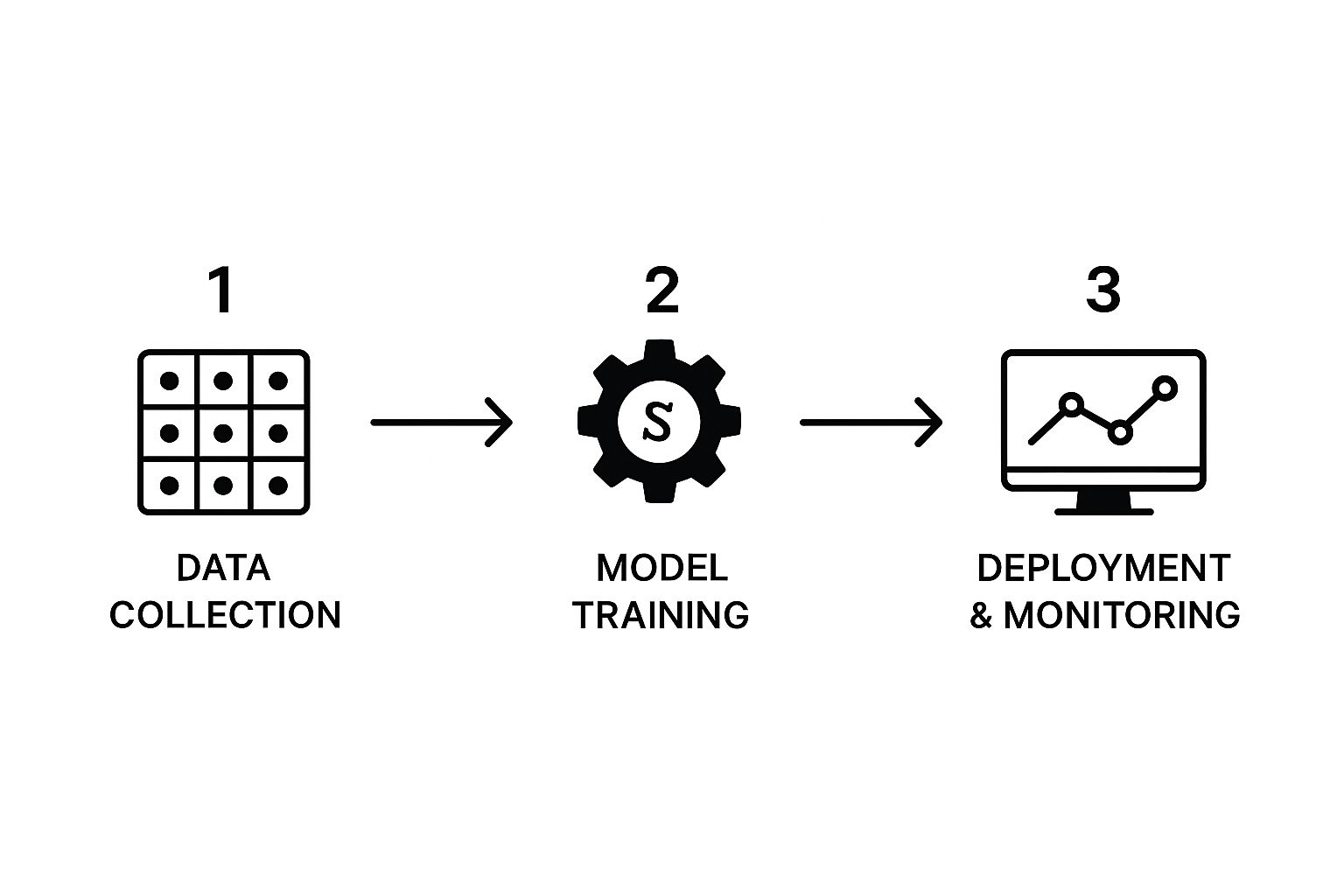
As you can see, after data collection, the model gets trained and then deployed. From there, it's a continuous cycle of monitoring and improvement.
Step 4: Evaluate Performance Against Business Goals
So your model is 95% accurate. That's great, but it's completely useless if it doesn't actually solve the business problem you started with. In this step, you have to measure your model’s performance not just with technical metrics, but against the business goal you set back in Step 1.
Actionable Insight: Connect the model's performance directly to ROI. If your goal was to reduce churn, test the model on new data. How many churning customers did it correctly flag? How much potential revenue did those predictions save? This is how you prove its value to stakeholders.
Step 5: Deploy and Monitor the Solution
Finally, a model doesn’t do any good sitting on a data scientist’s laptop. It needs to be integrated into your actual business operations. This is the deployment phase, where your model goes from being a project to a live tool.
Actionable Insight: Deploy your model into existing workflows. It might become a new dashboard for your sales team, an automated flag in your CRM, or an API that feeds predictions to your website. Once live, continuously monitor its performance. The world changes, and a model that worked perfectly last month might become less accurate. Monitoring ensures your solution keeps delivering value and tells you when to retrain it.
Common Questions About Machine Learning in Business
Even with a clear plan, diving into machine learning for business can feel like stepping into a new world. It’s natural to have questions. Getting these common concerns out on the table can demystify the process for you and your team, giving you the clarity to move forward with confidence.
How Much Data Do I Really Need to Start?
It's a huge myth that you need massive, "big data" warehouses just to get your foot in the door with machine learning. The reality? It’s far more about the quality and relevance of your data than the sheer quantity.
Practical Example: To build your first customer churn prediction model, a clean dataset with a few thousand records—showing past purchase histories, engagement metrics, and subscription statuses—is a perfect starting point.
Actionable Insight: Start with a well-defined question and a dataset that is clean, relevant, and directly addresses that question. Always prioritize quality over volume, especially in the early stages.
What's the Difference Between AI and Machine Learning?
People often use these terms interchangeably, but they aren't the same. Grasping the distinction is key to setting the right expectations for your team.
- Artificial Intelligence (AI) is the broad concept of creating smart machines that can perform tasks requiring human intelligence.
- Machine Learning (ML) is a practical subset of AI that focuses on teaching computers to learn from data without being explicitly programmed.
Actionable Insight: For your business, machine learning is where the action is. ML is the engine that drives practical applications like recommendation engines, fraud detection, and predictive forecasts. Fully understanding this relationship is key, as we explore in our guide to understanding AI integration in business.
How Can I Measure the ROI of a Project?
Measuring the return on investment (ROI) for a machine learning project isn't just a good idea—it's essential for proving its value. The best way to do this is to tie your model's performance directly to a tangible business metric you already track.
Actionable Insight: Define your success metric before you start building.
- Churn Model ROI: The total value of customers it helped you keep, minus retention costs.
- Maintenance Model ROI: Money saved by preventing equipment failures (avoided repair costs + eliminated downtime).
- Lead Scoring Model ROI: New revenue generated by sales focusing on high-quality leads.
When you can connect the model's output directly to a dollar value, its impact becomes undeniable.
Do I Need to Hire a Team of Data Scientists?
Not necessarily, especially when you're just starting out. While dedicated data scientists bring deep expertise, many businesses find early success by working with the talent they already have.
Actionable Insight: Empower your existing team. Business analysts or IT professionals who already understand your company and your data are invaluable. Giving them access to user-friendly cloud ML platforms, like Amazon SageMaker or Google AI Platform, can be a surprisingly effective first step. Alternatively, partner with a specialized consultant for your first project to get expert guidance while your internal team learns the ropes.