
When you hear "machine learning infrastructure," it’s easy to think of just powerful computers humming away in a server room. But that’s only a tiny piece of the puzzle. Real ML infrastructure is the entire technological ecosystem—the hardware, the software, and all the operational plumbing—that supports a machine learning model from its first spark of an idea to its life in the real world.
It's the foundation for everything you do, from collecting data and training models to deploying them and making sure they keep running smoothly.
Understanding the Foundations of ML Infrastructure
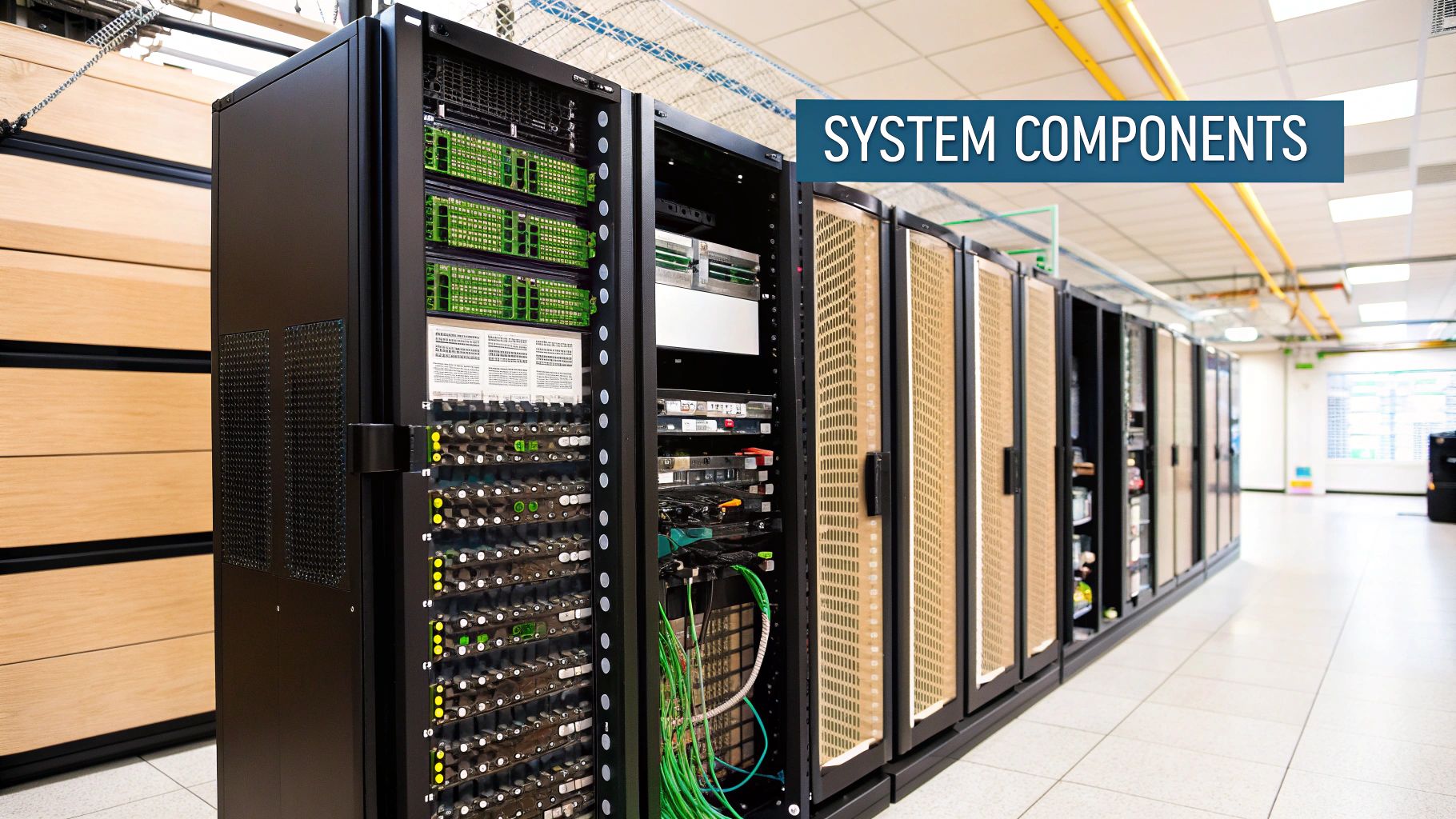
To really get what infrastructure for machine learning is, let's try an analogy. Picture a state-of-the-art machine learning model as a Formula 1 race car. It’s a marvel of engineering, built for incredible speed and performance. But on its own, it can’t even leave the garage, let alone win a race.
It needs a whole support system. That system is the infrastructure. It’s the racetrack for testing, the expert pit crew for tuning and maintenance, the garage where it was built, and the high-octane fuel that powers it. Without that comprehensive setup, the car is just an expensive, stationary sculpture.
This critical need for a solid support system is driving huge market growth. The global artificial intelligence infrastructure market, recently valued at around USD 47.23 billion, is expected to skyrocket to nearly USD 499.33 billion by 2034. That’s a compound annual growth rate (CAGR) of about 26.6%, showing just how seriously organizations are investing in these foundational components. For a closer look at these numbers, you can explore the full projections of the AI infrastructure market.
The Three Core Pillars
When you strip it all down, machine learning infrastructure rests on three fundamental pillars. Each one has a distinct and vital job in getting a model from concept to production.
To make this crystal clear, here's a quick breakdown of how each pillar contributes to the ML lifecycle.
Core Pillars of ML Infrastructure at a Glance
| Pillar | Primary Role | Key Technologies |
|---|---|---|
| Compute | Provides the raw processing power for training models. | CPUs, GPUs, TPUs |
| Storage | Securely houses datasets, models, and artifacts. | Object Storage (S3), Block Storage (EBS) |
| Networking | Enables high-speed data flow between components. | High-Bandwidth Interconnects, VPCs |
These pillars work together to form the backbone of any serious AI initiative. Let's dig a little deeper into what each one does.
-
Compute: This is the engine room of your entire operation. It supplies the immense processing power needed for the mathematically heavy lifting of training ML models, which can easily involve trillions of calculations.
-
Storage: Think of this as your library and fuel depot. It’s where you securely keep the massive datasets needed to train models, not to mention the trained models themselves and all their related files and versions.
-
Networking: This is the high-speed nervous system connecting everything. It allows data to zip seamlessly between storage and compute resources, which becomes absolutely crucial for large-scale, distributed training jobs where bottlenecks can kill performance.
A strong infrastructure for machine learning isn't just a technical nice-to-have; it is the strategic bedrock for any successful and scalable AI. Neglecting it is like trying to build a skyscraper on a shoddy foundation—it’s just a matter of time before you hit serious limitations or watch it all come tumbling down.
Getting a handle on these pillars is the first step. As we go on, we’ll explore how these components interact and why picking the right mix is the key to unlocking your organization's full AI potential. The journey from raw data to real, actionable intelligence starts right here.
The Building Blocks of a Modern ML Stack

To get AI systems off the ground, you need far more than just clever algorithms. You need a rock-solid technical foundation—a stack of hardware and software all working in perfect harmony. The quality of this infrastructure for machine learning is what ultimately determines how well your models perform, how far they can scale, and whether you can rely on them.
Think of this stack as a highly specialized engineering team. Each member has a distinct job, but they have to collaborate seamlessly to deliver the final product. The three core members of this team are Compute, Storage, and Networking.
Let's break down what each one brings to the table.
Our understanding of these systems didn't just appear overnight. Early conversations were all about basic data management, which we covered in posts like our Datanizant's Data Management Manifesto. From there, the focus shifted to more advanced applications, a journey we explored when we looked at how Data Science Is The New Alchemy. We then examined the critical role of cloud computing in our guide on Cloud Computing and Data Analytics. Finally, we delved into the operational discipline required to make it all work at scale with our look at MLOps Best Practices. Those ideas paved the way for the sophisticated infrastructure we rely on today.
The Engine Room: Compute Power
Compute is the raw horsepower that makes machine learning possible. It’s what churns through the trillions of mathematical operations needed to train a complex model on a massive dataset. Inside this engine room, two types of processors do most of the heavy lifting.
-
Central Processing Units (CPUs) are the versatile all-rounders. They're fantastic at handling the wide variety of tasks that come with data preprocessing, running the operating system, and managing the overall system logic. Think of them as the project managers of the compute world.
-
Graphics Processing Units (GPUs) are the dedicated specialists. Originally designed for rendering video game graphics, their architecture is perfectly suited for parallel processing—running countless calculations all at the same time. This makes them the undisputed workhorses for deep learning, capable of slashing model training times from weeks down to mere hours.
The choice and configuration of these compute resources are absolutely critical. A large-scale training job can trigger massive power fluctuations—sometimes in the tens of megawatts—as thousands of chips synchronize their work. This puts serious thermal stress on the hardware.
Without careful management, these power spikes can significantly reduce the lifespan of expensive data center equipment. In fact, research shows that a proactive, full-stack design approach can mitigate these power fluctuations by nearly 50%, proving just how vital it is to have hardware and software management working together.
The Library and Vault: Storage Solutions
Machine learning is fueled by data, and all that data needs somewhere to live. The storage layer of your infrastructure acts as the library, vault, and filing cabinet for every bit of information your models touch. Since different types of data have different needs, modern ML stacks use a mix of storage solutions.
-
Object Storage: This is the go-to for unstructured data like images, videos, and huge text files. Systems like Amazon S3 or Google Cloud Storage treat each file as a self-contained "object" with its own metadata. It’s incredibly scalable and cost-effective for housing gigantic datasets.
-
File Storage: This works just like the hierarchical file system on your laptop (folders inside folders). It's great for structured data and for situations where multiple users or applications need shared access to the same set of files.
-
Databases: For highly structured data that requires lightning-fast queries and transactions—like user profiles or financial records—databases are essential. They provide the organized framework needed for rapid data retrieval and manipulation during the preprocessing stage.
The Information Superhighway: Networking
Finally, networking is the connective tissue that holds the entire stack together. It’s the high-speed communications grid that lets data shuttle between storage and compute resources without causing frustrating bottlenecks.
Networking becomes especially crucial in distributed training, where a single model is trained across hundreds or even thousands of GPUs at once. In this scenario, each processor must constantly exchange information with all the others. A slow or congested network would be like a rush-hour traffic jam on a superhighway—everything grinds to a halt.
High-bandwidth, low-latency interconnects are the solution. They ensure data packets arrive quickly and reliably, allowing the entire distributed system to function as a single, cohesive unit. This robust connectivity is the final piece of the puzzle, transforming a collection of powerful components into a truly functional infrastructure for machine learning.
Choosing Your Deployment Model: Cloud, On-Premise, or Hybrid?
Once you have a handle on the basic building blocks of an ML stack, the next big question looms: where is all this stuff going to live? This decision—choosing between cloud, on-premise, or a hybrid approach—is one of the most critical you'll make. It has a direct line to your costs, scalability, security, and the overall agility of your AI work.
Let's break it down with a simple analogy:
- Cloud (AWS, GCP, Azure): This is like renting a supercomputer whenever you need it. You get incredible flexibility, scaling resources up or down in minutes and only paying for what you actually use.
- On-Premise: This is like building and owning your own secure data fortress. You have absolute control over your hardware and data, which is a must-have for companies with strict compliance or privacy mandates.
- Hybrid: This is the strategic middle ground. It blends the security and control of an on-premise setup with the flexibility and raw power of the cloud, aiming for the best of both worlds.
Each model has its own distinct personality, with clear strengths and trade-offs. Let's dig into each one.
H3 The Allure of the Cloud
For many teams, cloud providers are the default starting point when building out their infrastructure for machine learning. The biggest draw is immediate access to powerful, cutting-edge hardware—like the latest GPUs—without having to shell out huge amounts of cash upfront. You can spin up a massive training cluster for a few hours to tackle a big job, then tear it all down. That kind of on-demand power is simply impossible with hardware you own.
This pay-as-you-go model makes large-scale AI experimentation accessible even for smaller teams, dramatically lowering the barrier to entry. On top of that, cloud platforms come with a rich ecosystem of managed services for data storage, databases, and MLOps tools that can seriously speed up development. If you want to see how these pieces fit together, you can explore the relationship between cloud computing and data analytics in our detailed guide.
But this convenience isn't free. For continuous, large-scale training, the operational costs can really add up over the long term. You also give up some control over the underlying hardware and can run into data governance headaches if your data has to stay within a specific country or regulatory bubble.
H3 The Fortress of On-Premise
Going the on-premise route means you buy, own, and manage every piece of your infrastructure in-house. We're talking servers, networking gear, cooling systems, and the physical real estate to house it all. The initial investment is steep, no question. However, for organizations with predictable, high-volume workloads, the total cost of ownership can eventually dip below what you'd pay a cloud provider indefinitely.
The most compelling reason to build on-premise is one word: control. When you're working with extremely sensitive data, like patient records in healthcare or financial data in banking, keeping everything behind your own firewall is often non-negotiable. This model gives you total authority over security, data sovereignty, and hardware configurations. The trade-off? A lack of elasticity. You can't just magically summon more resources if you get a sudden spike in demand.
The decision to invest in infrastructure for machine learning is becoming central to corporate strategy, reflecting a massive market expansion. The global machine learning market was estimated at USD 93.95 billion recently and is projected to soar to USD 1,407.65 billion by 2034, growing at an incredible CAGR of 35.09%.
The Strategic Hybrid Approach
The hybrid model exists because, for many businesses, the choice isn't just a simple "either/or." It cleverly combines public cloud services with private, on-premise resources, creating a single, cohesive infrastructure. This setup allows a company to run its sensitive or baseline workloads on its own private hardware while "bursting" into the cloud to handle temporary demand spikes or to tap into specialized services.
This chart gives a quick visual rundown of the key differences in cost, scalability, and speed between the on-premise and cloud models.
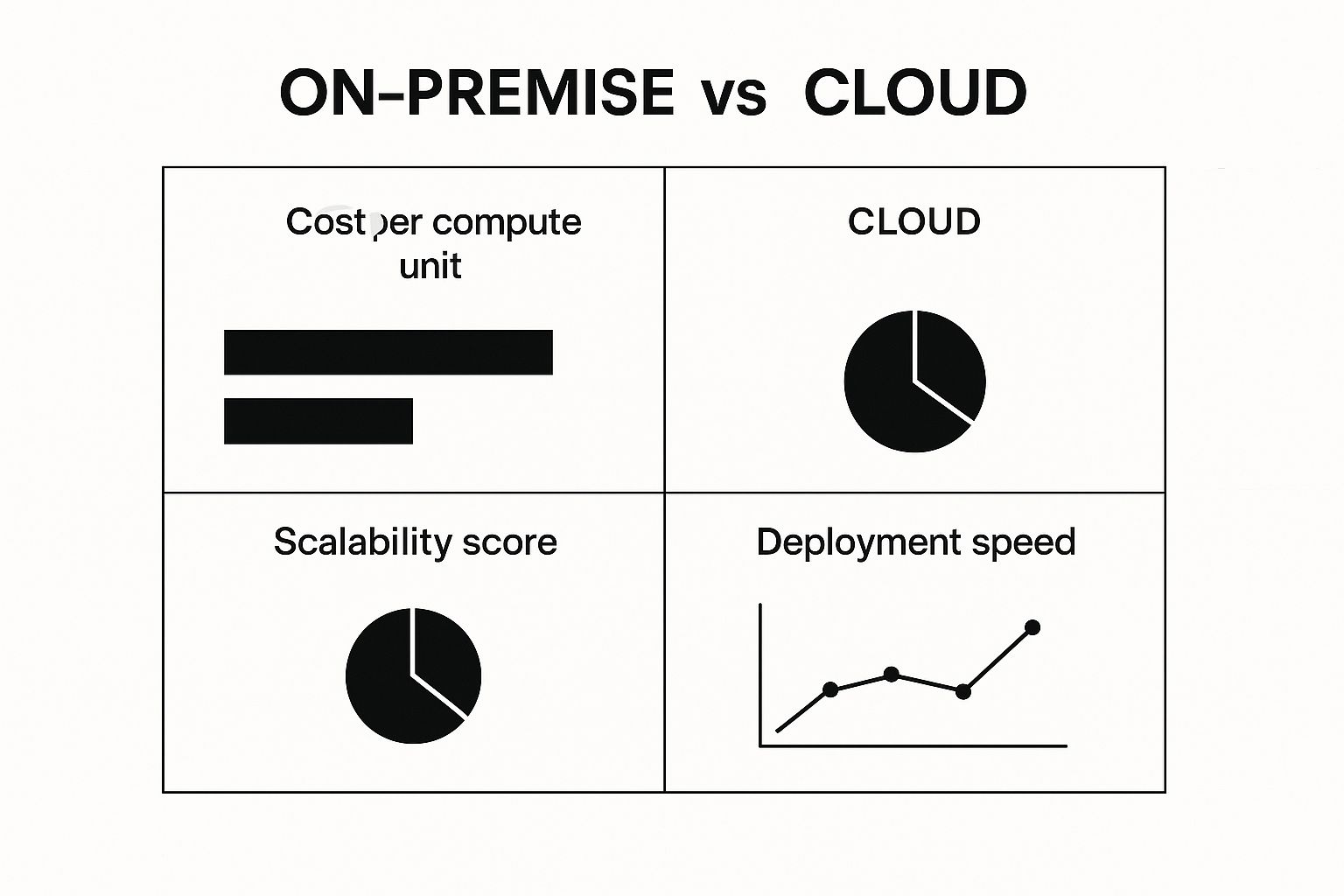
As the infographic shows, the cloud shines with its superior scalability and deployment speed, but at a potentially higher per-unit cost. On-premise, on the other hand, offers cost predictability but sacrifices agility.
To make this decision clearer, here's a side-by-side comparison of the key factors to consider when choosing your deployment model.
Comparing ML Infrastructure Deployment Models
| Factor | Cloud | On-Premise | Hybrid |
|---|---|---|---|
| Initial Cost | Low (Pay-as-you-go) | High (Large capital expenditure) | Moderate (Combines both) |
| Scalability | High (Near-instant elasticity) | Low (Fixed capacity) | High (Cloud bursting) |
| Control & Security | Moderate (Shared responsibility) | High (Full control over hardware/data) | High (Control over sensitive data) |
| Maintenance | Low (Managed by provider) | High (Requires dedicated IT team) | High (Complex to manage both) |
| Long-Term Cost | Can become high with scale | Potentially lower for predictable workloads | Varies based on usage patterns |
| Best For | Startups, variable workloads, experimentation | Strict compliance, predictable workloads, sensitive data | Balancing security and scalability |
Ultimately, a hybrid strategy aims to strike the perfect balance between these factors, tailoring the infrastructure to very specific business needs. For example, a company might use its on-premise servers for daily model inference while tapping into the cloud’s immense power for periodic, intensive model retraining. The main challenge, however, is the added complexity of managing and orchestrating two fundamentally different environments.
How MLOps Turns Infrastructure into a Production Engine

Having powerful compute, storage, and networking is like owning a factory filled with brand-new, top-of-the-line machinery. It's an impressive setup, but it won’t produce anything without a skilled crew and a smart operational blueprint. This is exactly where MLOps (Machine Learning Operations) comes in. It's the critical link that transforms your expensive infrastructure for machine learning from a static pile of resources into a dynamic, high-output AI production engine.
MLOps isn't some off-the-shelf tool you can just buy; it’s a cultural discipline. It's the philosophy that bridges the gap between development (data scientists building models) and operations (engineers keeping those models running smoothly in the real world). Think of it as the automated assembly line for your AI factory, designed to make the entire model lifecycle—from data prep to deployment and monitoring—repeatable, reliable, and efficient.
Without a solid MLOps strategy, even the most powerful infrastructure descends into chaos. Models get stuck in development limbo, deployments are a manual, error-prone nightmare, and once a model is live, no one is quite sure if it's still performing well. MLOps brings the structure needed to sidestep these all-too-common failures.
The Assembly Line for AI
At its heart, MLOps borrows proven principles from DevOps but tailors them to the unique, data-driven challenges of machine learning. It effectively builds a production line with several key stations, each designed to ensure both quality and speed.
- Continuous Integration (CI): This is more than just code. In an MLOps context, CI automatically tests and validates not only new code but also new datasets and model versions to ensure they all work together without breaking anything.
- Continuous Delivery (CD): This practice automates the release of a fully validated model into a production environment. Once a model passes all its CI checks, it can be deployed automatically, which drastically reduces manual effort and the risk of human error.
- Continuous Training (CT): This is a crucial, ML-specific addition. CT automatically triggers model retraining pipelines whenever performance starts to degrade or when a significant amount of new data becomes available. It’s what keeps your models sharp and relevant.
This automated workflow isn't just a "nice-to-have." Organizations that successfully implement MLOps can deploy models up to 11 times more frequently than their peers, turning AI from a slow-moving research project into a core business driver.
Core MLOps Practices on Your Infrastructure
So, how does this AI assembly line actually run on your hardware? MLOps practices connect directly to your compute, storage, and networking, making them work smarter, not just harder.
Data and Model Versioning: Every dataset and model is treated just like source code, complete with its own version history. This is typically handled by your storage layer (like an object store) and gives you the power to perfectly reproduce any experiment or roll back to a previous model version if a new one goes sideways.
Automated Monitoring and Alerting: Once a model is deployed, MLOps tools act as its vigilant guardians. They constantly watch for issues like concept drift (when the real world changes and the model's predictions become less accurate) or data skew. If performance dips below a certain threshold, the system can automatically fire off an alert or even trigger a full retraining pipeline (that's CT in action).
MLOps transforms infrastructure from a mere cost center into a strategic asset. It provides the operational guardrails that ensure the machine learning models running on that hardware consistently deliver accurate, reliable, and measurable business value at scale.
By putting these practices in place, you create a powerful feedback loop where the performance of live models directly informs the next cycle of development. It’s a structured approach that stops you from just throwing hardware at the problem. To get a deeper understanding of how to implement these strategies effectively, you can learn more about MLOps best practices in our detailed guide. This is the secret to turning static infrastructure into a system that drives continuous improvement and genuine innovation.
The Evolution of ML Infrastructure at Datanizant
To really understand modern AI systems, it helps to look back at how we got here. The sophisticated infrastructure for machine learning we talk about today didn't just pop into existence. It was built on foundational ideas about data, its value, and the nuts and bolts of managing it. At Datanizant, our own archives tell this story, showing a clear line from basic principles to the complex systems engineering of today.
This journey is more than just a history lesson. It provides valuable context, showing how early struggles directly led to the best practices we now take for granted. By revisiting these milestones, we can appreciate the layers of innovation that hold up modern AI.
Our story starts with the most fundamental piece of the puzzle: the data itself. Before anyone could dream of building complex models, organizations first had to get their information in order. This was the central challenge we tackled in one of our earliest foundational posts.
The ability to manage, govern, and secure data is the absolute bedrock of any analytics or machine learning initiative. Without a solid data management strategy, even the most advanced AI tools are built on quicksand, destined to fail under the weight of poor-quality inputs and inconsistent processes.
This early focus on structure and governance really set the stage for everything that followed. It drove home the core idea that great AI starts with great data. You can trace our initial thinking on this in our early writings, which you can find in Datanizant's Data Management Manifesto. That piece really captures the initial struggle and the absolute necessity of organizing data before anything more advanced was even on the table.
From Data Management to Value Creation
Once the principles of data management started to solidify across the industry, the conversation naturally evolved. It shifted from just storing and organizing data to actively using it to create something new. The spotlight turned to the people and processes that could transform raw information into predictive insights.
This was a huge step in our own thinking. The emphasis moved from pure infrastructure to the human element—the "alchemists" who could seemingly find gold hidden in sprawling datasets. We explored this very idea, capturing the excitement and a bit of the mystery surrounding this emerging field.
You can see this transition documented in our exploration of how Data Science Is The New Alchemy. This article shows the pivot from seeing data as a static resource to viewing it as an active ingredient for discovery. It reflects a time when the incredible potential of predictive modeling was just beginning to capture everyone's imagination.
Looking back, these two articles represent critical steps on the path to today's machine learning infrastructure. They show a logical progression that still holds true:
- First, master your data: Get control, establish governance, and make it accessible.
- Then, unlock its potential: Apply scientific methods and creativity to extract real value.
This path highlights a timeless principle: a robust infrastructure for machine learning is the essential bridge between well-managed data and powerful, real-world AI applications. It's the operational backbone that turns the "alchemy" of data science into a repeatable and scalable engineering discipline.
Building Your First ML Platform: Practical Next Steps
Theory is one thing, but translating all those components into a working platform is where the real work begins. Let's walk through a practical roadmap for getting your initial infrastructure for machine learning off the ground. The key here isn't to build a massive, custom-engineered system from day one. It's to start smart, chase some early wins, and build momentum.
For almost every team, the journey should not start with buying racks of servers. A phased approach works far better. It lets you prove the value of your work, learn from how people actually use the platform, and get the buy-in you'll need for bigger investments down the road.
The first step has nothing to do with technology. It's about understanding what you're actually trying to accomplish.
Step 1: Conduct a Thorough Needs Assessment
Before you even think about choosing a tool, you have to know what problems you’re trying to solve. This needs assessment is the foundation for every decision that follows. It's all about asking the right questions to define what your ML platform needs to do.
Start by mapping out your primary use cases. Are you building Natural Language Processing (NLP) models to sift through customer feedback? Or are you focused on computer vision models for product recognition? The infrastructure for these two domains looks completely different.
Drill down into these key areas:
- Data Volume and Velocity: How much data will you handle daily? Is it coming in as a real-time stream, or are you dealing with huge, static batches?
- Model Complexity: Will you be training fairly simple models? Or are you aiming for massive deep learning networks that will chew through serious compute power?
- Team Skills: What can your team do today? Are they cloud wizards comfortable with deep configuration, or would they be more productive with managed, user-friendly services?
Answering these questions first stops you from buying hardware you don’t need or picking tools that don't fit your team's goals. Think of it as the blueprint for your initial build.
Step 2: Prioritize and Start with Managed Services
With your needs clearly defined, the most sensible next move is to lean on managed cloud services. Platforms like Amazon SageMaker, Google AI Platform, or Azure Machine Learning give you a sandbox to experiment, train, and deploy models without getting lost in the weeds of managing hardware.
This approach pays off immediately. It keeps initial costs low, gets your models into production faster, and frees up your team to focus on building great models instead of playing sysadmin. For instance, you could use these services to quickly spin up a proof-of-concept for a recommendation engine or a churn prediction model. These early wins are crucial for showing the rest of the organization what machine learning can do.
The point of this first phase isn't to build your forever platform. It's to get real results, fast. Using managed services lets you validate your ideas and collect performance data that will shape your long-term infrastructure strategy.
This strategy is especially powerful in high-value sectors. The right infrastructure for machine learning is becoming a cornerstone for industries like healthcare and finance, where predictive models are changing how they operate. Healthcare uses ML to analyze medical data for faster diagnoses, while finance relies on it for real-time fraud detection across millions of transactions. In fact, one recent report projects the global machine learning market to hit $394.8 billion by 2032. You can read the full research about the machine learning market for more detail on this trend.
Step 3: Establish a Foundational Governance Framework
Data governance can't be an afterthought. It has to be part of the plan from day one. You absolutely must have clear rules for how data is collected, stored, accessed, and used. This is a non-negotiable part of your infrastructure for machine learning.
Start with the essentials:
- Access Control: Define exactly who can access which datasets and why. Role-based access controls are your best friend here.
- Data Lineage: Put tools or processes in place to track where your data comes from and every transformation it undergoes. This is vital for debugging models and making your work reproducible.
- Compliance: Figure out which regulations (like GDPR or HIPAA) apply to your data and make sure your infrastructure choices keep you compliant.
Building this foundation early on saves you from massive headaches later. It ensures your platform is not only powerful but also secure, compliant, and trustworthy. You can even tailor these principles for specific goals, an idea we explore in our guide on applying machine learning in marketing.
By following this phased roadmap, you can build a functional and scalable ML platform methodically, without getting overwhelmed.
Common Questions About Machine Learning Infrastructure
When you start digging into ML infrastructure, a lot of practical questions bubble to the surface. Getting clear answers is the difference between building something that actually delivers value and making a few expensive mistakes. Let's tackle some of the most common hurdles teams run into.
How Do I Estimate the Total Cost of My ML Infrastructure?
Budgeting for ML infrastructure is notoriously difficult, mostly because people fixate on the sticker price of a server or a cloud instance and forget everything else. To get a real number, you have to think in terms of Total Cost of Ownership (TCO), which lumps all the direct and indirect expenses together.
Your math needs to include a few key things:
- Hardware and Software: This is the obvious stuff—CPUs, GPUs, storage, and networking gear. It also includes licensing fees for any platforms or specialized software you need.
- Operational Costs: For an on-premise setup, this means electricity, cooling, and the physical space in your data center. In the cloud, this is your monthly bill from the provider.
- Personnel Costs: Don't forget the salaries for the engineers and data scientists who will build, manage, and maintain the whole system. Honestly, this is almost always the biggest line item.
A classic mistake is underestimating just how much compute you'll need for training and, more importantly, retraining models. Try to map out your model complexity and how often you'll be training, then add a healthy buffer for experimentation. You'll need it.
What Is the Best First Step for a Small Team Starting with AI?
For a small team just dipping their toes into AI, the best first move is almost always to start with managed cloud services. Fight the urge to build a glorious, custom on-premise system from scratch. It’s a trap!
Platforms like AWS SageMaker, Google AI Platform, or Azure Machine Learning give you access to incredibly powerful tools without the eye-watering upfront investment in hardware.
This approach lets your team zero in on what really matters: building and validating models that solve an actual business problem. It’s a low-risk way to get a quick win and prove the value of AI. Once you have a few successful models in production and a better feel for your long-term needs, you can make a much more informed decision about your infrastructure.
How Does Data Governance Fit into My Infrastructure Plan?
Data governance isn't a feature you tack on at the end; it has to be baked into your infrastructure's DNA from day one. It's the framework of rules and processes that makes sure your data is secure, clean, and used responsibly.
Think of data governance as the security system and quality control inspector for your AI factory. Without it, you risk building models on garbage data or, even worse, getting hit with serious compliance penalties.
To do it right, you need to build in a few key components:
- Role-Based Access Control (RBAC): Get strict about who can see and touch which datasets. Not everyone needs access to everything.
- Data Lineage Tracking: You must be able to trace where your data came from and every single transformation it went through. This is non-negotiable for debugging, auditing, and making your work reproducible.
- Compliance Checks: Make sure your storage and processing methods are in line with regulations that affect your business, like GDPR or HIPAA.
What Are the Most Common Mistakes to Avoid When Scaling?
As you move from one or two models to dozens, the processes that got you started will begin to crack. One of the biggest mistakes teams make when scaling is failing to automate. That manual deployment script that worked fine for your first model? It will become an absolute nightmare at scale. Adopting MLOps practices, especially CI/CD pipelines for models, is critical.
Another huge blunder is ignoring concept drift. The world changes, and when it does, your model's performance will slowly degrade. You have to build automated monitoring into your infrastructure to catch this decay and kick off retraining pipelines. If you don't, you'll be flying blind, making important business decisions based on stale, inaccurate predictions.
At DATA-NIZANT, we are committed to providing the expert analysis and deep insights you need to build and manage effective AI and data systems. Our content, crafted by industry thought leaders, cuts through the noise to deliver actionable intelligence on everything from infrastructure strategies to the latest AI breakthroughs. To continue learning and stay ahead of the curve, explore more of our expert-authored articles.